
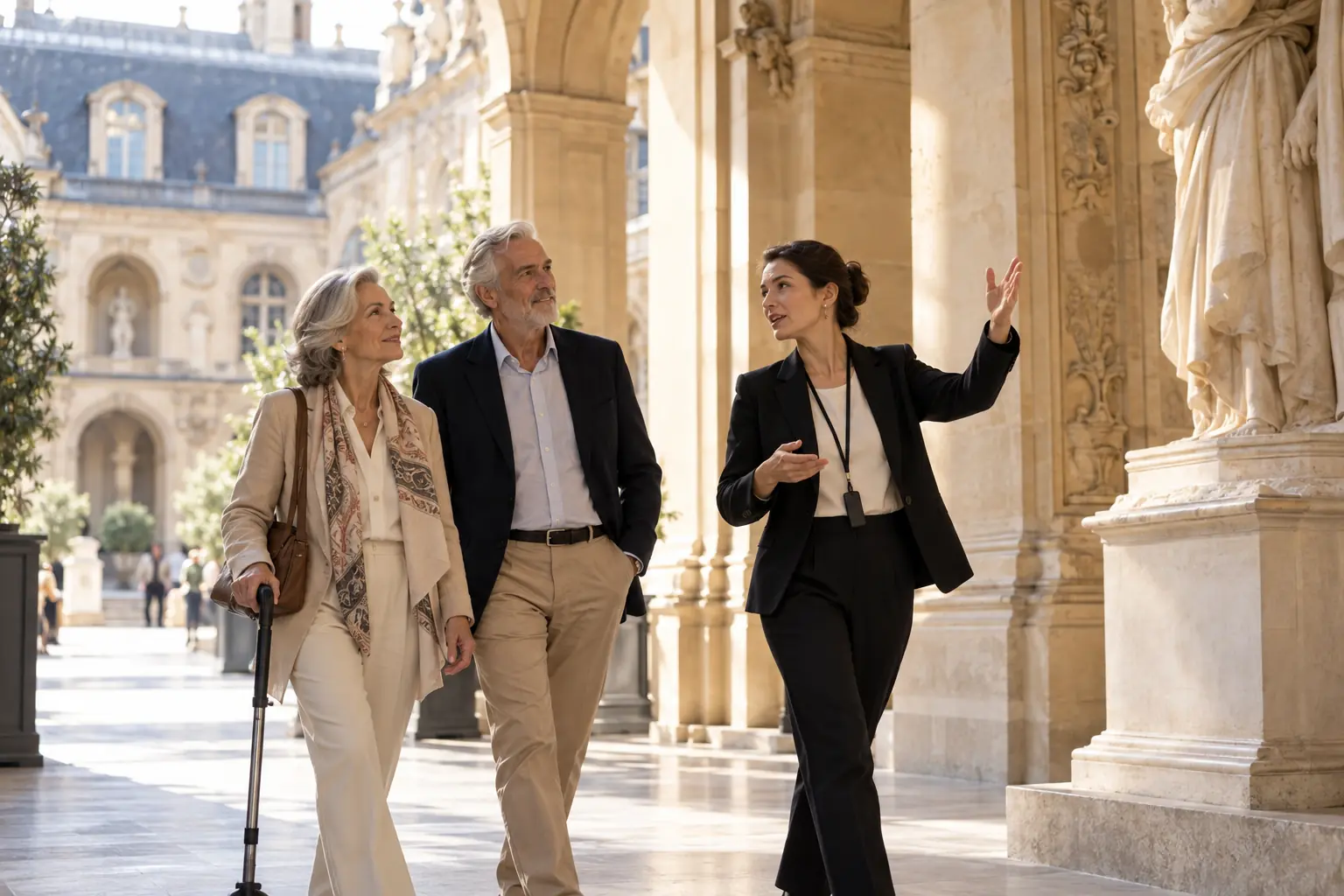
Begin with the guest’s preferences, not an accessibility checklist
Reduced mobility is not a single travel profile. One guest may use a power chair; another may walk short distances but need frequent seating; someone else may manage steps with assistance yet find prolonged standing difficult. The useful conversation is therefore practical and respectful. What distance feels comfortable? Is a ten-minute walk acceptable when it leads to a meaningful seated experience? Does the guest want an adapted vehicle, minimal transfers or the greatest possible independence? These questions should not turn a vacation into a medical interview. They translate personal preferences into service decisions. Once that work is done, the itinerary can be designed around the guest’s desired autonomy and interests rather than around an abstract definition of disability. Cultural depth begins here: when physical energy is protected, more attention remains available for paintings, places, stories and human exchange.
Measure the effort, not only the distance
A short route across cobbles, through security lines and between distant elevators may be harder than a longer journey with smooth surfaces and planned seating. Advisors should therefore map the actual effort required by each stage: standing time, gradients, ground conditions, toilet access, transfer frequency, vehicle drop-off and the distance between an adapted entrance and the main experience. Building access and route access are not identical. A museum may welcome wheelchairs while a terrace, historic room or particular exit follows a different path. Conditions can also change. Lift outages, conservation work and temporary crowd systems mean that details affecting the guest must be checked close to the travel date. The most useful itinerary does not bury this information in a generic “accessible” label. It shows where energy is spent and where it can be restored, allowing the advisor to compare options with honesty.
Choose fewer stops and give each one a purpose
Removing an address does not make a cultural day less ambitious when every remaining experience has a clear role. A collection can provide objects and visual evidence; an Encounter can add voice and point of view; a well-placed meal can create time to process what has been seen. This structure is more valuable than a rapid circuit of famous places. For some travelers, one substantial museum visit and one afternoon conversation will offer more than four abbreviated attractions. The same principle shapes a cultural day sequenced around encounters, landmarks and museums: prepare the eye, deepen the question, then leave room for it to resonate. The advisor should be able to say why each stage belongs and what guests may notice differently afterwards. Accessibility becomes part of editorial curation rather than a constraint added once the itinerary is already full.
Design seating, pauses and transfers as meaningful moments
Rest should not feel like an apology or an empty interval. A seat can be the place from which a guest studies a façade, compares portraits or listens to a character’s argument. A hotel lounge, restaurant or quiet cultural space may continue the day’s theme, provided its entrance, toilets and group conditions have been verified. Transfers require equal precision. A driver needs the correct adapted entrance, not only the venue’s postal address. Guides, hosts and transport teams should share the same meeting point and understand whether a mobility device stays with the guest, requires storage or needs charging. Time margins protect the party from occupied elevators and indirect routes. Guests should not have to repeat these needs at every door. The operational work remains discreet; what they experience is hospitality with a coherent rhythm.
Keep the encounter interactive without demanding performance
Cultural depth does not depend on the number of streets crossed. It often emerges through a precise character, close observation and time for a good question. An actor-led Encounter can suit a measured pace when the route and practical conditions fit the party. Advisors should neither promise access that has not been confirmed nor assume that a guest with reduced mobility wants an entirely seated program. The advance note should describe party size, languages, likely energy levels and the kind of assistance requested. It can also reassure guests that they may ask questions, respond naturally or participate more quietly. Our guidance on briefing clients before a historical Encounter shows how to provide complete practical framing while protecting narrative discovery. Choice and dignity matter as much as ramps and distances.
Build a Plan B with equal cultural value
A lift failure, demonstration, severe rain or delayed vehicle should not erase the day’s central idea. The alternative needs to preserve the editorial thread rather than merely move the party under the nearest roof. A program about fashion, public memory or Impressionism should continue that conversation in its fallback version. The substitute might be a compact collection, an accessible salon or an extended exchange in a quieter setting. Reservation and cancellation terms still need separate confirmation. Advisors can borrow from the logic of a rainy-day Paris itinerary designed as a complete cultural experience: shelter should have purpose, not feel like a lesser product. When guides, drivers and hosts know the alternative in advance, the adjustment appears intentional and guests retain the full intellectual value of the day.
Verify every service without making absolute promises
Accessibility information is dated and sometimes incomplete. A venue may be mostly step-free but use a separate entrance; public transport may be accessible while one required elevator is temporarily unavailable; a restaurant entrance may work while its restroom does not. The advisor’s job is to check the details that matter for this traveler and distinguish between the responsibilities of the venue, transport company and cultural provider. Official destination resources, accessibility labels and specialist apps provide a strong starting point, but they do not replace direct confirmation when one element determines the viability of the day. Avoid broad claims such as “fully accessible” or “completely barrier-free” unless the exact journey supports them. Describe the route, assistance and fallback precisely. Trust comes from useful information rather than from certainty that no professional can guarantee.
A B2B briefing that preserves the journey’s intellectual ambition
Before confirming the program, a travel advisor can keep one concise operational record: guest preferences, comfortable distances, equipment, desired assistance, verified entrances and toilets, drop-off points, rest periods, contacts and fallback options. Then add the question that gives the day meaning: what does this guest hope to understand, feel or see differently? That question prevents accessible planning from becoming a technical spreadsheet without a story. The final itinerary promises a cultural progression, never the absolute absence of disruption. Explore Elyrea’s Encounters to identify a fitting personality and place, then ask the team to confirm the format for the party. Sharing date, language, party size, mobility and interests through Elyrea’s contact page allows the advisor to design with precision and avoid unverified assumptions.
FOR YOUR GUEST ITINERARIES
Planning Paris for guests with specific mobility needs? Elyrea can help assess the pace, format and right place for an Encounter within their itinerary.
Discuss your itinerary