
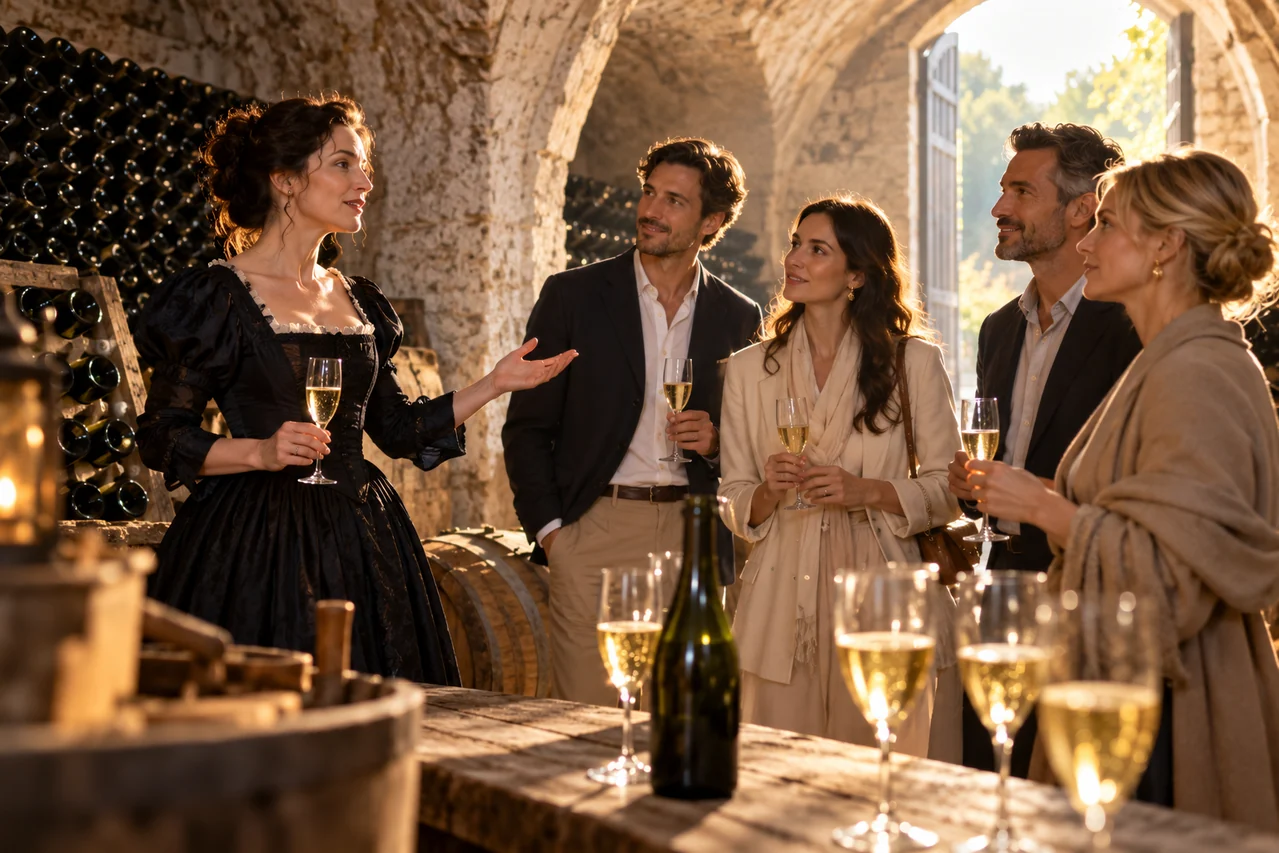
Look beyond the label and the tasting sequence
A bottle represents relationships between land, production, technical knowledge and the image built around the wine. Travelers who understand some of those relationships have more to notice when they taste. This does not mean replacing pleasure with a lecture. A clear story can make an aroma, texture or visual impression more meaningful. For an advisor, the objective is to create a Champagne experience in which sensory enjoyment and cultural understanding support each other, rather than planning a succession of largely similar tastings. Select one or two relationships that the visitor can actually follow during the experience. A discussion of sediment connects with clarity, while a commercial history connects with the idea of reputation abroad. Trying to explain every stage at once may leave little attention for tasting itself. The wine remains an object of pleasure as well as knowledge. A well-designed narrative alternates explanation and observation, giving guests something specific to notice before returning to a wider question. This approach is useful for mixed-interest groups because it provides several entry points without assuming that everyone wants a technical course. It also lets the advisor explain the cultural function of the experience beyond the general appeal of a premium bottle.
Use a life to connect business and wine
Barbe-Nicole Clicquot Ponsardin became a widow at twenty-seven and took on business responsibilities unusual for a woman of her period. Her trajectory provides an entry into questions about enterprise, innovation and international markets. The interest is broader than a simple tale of determination: commercial decisions helped shape how Champagne developed and how it was understood abroad. The woman behind the Veuve Clicquot name gives travelers a human point of reference before they encounter technical vocabulary or a wider regional story. Place the business decisions within the uncertainties of their own time. Widowhood affected legal and economic possibilities, but a possibility still needed to be turned into effective action through knowledge and relationships. Family background and collaborators should not disappear from the account to make determination look like the only cause of success. Nor does contemporary interest in women's enterprise justify supplying the historical figure with a modern political manifesto. Travelers can draw connections with present concerns while understanding those differences. The human story then gains depth from resources, constraints and choices, rather than becoming a universal lesson whose conclusion was selected in advance because the brand's eventual recognition makes success appear inevitable.
Explain innovation through a visible result
The development of riddling, or remuage, to help deal with sediment and achieve clearer wine becomes easier to understand when connected with something the traveler can observe. The historical explanation becomes clearer when each production stage is related to the problem it addresses. Introduce the problem first, then explain why the technique mattered, rather than beginning with specialist terms. A visitor need not become an expert in production to appreciate the ingenuity involved. This approach gives technical content a narrative purpose and helps prevent a wine experience from becoming an intimidating examination. Be precise about the two production stages. Riddling gathers the sediment toward the neck; disgorgement subsequently removes it. An accessible explanation can establish that sequence through the problem being solved, without requiring a comprehensive account of fermentation. Madame Clicquot and her house are associated with important improvements within a much longer collective history. That contribution need not be inflated into invention of the wine itself. The visible result provides a useful link with the tasting, but clarity alone does not establish every aspect of quality or the entire production history of a particular glass. A thoughtful mediator keeps the observation meaningful while explaining what it can reasonably show and where additional knowledge would be needed.
Invite attention without prescribing the right reaction
Acidity, effervescence, texture, temperature and aromatic development offer useful ways to explore a glass. Encourage travelers to notice differences and describe them in their own words. Familiarity varies, and someone new to Champagne may be reluctant to speak if the experience feels like a test of connoisseurship. Tasting Champagne with greater understanding should increase pleasure and confidence. The cultural story supplies context, while the guest's own sensory response remains a legitimate part of the conversation. Let the vocabulary develop from perception rather than replace it. Guests may use broad words such as fresh, rounded or persistent before identifying more precise associations. The facilitator can help clarify the response without presenting a single descriptor as the only valid reaction. Comparisons can occur between people or between impressions over time, not necessarily through a promised selection of several wines. Practical contents should be established with the team. For experienced enthusiasts, technical discussion can coexist with biography and commerce, providing another layer rather than repeating an introductory tasting they already know. For newcomers, the story gives confidence by organizing attention around something more accessible than a test of specialist recognition.
Discuss prestige as something that developed
Champagne's connection with French luxury should be explored as a historical and cultural construction, not treated as an intrinsic quality that needs no explanation. Techniques, trade and public associations contributed to the wine's image. Asking how a product acquired prestige can interest travelers whose concerns extend beyond wine, including entrepreneurship or the history of consumption. This wider perspective also helps an advisor connect Champagne with other French cultural themes without implying that every luxury tradition developed in the same way. The social use of champagne also deserves consideration. A celebratory opening, a meal and a reflective tasting create different relationships with the same category of wine. Prestige develops partly through those repeated contexts and the ways consumers interpret them. Explain that cultural construction without dismissing quality as mere image. Technical skill and the material product remain important, while international audiences help shape reputation. Guests interested in French luxury can then compare sectors through defined questions about work, naming and circulation, recognizing both parallels and differences. The itinerary gains a broader intellectual role without suggesting that every prestigious French object shares the same origin or that expense alone supplies cultural meaning.
Give Paris and the region different roles
A Paris encounter around Veuve Clicquot can introduce a person and a story before a journey into Champagne, or provide a reflective continuation afterward. The region contributes landscape, production settings and its own sense of place. These experiences should complement each other rather than repeat the same explanation. Avoid assuming that an Elyrea Encounter includes a visit to a specific cellar or access to a particular production site. The practical elements of each part of the itinerary need to be established independently. A complementary sequence can work in either direction. History in Paris may prepare questions that guests carry into the region; a later Encounter may give personal focus to production and landscape observations already made. Decide which role suits the actual trip instead of assuming a fixed order. The surrounding visits require independent confirmation of access, venue and content, and should not be described as components automatically included in the character experience. Distinguishing these practical boundaries makes the proposal more precise without weakening its narrative continuity. What joins the stages is an understood question and a change of perspective, allowing the guest to connect the glass with a person and the person with a territory rather than hear the same story repeatedly.
Alternate sensory and cultural attention
Repeated tastings can make an itinerary less distinct, even for guests who love wine. A discussion of history, time to observe the landscape, a meal and a carefully chosen tasting create different kinds of engagement. This variation gives travelers room to absorb what they have learned and enjoy the destination beyond the glass. A strong day does not need to maximize the number of wines encountered. It should make the chosen moments meaningful and preserve the guest's energy for them. Variation should remain coherent rather than simply provide breaks from wine. A landscape stop can explain geography, a meal can consider social use, and historical discussion can return sensory details to a production context. Each contributes a different kind of attention to the same journey. Plan time for guests to absorb and compare instead of making a dense succession of tastings the default measure of quality. The traveler may leave with a stronger memory of one question and one glass than of numerous similar appointments. An advisor's judgment lies in selecting those relationships and protecting the energy needed to experience them, especially when the party includes people whose expertise and enthusiasm differ substantially.
Connect the story with the guest's wider interests
Some travelers will be drawn chiefly to flavor, others to technical innovation or a woman's entrepreneurial life. An advisor can identify that emphasis before building the program. Exploring the women who created French cultural icons may interest guests combining fashion and Champagne, while an art-of-living journey can place tasting beside gastronomy and narrative. A tasting with Veuve Clicquot belongs where it advances that particular story, giving the guest a connection they can carry into the next part of the trip. A broader theme should follow the guest's expressed curiosity. The comparison with fashion can examine reputation and practical innovation, while gastronomy introduces use at the table. A journey centered on women's lives needs the social context of each figure, not only a shared story of overcoming obstacles. Choose the connecting question first and let the additional chapter answer it differently. A performed conversation offers engagement without supplying archival proof of motives or words. Guests can respond through sensation, historical interest or their own associations, with no need for an identical conclusion. The cultural itinerary becomes distinctive through that clear relationship between pleasure and understanding, rather than through vague claims that the selected experience is more exclusive than all other ways to encounter champagne.
FOR YOUR GUEST ITINERARIES
Planning a wine-focused journey for guests? Our team can help integrate A tasting with Veuve Clicquot into a cultural itinerary that connects history and the senses.
Discuss your itinerary