
Begin with Édith Gassion
Édith Giovanna Gassion was born in Paris in 1915. The later Piaf image became so powerful that it often seems to replace the person behind the name. Recovering her beginnings helps separate a developing artist from an icon already imagined as destined for greatness. The famous account of a birth on a Belleville sidewalk belongs to her biographical legend, not to established fact. That distinction offers a useful opening into the way a public story can reshape the memory of an actual life.
A different social geography
The Paris associated with Piaf's origins includes Belleville and working-class environments rather than only monumental views and grand hotels. These settings give travelers a route into the city's social history. They should not be reduced to picturesque poverty or treated as places frozen in an earlier period. Neighborhoods changed, and Piaf's story offers one perspective within a larger urban history. The value of the connection lies in understanding conditions and cultural practices, not in searching for an untouched backdrop to a celebrity's childhood.
Performance was part of her early world
Her father worked as an acrobat and her mother as a singer, placing entertainment within the family environment. Childhood stories have often been amplified, but this relationship with performance supplies a more grounded context than the most dramatic anecdotes. A public career did not emerge from nowhere. Piaf before La Môme explores how early environments and later professional relationships helped shape an identity. The story becomes more human when its stages are visible rather than compressed into a single miraculous discovery.
The street required immediate presence
Singing before passersby demanded a different kind of attention from performing for an audience already seated in a theater. People could continue walking, so the singer had to establish a connection quickly. This setting helps explain the importance later attached to Piaf's intensity and directness. It does not mean professional technique was unnecessary. The transition from street to stage involved work, collaborators and changes in presentation, allowing an initial ability to develop into a sustained artistic career.
A name and a career took shape
Louis Leplée helped bring the young singer into the cabaret world in the mid-1930s, with the name La Môme Piaf becoming part of her public identity. Piaf evokes a sparrow in colloquial French, joining small stature with the image of a distinctive voice. After Leplée's violent death in 1936, damaging publicity complicated her career. Later professional development, including Raymond Asso's contribution, reveals an interrupted and worked-on ascent rather than an uninterrupted movement from discovery to inevitable fame.
Paris traveled with the voice
Piaf became closely associated with a representation of Paris through her repertoire, accent, performance and biography. That association should not be mistaken for a complete portrait of the city or its music. It is a cultural image built through artistic work and public reception. Her international career shows how that image traveled beyond France, reaching audiences who might not understand every word. Voice and gesture supplied an emotional connection, while records and performances widened the distance over which it could circulate.
Look for layers rather than a preserved set
Today's streets are not replicas of the Paris in which Piaf began. Buildings, venues and social conditions have changed. A cultural visit becomes more rewarding when it acknowledges that difference. The traveler can observe the present while learning about earlier activities and people, making absence and transformation part of the story. The aim is not to promise that every location retains an intact Piaf atmosphere, but to help guests read a contemporary city through historically grounded connections.
Give the biography an embodied form
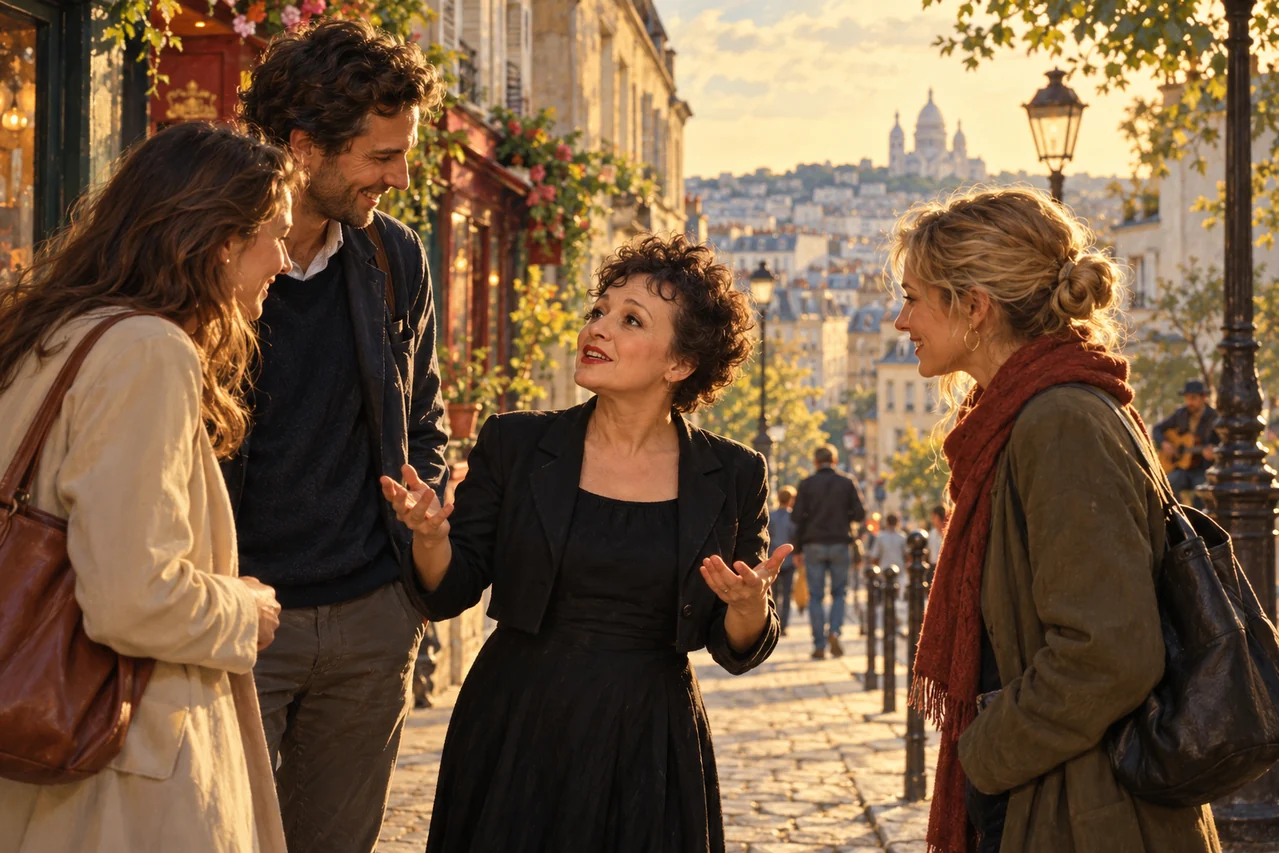
Elyrea's Paris with Édith Piaf uses a theatrical interpretation of the character to connect place, narrative and interaction. It gives travelers a way to approach the person behind a familiar voice without treating dramatic dialogue as independent historical testimony. For advisors, the experience can anchor a musical or biographical theme, especially for returning guests. A successful Encounter leaves them understanding how a career took shape and how Paris entered its memory, rather than merely collecting names and addresses.
FOR YOUR GUEST ITINERARIES
Planning Paris for guests interested in music or cultural biographies? Ask Elyrea how Paris with Édith Piaf can bring another dimension to their private itinerary.
Discuss your itinerary