
Eiffel’s other achievement beyond the Tower
The wind tunnel on Rue Boileau reveals a less familiar side of Gustave Eiffel. After bridges, metal structures and the tower built for the 1889 Exposition Universelle, the engineer devoted much of his later life to experimental research. His question was no longer limited to the stability of a structure. He wanted to understand how air acts on a moving form. That continuity matters. Eiffel did not suddenly become a scientist detached from his earlier profession; he applied a builder’s culture of measurement, calculation and physical verification to a new field. For travelers, Auteuil therefore offers another way to read Paris: as a city where a monument, a laboratory and the emerging science of flight formed part of the same intellectual landscape.
From the Tower’s height to controlled measurements
In the early twentieth century, Eiffel used the height of his tower to investigate air resistance. Objects of different shapes were connected to a guided drop apparatus while instruments compared velocity, mass and drag. The arrangement sounds theatrical, yet its scientific value came from repetition and precision. Eiffel wanted to test accepted formulas against observable results. The Tower became more than a symbol; it served as part of a measuring system. This work does not mean that Eiffel single-handedly invented aerodynamics, a field shaped by many researchers across Europe. It shows how an experienced structural engineer helped turn unsettled questions into comparable data. The distinction makes the story stronger, because it replaces the myth of a solitary genius with the practical discipline of experimentation.
Why a wind tunnel changed the experiment
Dropping an object limits observation time and makes conditions difficult to control. A wind tunnel reverses the problem: the model remains stationary while adjustable airflow moves around it. Forces can then be measured for longer periods, at different angles and under repeatable speeds. Eiffel’s laboratory at the foot of the Tower, established in 1909, provided that control. The official Eiffel Tower site records roughly five thousand tests between August 1909 and December 1911. Models included forms connected with the new aviation industry. The tunnel did not replace theory; it challenged and refined it. That exchange among calculation, instrument and observed result is why the laboratory belongs in the history of modern scientific Paris rather than merely in a list of curiosities associated with a famous engineer.
1912: a permanent laboratory at Auteuil
The Champ-de-Mars laboratory did not remain beside the Tower. In 1912 Eiffel transferred the work to Rue Boileau in the 16th arrondissement and commissioned a permanent installation. The Auteuil tunnel combined a test section, collector and diffuser intended to recover part of the airflow’s energy. Its design allowed steadier experiments and helped make the facility efficient. The wind tunnel remains active, and the building was listed as a historic monument in 1996. Heritage status should not be confused with unrestricted visitor access. A working research facility is not automatically a public attraction, however compelling its history. Advisors must confirm current access directly with the operator rather than promise entry because a historical site appears on a map or in an article.
Early aviation came to test its shapes
The first aircraft builders needed ways to compare wings, airfoils, propellers and fuselages before flight. Scale-model tests reduced some risk and allowed a form to be changed quickly. Eiffel published results, and his laboratory supported research linked to early twentieth-century aircraft. The story should not become the achievement of one isolated inventor. Pilots, manufacturers, mechanics, mathematicians and other laboratories all contributed to aviation’s development. Gustave Eiffel beyond the Tower places the research within his broader career. Auteuil remains exceptional because the historic instrument still makes the process visible: scientific knowledge advances through trials, corrections and comparisons, not through a single moment of inspiration.
What the historical photograph can show
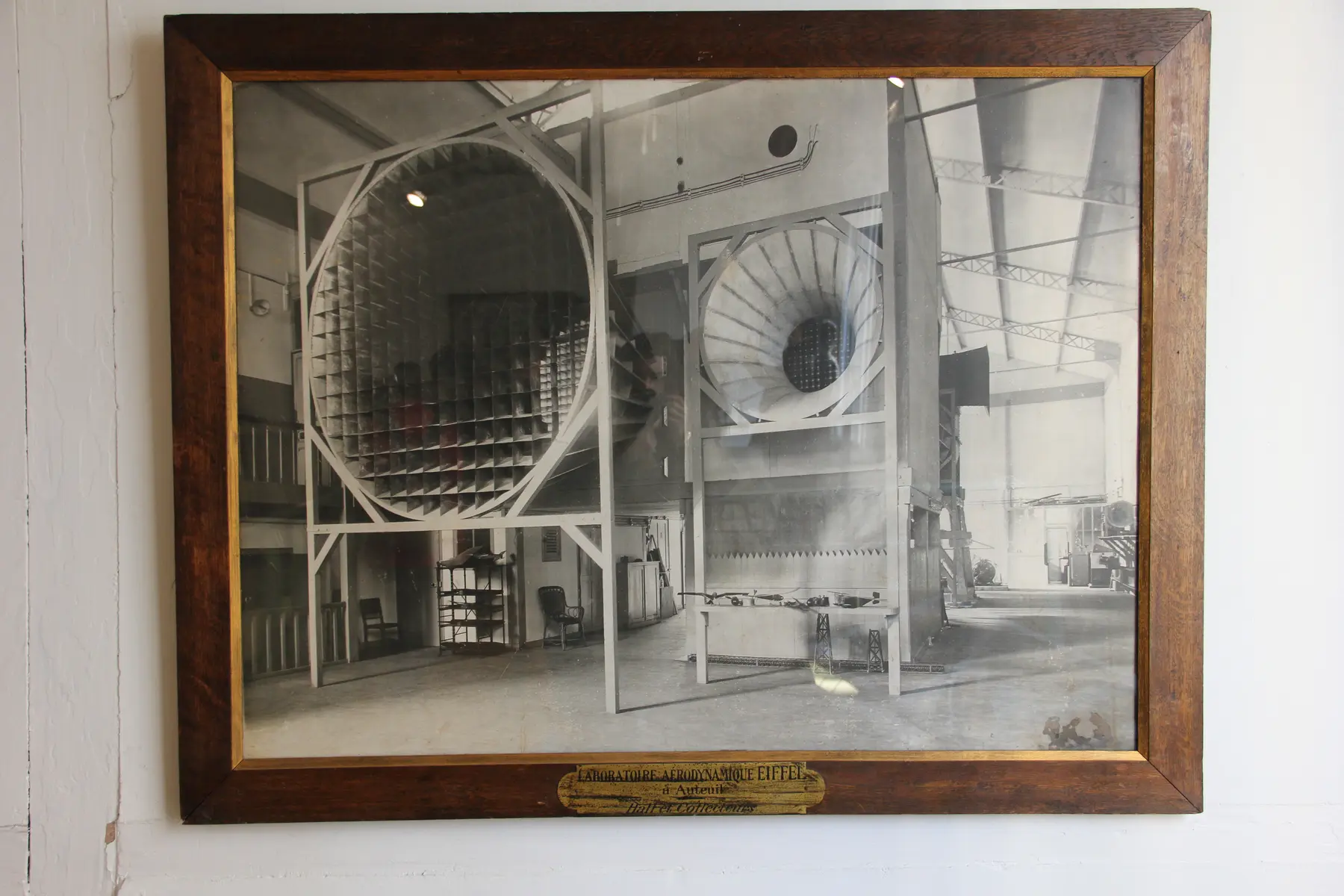
The selected image depicts an old photograph of the installation displayed inside the laboratory. Large ducts, geometric air inlets and the test table make the experimental sequence immediately legible. This is not a fictional reconstruction; it is a document about the instrument itself. It still requires careful interpretation. The photograph alone cannot date every component or assign every improvement to Eiffel without supporting evidence. Its value is to introduce a method visually. The photographer, CC BY-SA 4.0 license and digital changes are credited as required. That makes the image editorially useful as well as legally reusable. Instead of decorating the page with another generic view of the Tower, it directs attention to the machinery that made repeatable aerodynamic research possible.
Connecting engineer, researcher and character
The Eiffel by Eiffel Encounter can build on the tension between monumental fame and scientific curiosity. Gustave Eiffel should not be reduced either to a signature above Paris or to a hero who designed everything alone. In the Tower’s history, Maurice Koechlin, Émile Nouguier and Stephen Sauvestre must receive their proper roles. In aerodynamics, equal rigor requires acknowledging a wider research community while showing Eiffel’s ability to organize experiments. Meeting the man behind the monument continues that perspective. Performance can make the reasoning tangible, but documented history, interpretation and theatrical choices must remain visibly distinct.
B2B guidance: design a scientific Paris itinerary
For guests interested in engineering, aviation or innovation, the wind tunnel moves the story beyond viewpoints and skyline photographs. An itinerary might begin with the Tower as a platform for experiment, continue toward Auteuil when access has been confirmed, and then connect with Paris collections devoted to science and technology. The unifying question is simple: how does a calculation become a structure or a working machine? Building a premium cultural experience around the Eiffel Tower supports that progression. Advisors should distinguish freely visible places, sites requiring permission and locations that belong only to the historical narrative. Exclusivity does not mean promising impossible access. It means connecting places, instruments and ideas with precision.
FOR YOUR GUEST ITINERARIES
Planning a private cultural itinerary? Elyrea can help you weave this perspective into your guests’ journey.
Discuss your itinerary