
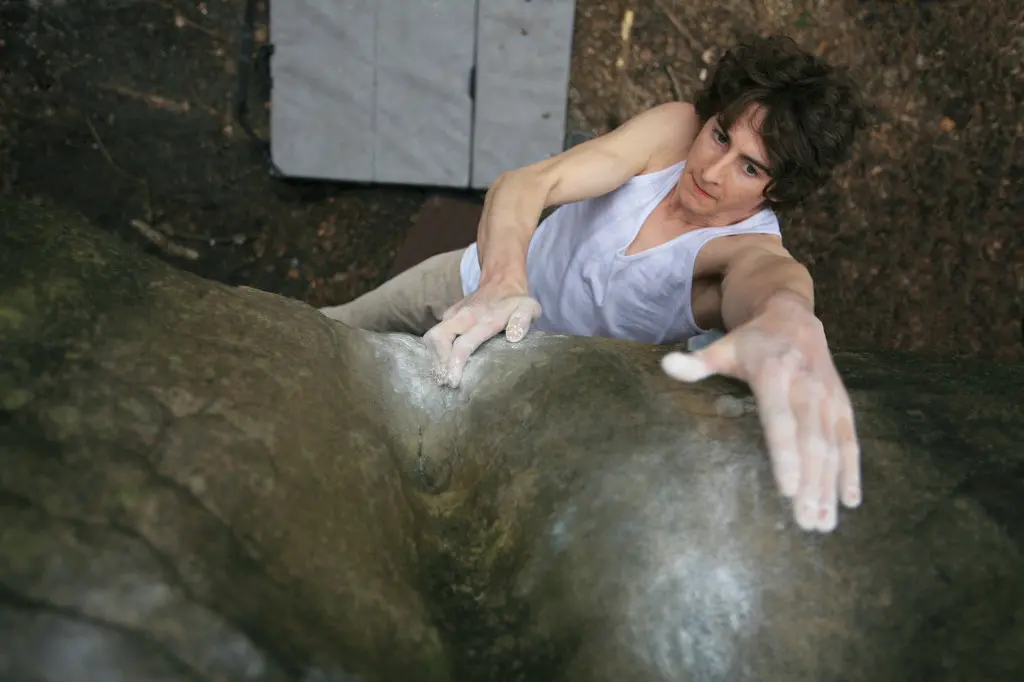
A distinctive terrain that became a language of movement
Fontainebleau Forest was not designed for climbing. Its sandstone blocks, exposed by erosion and scattered across sandy ground, nevertheless offered an unusual range of shapes, holds and landings. Travelers now see a world-famous bouldering destination, but that status grew from layers of use. Sandstone was quarried and built with; foresters, quarry workers, painters and walkers all interpreted the terrain before climbers added another reading. An edge became an exercise in balance, a slab a lesson in footwork and a short line a complete sequence. This sporting use did not erase earlier meanings. It helps explain why Fontainebleau can be understood at once as a natural environment, a cultural landscape and a school of movement.
Parisian mountaineers looking for nearby practice
In the late nineteenth and early twentieth centuries, members of Parisian alpine circles used the rocks to train without waiting for a journey to the Alps. The forest was reachable from the capital and offered repeated opportunities to test friction, balance and confidence. Early participants did not necessarily think of bouldering as the independent global discipline it is today. They often treated the blocks as preparation for mountain routes. That origin remains visible in the culture of effort, shared solutions and achievement without extensive equipment. Fontainebleau Tourisme now describes the forest as the birthplace of bouldering. The phrase captures a gradual shift: a training method developed its own techniques, reference problems and ambitions.
When bouldering became an end in itself
Over time, climbers stopped measuring every passage solely by its usefulness for alpinism. Limited height concentrated difficulty into a handful of exact movements. Attempts could be repeated, solutions compared and individual lines named. Figures such as Pierre Allain contributed to the technical and cultural transformation during the 1930s; his name is connected with benchmark problems and the development of footwear suited to friction. A single-inventor story would be misleading. Methods grew through communities, informal groups and repeated transmission. For travelers, the important change is perceptual. A seemingly random field of rocks became a library of problems read through the body, each with a sequence, style and memory shared among climbers.
Colored circuits made the forest legible
One of Fontainebleau’s most characteristic contributions is the circuit: a sequence of problems marked by a color and composed to provide a route at a given level. Developed after the Second World War, circuits made practice easier to navigate and supported progression without requiring a permanent guide. The arrows did not turn the forest into a standardized gym. They created an itinerary through irregular terrain. Fontainebleau Tourisme now reports more than 30,000 established and secured boulders across circuits of varied difficulty. The number communicates the scale of the sporting heritage without suggesting that every problem is suitable for every visitor. Weather, experience, the chosen area and the condition of the sandstone remain essential considerations.
A culture that traveled far beyond France
Climbers often call the forest simply “Bleau,” a sign that a real place has become a cultural reference. International visitors come to test technique on sandstone that rewards precision, confidence and careful reading. Films, guidebooks and stories have carried problem names around the world. That fame should not obscure the forest’s other legacies. Barbizon painters, hikers, naturalists and narratives connected with the château have all shaped the massif’s identity. Bouldering adds to those layers rather than replacing them. A cultural day can ask how the same rock changes meaning when it becomes a painted motif, a geological resource, a sporting challenge or an element in a legend.
Reading sandstone without confusing observation and participation
A non-sporting itinerary can use climbing history as a way of reading the landscape without implying that instruction is included. Chalk traces, circuit arrows and a climber’s concentration reveal a culture of gesture. Fontainebleau’s rocks and legends offers another interpretive layer. Any climbing session requires its own planning, level-appropriate supervision, conditions check and respect for local guidance. Wet rock, crowding and fragile ground all require care. Cultural discovery and sporting practice can support one another, but they are not interchangeable and should never be presented as automatically included within the same service.
The Grand Huntsman opens another forest story
The Elyrea Encounter centered on Fontainebleau’s Grand Huntsman approaches the forest through memory, royal hunting and legend. It is not a climbing lesson. Placing the theatrical encounter beside bouldering history nevertheless reveals a useful parallel: each community learns to read signs in the woods. One follows stories, paths and apparitions; the other looks for holds, colors and sequences. This comparison must remain clearly identified as interpretation rather than historical equivalence. It enriches the journey by showing that landscape is never neutral. It becomes cultural when generations give it names, routes and disciplined ways of paying attention.
B2B framing: design a day with more than one pace
For a travel advisor, Fontainebleau can unite art, heritage, forest and sporting culture if the itinerary does not stack incompatible promises. The brief should separate guests who want to climb from those who want to walk, observe or listen. Planning a premium Fontainebleau day from Paris helps clarify sequence and transfers. If active climbing is planned, it needs appropriate providers, insurance and conditions. For a cultural group, the aim can be simpler: understand how sandstone blocks gradually formed an international school of movement while remaining part of a forest that has also been painted, narrated and protected.
FOR YOUR GUEST ITINERARIES
Planning a private cultural itinerary? Elyrea can help you weave this perspective into your guests’ journey.
Discuss your itinerary