
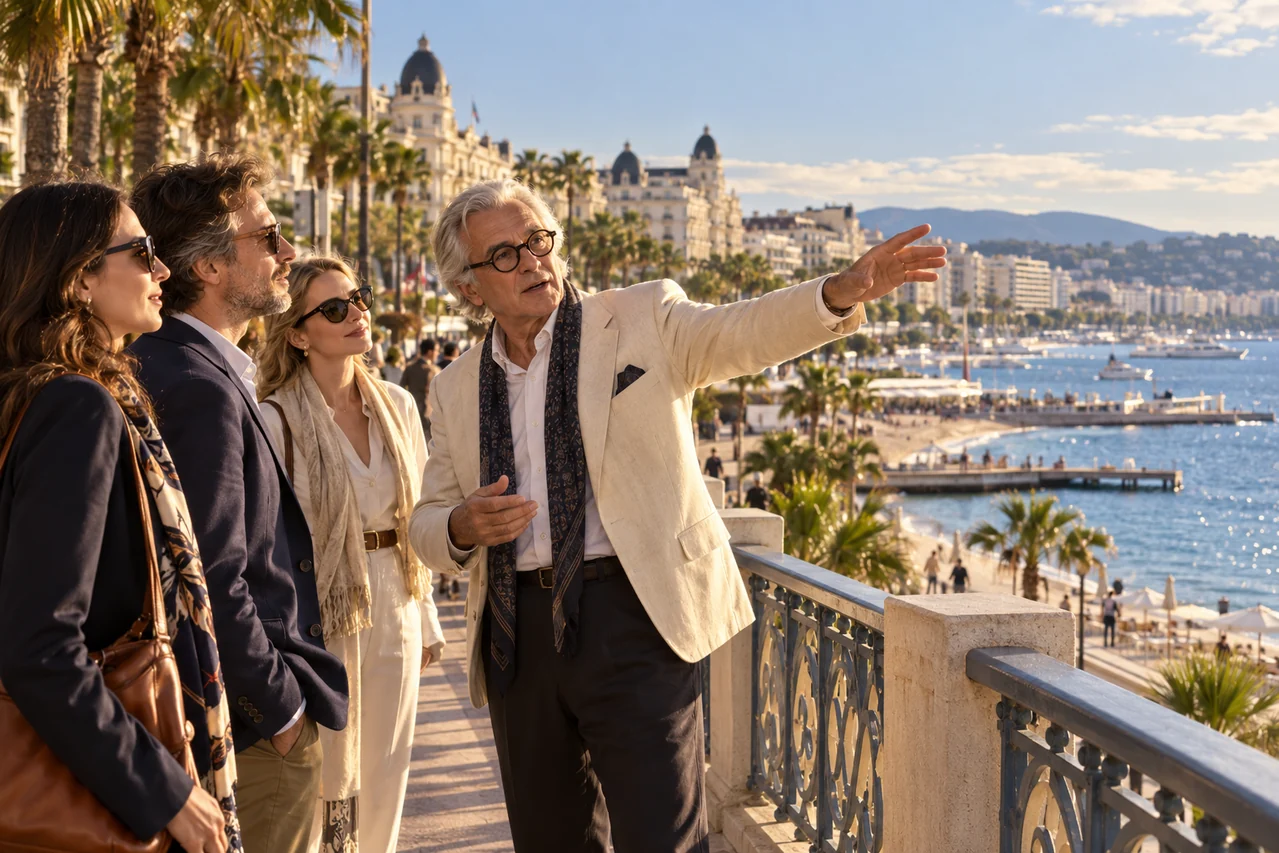
Begin with a resort rather than a red carpet
Cannes developed its international resort identity during the nineteenth century, before the Festival's first full edition in 1946. Visitors came for climate, scenery and social life, and the city changed to receive them. The waterfront therefore had meanings before film culture became its dominant association. Seeing that earlier layer helps travelers avoid imagining the promenade was constructed simply as a stage for stars. Cinema inherited an environment already used to hospitality and public display, then transformed those functions through a much wider media audience.
A promenade organizes looking as well as movement
Walking beside the sea is a physical activity, but in an established resort it can also be a social act. People observe others and participate in a visible public setting. That function makes the promenade more than a convenient link between buildings. The Festival intensified an existing relationship between leisure and being seen. A traveler can enjoy the Mediterranean view while asking how the opposite side of the street contributes to the scene, and why a public route becomes culturally significant through repeated patterns of meeting, observation and representation.
Grand hotels support the destination's public identity
The Croisette's hotels contribute architecture and a recognizable language of hospitality. Their cultural importance is not exhausted by the idea of expensive accommodation. They also belong to the social infrastructure through which visitors, professionals and media participate in Cannes. A thoughtful account can discuss those roles without inventing private anecdotes about particular guests or promising access beyond ordinary arrangements. The hotel becomes a place within a network, linking resort history with the later demands of an event whose participants work, meet and present themselves around the waterfront.
The Festival concentrates activity in a small geography
During the event, film professionals, journalists, celebrities and onlookers share a relatively concentrated setting. The proximity of Palais, hotels and other spaces creates movement that has practical and symbolic significance. Looking at the geography helps explain how Cannes operates, even when the Festival is not taking place. The visitor should not confuse that interpretation with entry into professional events. Public places can reveal relationships between functions without providing backstage access, and their meaning depends as much on organized activity as on what remains physically visible throughout the year.
The waterfront extends the image beyond the Palais
The official stairs offer one focal point, while the Croisette supplies a broader environment of arrivals, photographs and public presence. Together they make the Festival recognizable outside screening rooms. The Palais's red-carpet ritual explains one concentrated ceremony; the promenade shows the wider stage surrounding it. This distinction helps guests read Cannes as a city participating in the event, rather than a single building hosting films. It also reveals why the destination and the Festival reinforce each other's international visibility through a recurring set of spatial and visual associations.
Fashion makes visibility a cultural subject
Clothes worn in a highly photographed setting can become images circulated far beyond the wearer's immediate audience. Couture, publicity and cinema consequently meet on the Croisette in ways that interest travelers beyond specialist film knowledge. The subject is not limited to identifying brands or admiring expense. It asks how a silhouette becomes recognizable, how images acquire authority and how a place helps communicate them. For guests with a Paris fashion chapter, Chanel and Dior's differing approaches can lead toward Cannes as a setting of representation rather than creation.
Outside Festival time, the quieter city remains legible
The absent crowd can make the relationship between permanent setting and temporary activity easier to discuss. Guests see the route and its buildings without necessarily experiencing the event's density. A narrative can explain what changes when professionals and cameras return, but should not claim the same atmosphere exists continuously. The difference is part of the cultural interest. Cannes is a functioning destination throughout the year, and its waterfront carries resort life alongside its cinematic identity rather than becoming meaningless when no red carpet audience is present.
Let a fictional character offer another way of reading
Quentin Tarantini, the fictional figure in Elyrea's Cinéma, Strass & Scandales, can bring humor and a narrative viewpoint to this geography. He is not Quentin Tarantino, and the Encounter does not borrow a real director's life as the character's biography. The actual promenade provides the cultural setting in which fictional mediation becomes useful. For first-time and returning guests, the aim is a changed reading of familiar sights: sea, façades and movement become parts of a relationship between tourism, cinema and the public construction of celebrity.
FOR YOUR GUEST ITINERARIES
Planning Cannes for guests interested in the Riviera's cultural life? Contact Elyrea to discuss a fictional Quentin Tarantini Encounter that adds depth to their Croisette experience.
Discuss your itinerary