
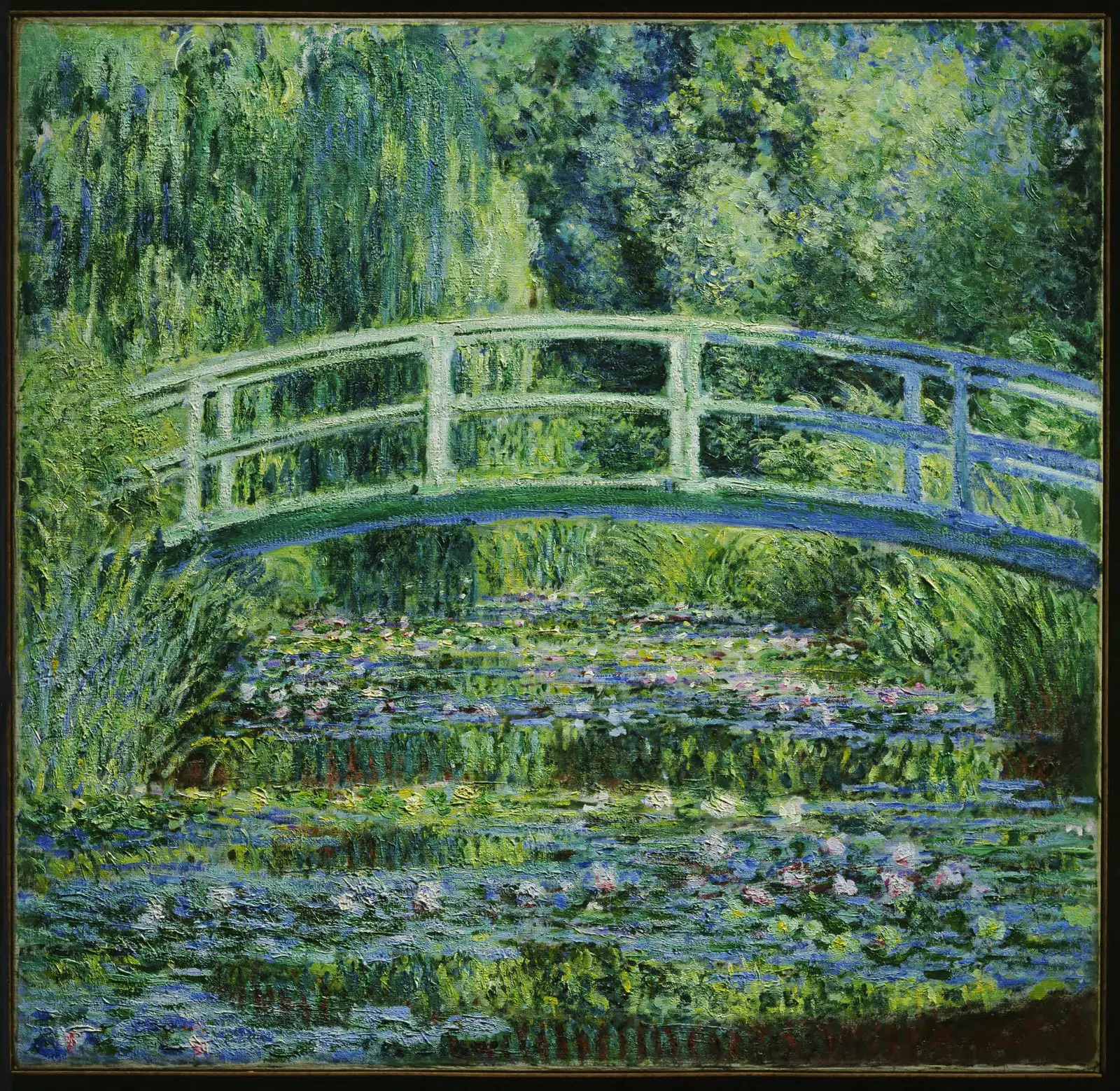
A famous garden that was never a spontaneous landscape
The water-lily pond now seems inseparable from Giverny, as though it had always been waiting beyond Monet’s house. In fact, it was a deliberate, gradual and technically constrained project. Monet settled in Giverny in 1883, purchased the property in 1890 and acquired land across the railway in 1893. That sequence changes the way the garden should be read. It was neither untouched nature discovered by the painter nor a decorative extension he could create at will. The project crossed infrastructure, altered the movement of water and required official permission. The Fondation Claude Monet explains that the plot was crossed by the Ru, a branch of the Epte, whose water would feed the new garden. Visitors are therefore looking at a work of horticulture, engineering and negotiation as well as the source of famous paintings.
Why official permission mattered
A pond supplied by flowing water was not solely a landowner’s private decision. Monet sought permission to dig channels that would bring water from the Ru into his property and return it to the stream. Authorities had to consider possible effects on flow and downstream uses. The National Gallery records that villagers in Giverny objected to the request. It is misleading to reduce the episode to a clash between a modern genius and neighbors who failed to understand art. Local families depended on water for work and evaluated a practical risk to a shared resource. They could not know that the proposed pond would one day support the Water Lilies. Their concern belonged to the present conditions of rural life, not to the future reputation of the painter.
Rural fears with a rational setting
Reported objections included fears that the water might be contaminated and that imported plants could poison cattle. Those anxieties may sound exaggerated today, but they arose in a landscape where changes to water could affect meadows, animals and established routines. The fairest interpretation treats them as concerns about use rather than a picturesque quarrel. Monet wanted selected species whose color and form would compose the surface of the pond. His neighbors first saw an unfamiliar intervention in a living network they shared. The episode reveals an important truth about cultural landscapes: places later celebrated as masterpieces can begin with ordinary disputes about water, property and responsibility. Acknowledging that context makes the story more human without making either side unreasonable.
An administrative success, not a break with the village
Permission was eventually granted and the first pond could be developed. Monet enlarged it later, shaped its banks and organized plantings that demanded continual labor. It would be easy to narrate this as one artist’s solitary victory. The stronger history is more complex. Rules, local voices and a prefectural decision all formed part of the garden’s creation. Monet also remained a resident of Giverny, living with family, employing gardeners and participating in the village’s daily geography. The water garden did not float outside that world. It belonged to an economic and social setting. For cultural travelers, this continuity prevents villagers from becoming resistant extras in a great-man story and restores the ordinary relationships that made an extraordinary project possible.
From Japanese inspiration to a painting laboratory
Monet shaped the water garden with Japanese references visible in the bridge, plantings and enveloping sense of space. His admiration for Japanese prints is well documented, but the garden should not be described as a copy of one specific Japanese site. It combined influences, plants and carefully managed views into a personal environment. From the late 1890s, the pond, bridge and water lilies became recurring subjects. The Musée des impressionnismes Giverny emphasizes the pond’s role in the radical development of Monet’s painting. Framing tightened, the horizon sometimes vanished and reflections unsettled the boundary between sky, water and vegetation. A local hydraulic proposal thus became the material condition for one of the major sustained investigations in modern art.
What the dispute teaches visitors
Knowing the early controversy prevents the garden from appearing timeless. Guests can notice the slope of the land, the crossing beneath the railway, the shaped banks and the way water organizes each view. Beauty emerges from repeated intervention rather than nature left entirely alone. The Hôtel Baudy and Giverny’s artists’ colony broadens the story to the village and its international visitors. Current admission, opening hours, group policies and seasonal conditions still require direct confirmation with the relevant institutions. The history of the pond provides a narrative thread; it does not replace careful operational planning for a private itinerary.
Embodied interpretation without inventing the quarrel
The Elyrea Encounter centered on Monet at Giverny can give voice to the painter’s choices and persistence without claiming to reproduce every exchange word for word. A responsible performance distinguishes established administrative facts, reported concerns and dramaturgy used to make the episode intelligible. The approach is particularly rewarding for guests who already know the paintings because it connects celebrated images with actual water, permissions and maintenance. For newcomers, it replaces the myth of instantaneous inspiration with a longer creative process. Monet’s achievement appears as observation and invention supported by resources, labor and an evolving relationship with a real territory.
B2B framing: tell the story of a negotiated creation
For a travel advisor, the best promise is not merely to see Monet’s garden but to understand how a private landscape became a globally significant artistic laboratory. The brief should cover guests’ familiarity with Impressionism, mobility, desired time in the garden and interest in botany, social history or painting. Planning a Monet day in Giverny from Paris offers sequencing guidance. The narrative can begin with shared water, move through permission and objections, and then lead to the works. It gives the pond human depth without caricaturing Monet’s neighbors or turning the paintings into mere illustrations of a local dispute.
FOR YOUR GUEST ITINERARIES
Planning a private cultural itinerary? Elyrea can help you weave this perspective into your guests’ journey.
Discuss your itinerary