
The Napoleonic legend began before Napoleon’s death
Napoleon did not wait for memoirists, Romantic painters or the return of his remains to understand the force of narrative. During the Italian campaigns, Bonaparte already organized the circulation of news that staged the general, his victories and his bond with soldiers. Once in power, that effort became a system in which official texts, controlled newspapers, ceremonies, medals, paintings and architecture reinforced one another. Calling it a legend does not mean that every element was false. The term describes a combination of selected facts, omissions, symbols and images that gave heroic coherence to a career marked by abrupt political change. Paris allows travelers to observe how that image was manufactured and how it continued to evolve after the Empire had fallen.
Bulletins turned campaigns into narrative
The Bulletins of the Grande Armée reported military operations, but they were not neutral field summaries. The Fondation Napoléon notes that they were prepared under the emperor’s personal supervision and at times dictated by him. They celebrated endurance, arranged events, emphasized success and could soften losses or reverses. Read to soldiers, reprinted in newspapers and circulated to the public, the bulletins brought the commander close to the army while imposing an official version of the campaign. Their power came from a blend of concrete detail and political framing. Historians should treat them neither as worthless fiction nor as transparent evidence. They must be compared with archives, correspondence, casualty records and accounts produced by opponents.
A single picture could summarize a political claim
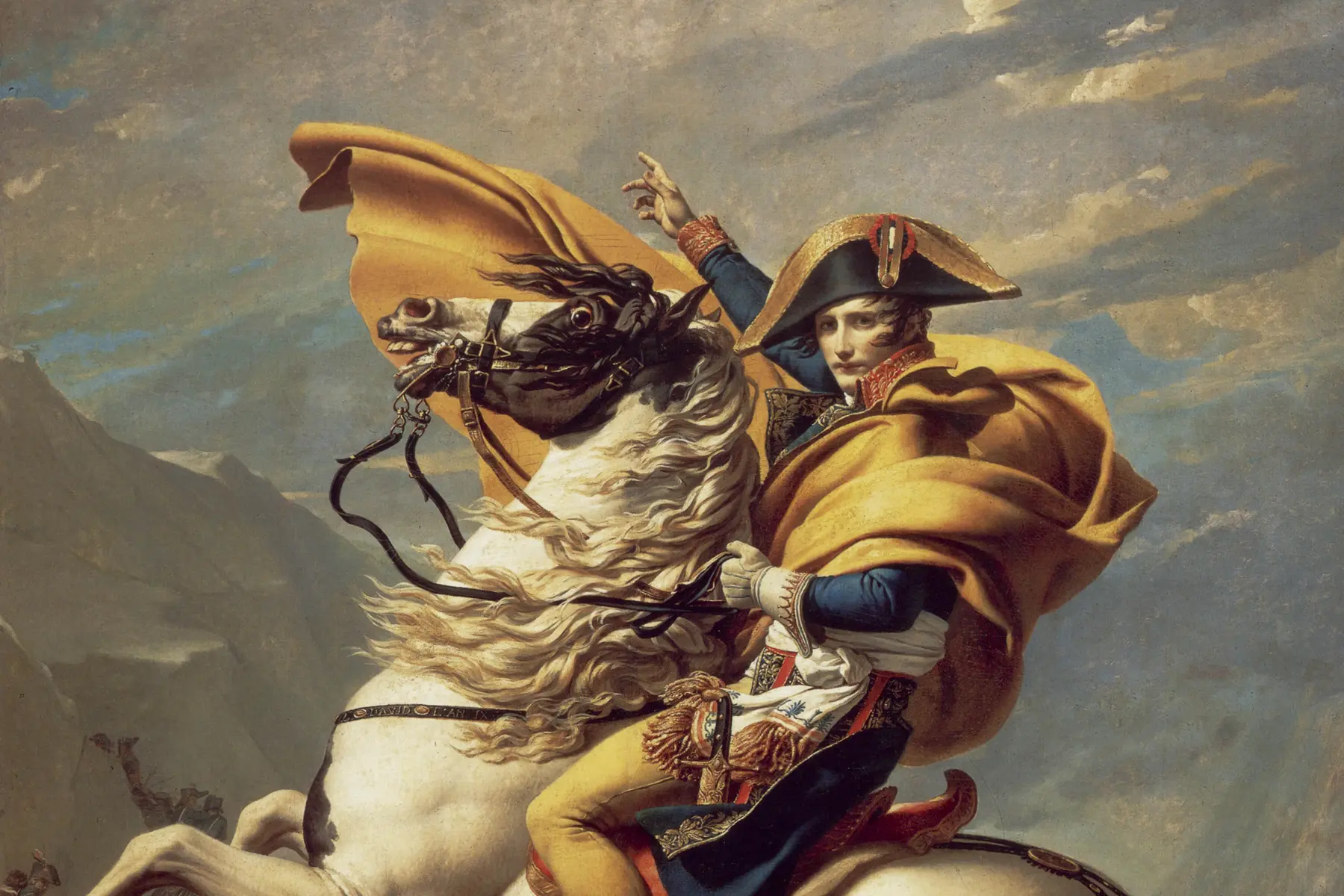
Jacques-Louis David’s Napoleon Crossing the Alps demonstrates the force of a constructed image. Bonaparte appears calm on a rearing horse, wrapped in a cloak animated by wind, while the names Hannibal and Charlemagne carved into the rock place him in a lineage of conquerors. The Malmaison museum explains that he actually crossed the pass on a mule, the safer animal for that terrain. The difference is not a charming footnote. It confirms that the painting was never intended as a literal record of travel. It manufactures visible authority. Napoleon: hero, tyrant or a figure impossible to summarize? places the image within a more critical interpretation.
Power also organized what people could see
The regime controlled the press closely and mobilized cultural institutions. State commissions, official Salons, festivals, temporary arches, coins and reproduced objects placed imperial signs within everyday life. Artists were not identical servants; they negotiated programs, invented visual solutions and sometimes produced works more complex than the original brief. Yet the state largely determined which events deserved a major canvas and which interpretation should dominate. Classical vocabulary, eagles, laurel wreaths and references to Rome gave the new regime historical depth. That appropriation could not erase the Empire’s recent origins. Its purpose was to transform a rise born from revolution and war into an apparently legitimate dynastic order.
Monuments carried the story beyond the reign
Napoleon commissioned the Arc de Triomphe in 1806, but died before its completion in 1836. The gap reminds visitors that a monument never transmits only its founder’s intention. Later regimes chose to continue, alter and reinterpret the project. Inscribed names, reliefs and ceremonies made the Arc a place where imperial memory met other national histories. Reading the names and battles on the Arc de Triomphe examines those choices. The tomb at Les Invalides, created after the return of Napoleon’s remains in 1840, also belongs to a posthumous construction. Paris therefore preserves several Napoleons at once: victorious commander, fallen ruler, national great man and an endlessly contested figure.
The counter-legend mattered just as much
Napoleon’s opponents produced their own images. British caricatures, royalist narratives and memories from conquered societies presented the conqueror, usurper or “Corsican ogre.” Human losses, conscription, the war in Spain, the Russian campaign, the restoration of slavery in 1802 and the regime’s authoritarian institutions prevent the story from becoming a celebration of military brilliance. Those hostile accounts were not automatically neutral; they served other political interests. Comparing them shows that Napoleon’s legend developed through conflict. His reputation was never one poster imposed on a passive public. It became a lasting battlefield among admiration, rejection, nostalgia and historical analysis, with every later generation selecting different evidence and symbols.
From communication to strategy
The Elyrea Encounter centered on Napoleon approaches strategy without limiting it to troop movements. Deciding what to announce, when to speak, which symbol to attach to a decision and which audience to address is also a strategy of power. Performance can clarify that mechanism only if it does not repeat the imperial viewpoint as fact. Learning strategy with Napoleon in Paris develops this route into the subject. The historical character must remain contradictory: gifted organizer, military commander, lawmaker and authoritarian sovereign. Depth comes from confronting effectiveness with human cost, rather than presenting a uniformly heroic master class.
B2B guidance: teach guests to read an image of power
A private itinerary need not accumulate every Napoleonic landmark. It can teach guests to interrogate them. Who commissioned this image? Which audience was meant to see it? What does it show, and what remains outside the frame? From David’s painting to the Arc de Triomphe, those questions create a method that works across Paris. Planning a Napoleon-focused day in Paris helps balance Les Invalides, the urban landscape and time for interpretation. The angle suits guests interested in military history, political communication, art or leadership, provided easy management analogies are avoided. A successful day does not require admiration or condemnation in advance. It equips guests to understand how power manufactures memory.
FOR YOUR GUEST ITINERARIES
Planning a private cultural itinerary? Elyrea can help you weave this perspective into your guests’ journey.
Discuss your itinerary