
The original title changes the reader's emphasis
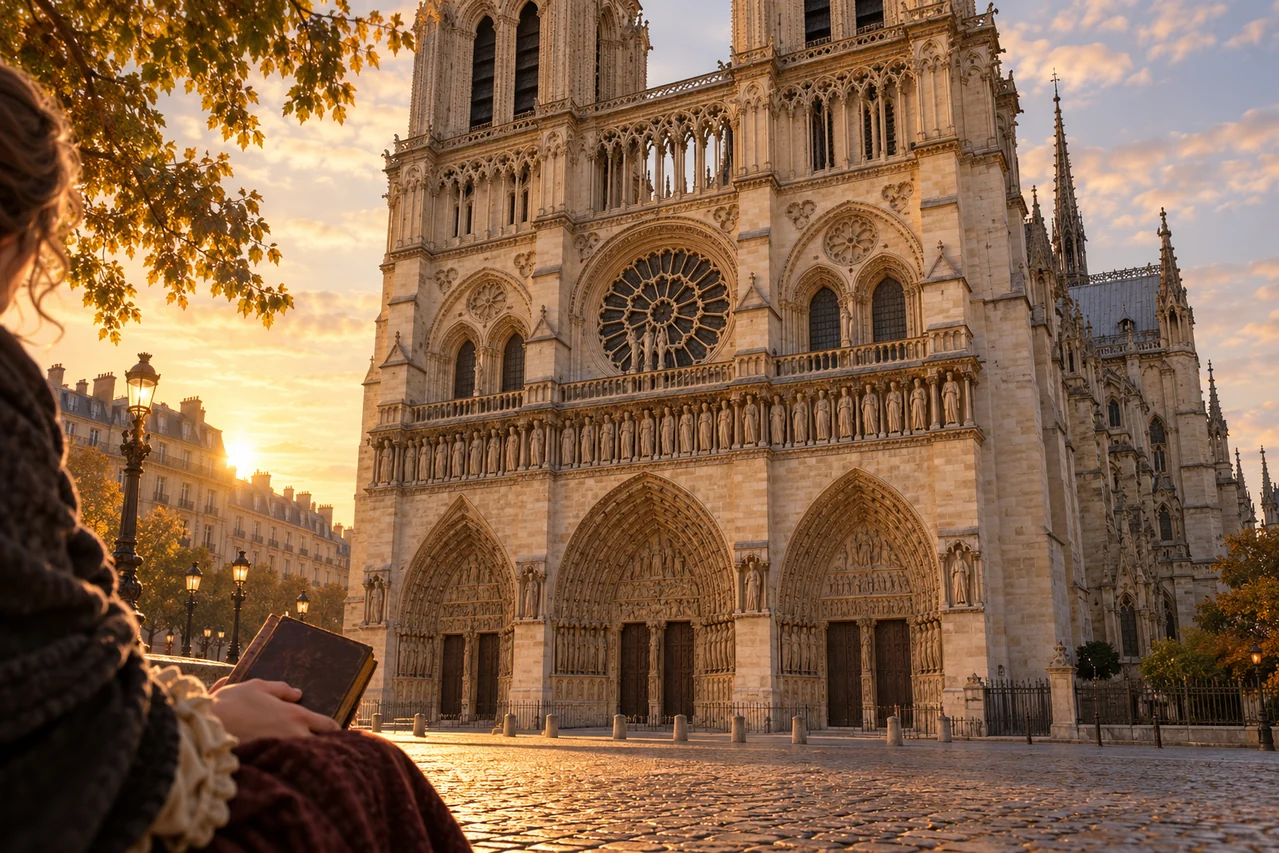
Many English-speaking readers encounter Hugo's story under a title that foregrounds the hunchback. The original French title names Notre-Dame itself. That difference is a useful starting point for a visitor: the book is not only about a striking human character but also about a building, a city and what societies preserve. Hugo makes room for sustained attention to architecture, rather than allowing it to remain behind the action. Recognizing that intention helps a traveler approach the cathedral differently. The question becomes how Notre-Dame shapes the world of the novel, not merely where a familiar scene is supposed to have happened.
Architecture can hold a memory of generations
Hugo's cathedral bears the accumulation of time: different parts, interventions and injuries belong to a long material history. Its value does not rest only on an imagined state of original perfection. The building can be read as a memory carried in stone, with successive generations leaving marks. This idea is especially useful in Paris, where visitors may expect an ancient monument to be simply medieval. Notre-Dame's later restorations complicate that expectation productively. In the literary account, the architecture already asks the reader to notice that a building has a life, even though it does not act or speak in the same way as a person.
Quasimodo and the cathedral form an inseparable world
Quasimodo's relationship with Notre-Dame, particularly its bells and interior spaces, makes the building central to his character. It is a refuge and an environment through which the reader understands him. His social exclusion and the public's judgments of appearance also connect with Hugo's willingness to find grandeur in what others regard as irregular. The association does not make Quasimodo a documented historical inhabitant of the cathedral. It reveals how a fictional person can direct attention to its spaces and symbolic qualities. The relationships among Hugo's main characters help explain why this connection has such enduring emotional power.
Refuge makes the building part of the action
Notre-Dame acquires a role in Esmeralda's fate through the novel's use of sanctuary. The possibility of refuge changes what the building means: stone, space and religious authority become involved in a human drama. Sanctuary has a complex legal and religious history, and Hugo's treatment should not be taken as a complete historical description of how it operated in 1482. That boundary is important but does not diminish the passage's literary force. The cathedral can protect, separate and create tension within the story. A visit shaped by fiction can explore those meanings while acknowledging that a novel and an archival account answer different questions.
Hugo also considers how societies communicate
Beyond the immediate plot, the novel reflects on architecture and print as ways in which civilizations transmit beliefs, power and memory. Buildings can be read as carriers of collective expression, while the printed book offers another form of circulation and preservation. This makes Notre-Dame de Paris a novel about media as well as about people. For contemporary travelers accustomed to images shared through screens, the broader question is readily intelligible without pretending Hugo was writing about today's technology. What can a society make durable, and through which forms? The cathedral and the book become two different answers that the work places in conversation.
Literature contributed to attention, not preservation alone
Hugo's novel strengthened attachment to Notre-Dame within a wider nineteenth-century concern for medieval monuments. Its emotional power helped people see a building as something worth caring about. That cultural contribution should remain distinct from the decisions and skilled work required to conserve it. Hugo and the cathedral's preservation explains why saying he saved it alone is misleading. Architects, public action, funding and crafts all had roles. The point is more interesting than a heroic shortcut: a story helped shape the desire to preserve, and collective effort had to translate that desire into interventions on an actual monument.
Restoration adds new chapters to the character
Jean-Baptiste Lassus and Eugène Viollet-le-Duc played major roles in the nineteenth-century restoration, which helped shape the cathedral's later image. Following the fire of April 2019, another major restoration preceded its reopening in December 2024. The building now makes the idea of accumulated history unusually visible. A medieval monument contains later interpretations that can themselves acquire heritage value. The literary reading is therefore not frozen in 1831 or 1482. It gives visitors a way to consider continuity and vulnerability in a place that has kept changing, without claiming that Hugo predicted contemporary events or that all familiar details are original medieval work.
Notice the heritage that is not made of stone
Even travelers who have never opened Hugo's novel may know Quasimodo or Esmeralda. Those fictional associations arrive with them and influence their first view of Notre-Dame. Literature has become an intangible layer of the place, alongside religion, history and architecture. An Elyrea encounter with Esmeralda can make that layer explicit rather than leave it as a vague memory of an adaptation. Meeting Esmeralda around Notre-Dame connects the reading with an actual itinerary. The visitor can then distinguish the building's material history from the imagined world attached to it, while understanding why the two have become culturally inseparable.
FOR YOUR GUEST ITINERARIES
Are your guests interested in the relationship between books and places? Elyrea's Esmeralda encounter can help them read Notre-Dame through Hugo's fiction within a thoughtfully designed Paris itinerary.
Discuss your itinerary