
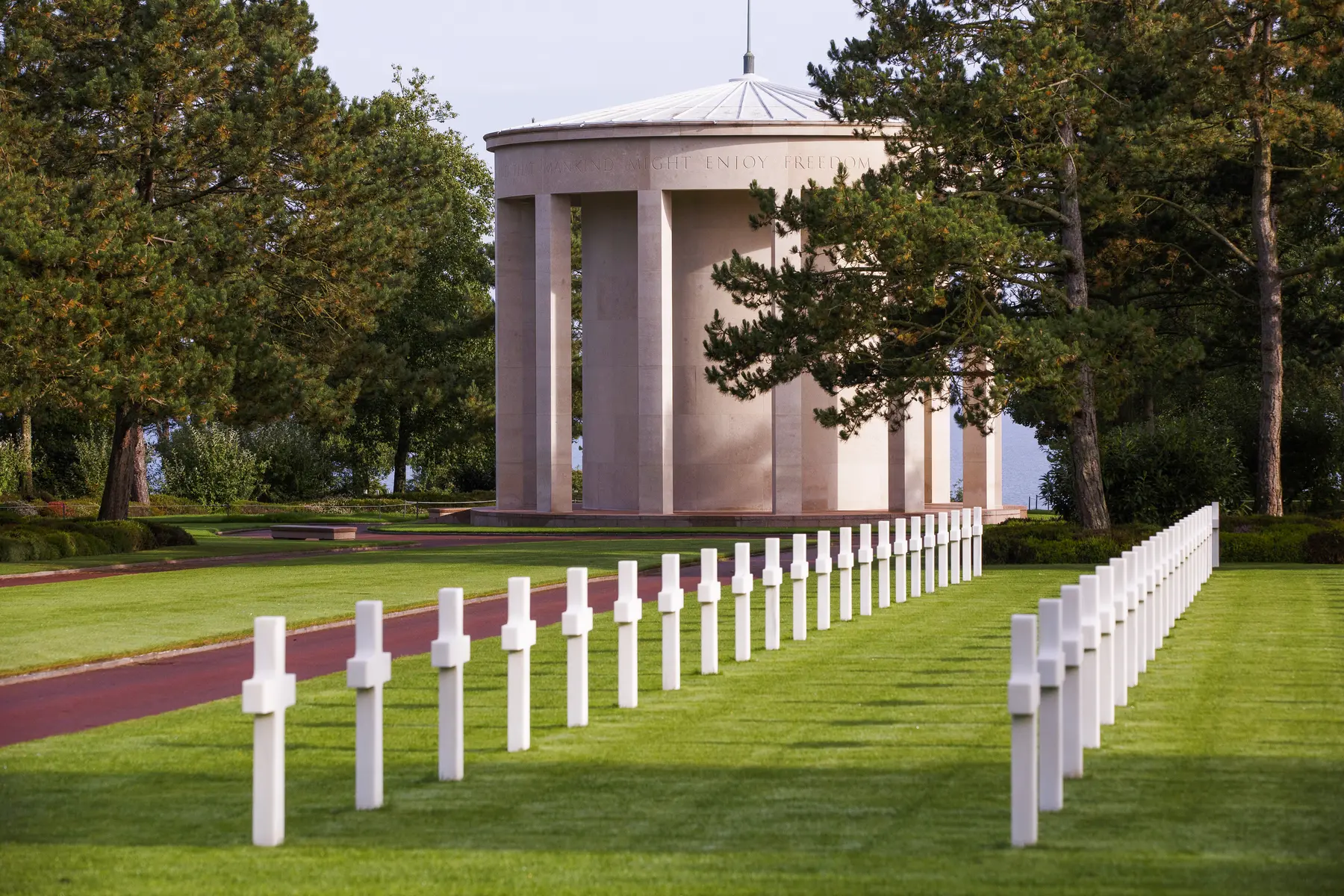
Beach first or cemetery first?
There is no universal order for connecting Omaha Beach with Normandy American Cemetery at Colleville-sur-Mer. For a first visit, beginning at the beach often creates the clearest progression. Guests read the width of the shoreline, the exits, the bluffs and the distances before moving to the plateau where the dead are buried. The cemetery then gives names, dates and individual weight to terrain understood only moments earlier. Reversing the order may be wiser when a ceremony, a family grave, opening hours, weather or mobility determines the day. The decision is therefore not a tourism formula. It should follow the story the advisor needs to build and the amount of attention guests can bring to a serious subject.
The beach establishes the scale of the battle
On the sand, Omaha becomes more than a familiar name on a map. The distance to the high ground, the exposed terrain and the routes inland make the difficulty of June 6, 1944 legible without turning history into spectacle. The US 1st and 29th Infantry Divisions faced heavy German resistance and held only fragile control of the beachhead by the end of the day. Reading the landscape explains why sectors, timing, obstacles and units matter. Interpretation still requires caution. The peaceful beach has changed, and no single viewpoint can summarize the entire landing. The purpose is to establish spatial evidence, not to claim that a contemporary visitor can know what a soldier felt.
The cemetery turns numbers into lives
Normandy American Cemetery occupies the plateau above Omaha at Colleville-sur-Mer. Its burial plots, memorial, chapel, Garden of the Missing and orientation table create a different scale of history. The American Battle Monuments Commission maintains 9,389 graves there and commemorates missing service members on the walls. Maps place the sector within a much larger operation, while individual inscriptions return attention to lives cut short. After the beach, that movement from terrain to people can be especially powerful. It requires unhurried silence, clear expectations about conduct and interpretation that never treats crosses and Stars of David as a photographic backdrop.
Why beach then cemetery often works
The sequence of terrain, operation, individual lives and memory builds depth instead of merely adding stops. On the beach, guests understand geography. On the plateau, they examine how the United States and France created a place of burial and remembrance. The conclusion is no longer only military; it concerns naming, mourning, searching for the missing and transmitting history. How to visit Omaha Beach respectfully adds a useful reflection on the conduct and language suited to this landscape. The order suits many first-time visitors, but it should remain flexible. The quality of the visit depends on narrative clarity, not mechanical obedience to a standard route.
When the cemetery should come first
A family arriving to honor a particular grave should not wait through a long topographical explanation. A scheduled ceremony, flag lowering, group arrangement or timed entry may also determine the start of the day. In those cases the cemetery can establish the tone before the beach provides wider geographical context. Reversing the sequence requires a careful transition. After a personal act of remembrance, the coast cannot suddenly be treated as an attraction. The advisor should consider transfer time, the need for privacy and how guests wish to continue. D-Day medics at Omaha Beach can extend the story through care under fire rather than through another list of military objectives.
Close on the map, but no direct public path
Visual proximity creates an operational trap. ABMC states that the direct path between the cemetery and the beach has been closed to the public since 2016 for security reasons. Public access to the beach remains available nearby, but the itinerary needs a separate road transfer. ABMC currently lists daily opening, except December 25 and January 1, from 9 a.m. to 5 p.m., with last admission at 4:30 p.m.; advisors should reconfirm every file. ABMC has also announced free timed-entry reservations from April through August beginning in 2027. A premium itinerary therefore cannot rely on a straight line on a map. It must coordinate access, parking, opening hours and enough time for reflection.
Charles as a narrative voice, without an invented biography
The Elyrea Encounter at Omaha Beach uses Charles as its narrative thread. Publicly he has only that first name; no surname or fabricated historical biography should be attached to him. His dramatic perspective can make uncertainty, fear and a GI’s movement across the terrain intelligible when documented facts remain distinct from theatrical interpretation. The encounter does not replace a historian, ABMC information or private remembrance. It offers a human point of entry into the landscape. A conventional tour or an Encounter with Charles at Omaha Beach? helps advisors decide whether that degree of embodiment suits their guests.
B2B guidance: let the guests determine the order
The brief should identify any family connection to World War II, nationality, ages, mobility, existing knowledge, children in the party and the desired emotional intensity. For a first visit without a known personal connection, beach then cemetery often provides a clear narrative. For family remembrance, a tribute or a fixed institutional schedule, the cemetery may need to come first. Either way, a genuine pause prevents the day from becoming a stream of commentary. The advisor should confirm entry arrangements, ceremonies and current conditions directly with the site. A successful experience does not try to cover every D-Day location. It connects terrain, individual lives and remembrance with accuracy, restraint and respect.
FOR YOUR GUEST ITINERARIES
Planning a private cultural itinerary? Elyrea can help you weave this perspective into your guests’ journey.
Discuss your itinerary