
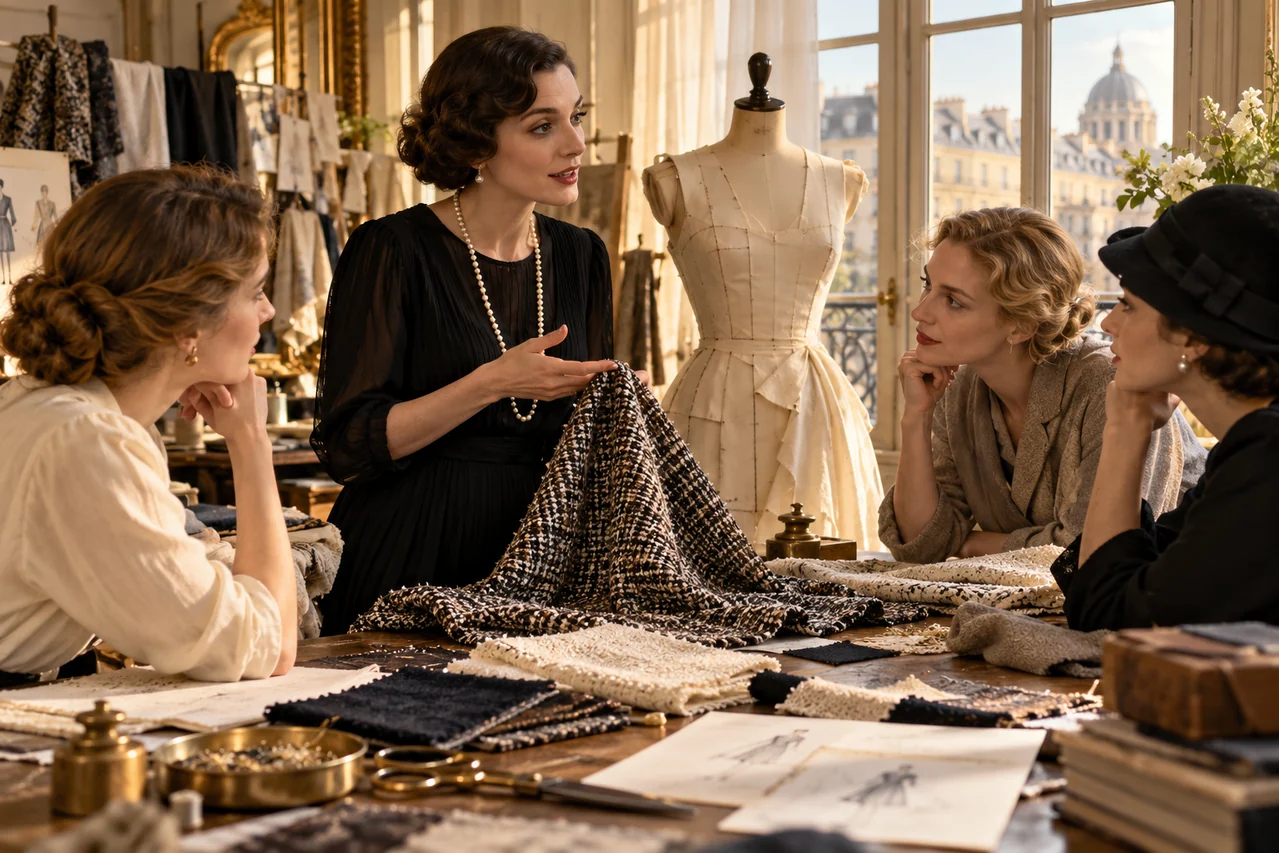
Read fashion through the geography of Paris
Rue Cambon, Place Vendôme and Avenue Montaigne are more than addresses on a shopping map. They help travelers consider how fashion, architecture and the representation of prestige occupy the city. Start by explaining the relationship between a place and the story being told. A walk that simply identifies brands leaves much of the cultural interest unused. The traveler can instead begin to see why particular districts matter and how the urban setting contributes to the image of French style. Look at what an address makes possible within the historical story. A house's workplace, a nearby hotel and a public square can reveal different forms of activity rather than three interchangeable expressions of prestige. The present surroundings also contain later layers and new uses. Explain those changes instead of suggesting the traveler has stepped into an untouched scene. A visitor who already knows the shopping district can then gain a new relationship with familiar streets. The advisor should confirm actual routes and visits, keeping the editorial geography distinct from a promise that every mentioned interior or landmark will be included in one experience. Cultural depth begins with a precise relationship between place and question.
Ask what clothing reveals about its period
A garment can open questions about movement, work, social expectations and the image of the body. This makes fashion history useful even for a companion with little interest in shopping. Rather than describing a succession of looks, connect a design choice with the circumstances in which it was made and worn. Travelers can then recognize that elegance is neither fixed nor universal. The contrast between periods becomes part of the journey's intellectual content as well as its visual pleasure. Use an observable detail to establish the discussion. A change in the waist, the volume of a skirt or the way an accessory is carried can lead to questions about movement and public appearance. That gives non-specialists an entry point without requiring a long introduction to terminology. The explanation should remain specific: a visual feature offers one perspective on its period, not proof that everybody lived or thought in the same way. Guests can compare different proposals and notice where their responses diverge. Such discussion makes the fashion chapter accessible to a mixed-interest group while preserving its seriousness, because the subject concerns everyday use and social representation as well as aesthetic preference.
Approach Chanel through change and complexity
Chanel contributed to a profound transformation of women's clothing, including a different relationship with movement and simplicity. Her work belongs within wider changes in dress and women's lives rather than a story in which one designer changed everything alone. Her biography also contains controversial aspects that should not disappear behind the brand's image. Exploring Chanel's Paris can connect these questions with places. The Chanel Encounter ends on Place Vendôme, in front of the Vendôme Column, providing a precise final setting for its narrative. The biography should also distinguish Gabrielle from the later institution carrying her name. Contemporary objects and creative directions reflect generations of work and cannot all be treated as direct expressions of the founder's intention. Likewise, acknowledging her influence does not resolve the ethical questions raised by her conduct. An Encounter can make those contradictions approachable while remaining clear that theatrical dialogue is interpretation, not archival evidence. For the advisor, the subject may interest entrepreneurs and travelers concerned with reputation as much as shoppers. Ask what attracts the guest to Chanel, then select the surrounding chapter accordingly rather than assume the famous name establishes the same motivation for everyone in the party.
Understand Dior's New Look in its context
Christian Dior's first collection in 1947 offered an abundant, structured silhouette that contrasted with wartime restrictions. Its impact included criticism as well as enthusiasm, making it a useful subject for discussion rather than automatic celebration. What did the look suggest about femininity, materials and the desire for change after war? The story of Dior's New Look allows an advisor to connect a familiar fashion term with a broader cultural moment, while keeping the historical designer distinct from the house's subsequent development. The contrast becomes tangible when guests examine the silhouette alongside the circumstances of postwar life. An abundant silhouette could be experienced as a welcome change or questioned in relation to recent scarcity and women's daily lives. The historical explanation should not prescribe a single response to those issues. Give guests enough context to consider why design became a public discussion, then return to the actual forms and their making. A Dior chapter can develop an inquiry into postwar culture rather than restart a general introduction to luxury. Practical visits and Encounter arrangements should be confirmed independently, allowing the cultural connection to remain strong without implying special access or an exhibition that has not been checked for the guest's stay.
Compare designers without reducing them to opposites
Chanel and Dior provide contrasting approaches to elegance, but a complete opposition between freedom and restriction would flatten both. Compare specific design choices and their contexts rather than assigning each designer a single moral or aesthetic position. A traveler may admire different qualities in their work. Such a conversation can make a fashion itinerary more sophisticated than a competition between two famous names. It also leaves room for guests to relate the history to their own tastes and experience of clothes. Choose examples that can be compared meaningfully, and explain when they come from different stages of a career. A house is not an unchanging set of traits, and both creators evolved within circumstances that affected reception. Simplicity and visible complexity are not reliable measures of how much skill was required. The visitor can notice those differences without being asked to identify the superior version of femininity. This creates a more useful conversation for families or professionals, where responses may reflect different needs and tastes. The itinerary's value lies partly in that plurality: Paris becomes a setting for several arguments about elegance, rather than a place that supplies one final answer through the authority of famous names.
Bring the work of couture into view
The finished garment can hide the skills, materials and time required to create it. Introducing the role of workshops and craftspeople changes how a traveler interprets value. A cultural explanation can examine this work without promising entry to an atelier or access to processes that have not been arranged. Understanding how a haute couture atelier works provides useful background. The traveler can then approach an exhibition, a shop or an encounter with more informed attention to what lies behind the visible result. Collective work also changes how authorship is understood. The signature may organize public recognition, but garments rely on specialist knowledge, repeated decisions and exacting adjustment. Explain a few functions clearly instead of listing every craft as another sign of exclusivity. An apparently effortless line can be the result of substantial work, while a decorative effect may involve several skills. The guest can carry that knowledge into looking at a finished piece, whether in a collection or a contemporary display. This is distinct from access to the work itself, which requires specific arrangements. Keeping the distinction explicit allows an advisor to offer serious cultural background without turning a discussion of craftsmanship into an unsupported promise of private workshop entry.
Let other arts widen the fashion story
Photography, decorative arts, architecture and museum displays can extend a fashion journey beyond brands. These connections help explain how clothing participates in a larger visual culture. Choose additions that advance the guest's particular interest: someone fascinated by craft may want different material from a collector interested in public image. The advisor should avoid inserting an unrelated cultural activity simply to balance a day of shopping. A focused connection gives both the cultural stop and the later shopping experience a clearer purpose. The wider connection should develop a question already present in the day. Photography might help examine how a silhouette becomes an image, while architecture can show how prestige is situated in the city. Decorative arts may support an inquiry into materials or personal environments. If an addition does not advance the guest's particular interest, another moment of independent observation may be more useful. A cultural program need not include every medium to feel complete. Selectivity lets each relationship be understood, and it protects attention from an accumulation of loosely linked appointments. The advisor should describe the function of the selected visit rather than rely on institutional fame to explain why it belongs within a fashion itinerary.
Build a day in which shopping has a meaningful place
A useful sequence might introduce the history, develop an understanding of craft or design, then leave time for shopping and independent exploration. It should remain flexible enough for the guest to follow a new curiosity. Not every fashion traveler wants every appointment to be interpreted. An Elyrea Encounter can serve as the day's narrative anchor, connecting a character with a meaningful setting, while the rest of the program gives the traveler opportunities to look, compare and make choices in a city they now understand more deeply. Make room for guests to use the new perspective in their own way. One may want to recognize inherited codes, another to compare current proportions, and another simply to browse with less interpretation. Those responses can coexist within a thoughtful day. The program should not turn every purchase into a necessary conclusion or imply that deeper cultural understanding requires buying something. A meal, an independent walk or another creative chapter can also provide continuation. The value lies in giving shopping, if desired, a meaningful and proportionate place alongside history and observation. With that structure, a fashion-focused Paris stay feels tailored to the traveler's curiosity instead of assembled from the maximum number of prestigious retail appointments.
FOR YOUR GUEST ITINERARIES
Designing Paris for guests passionate about fashion? Our team can help connect Chanel and Dior Encounters with a thoughtful itinerary of culture, craft and shopping.
Discuss your itinerary