
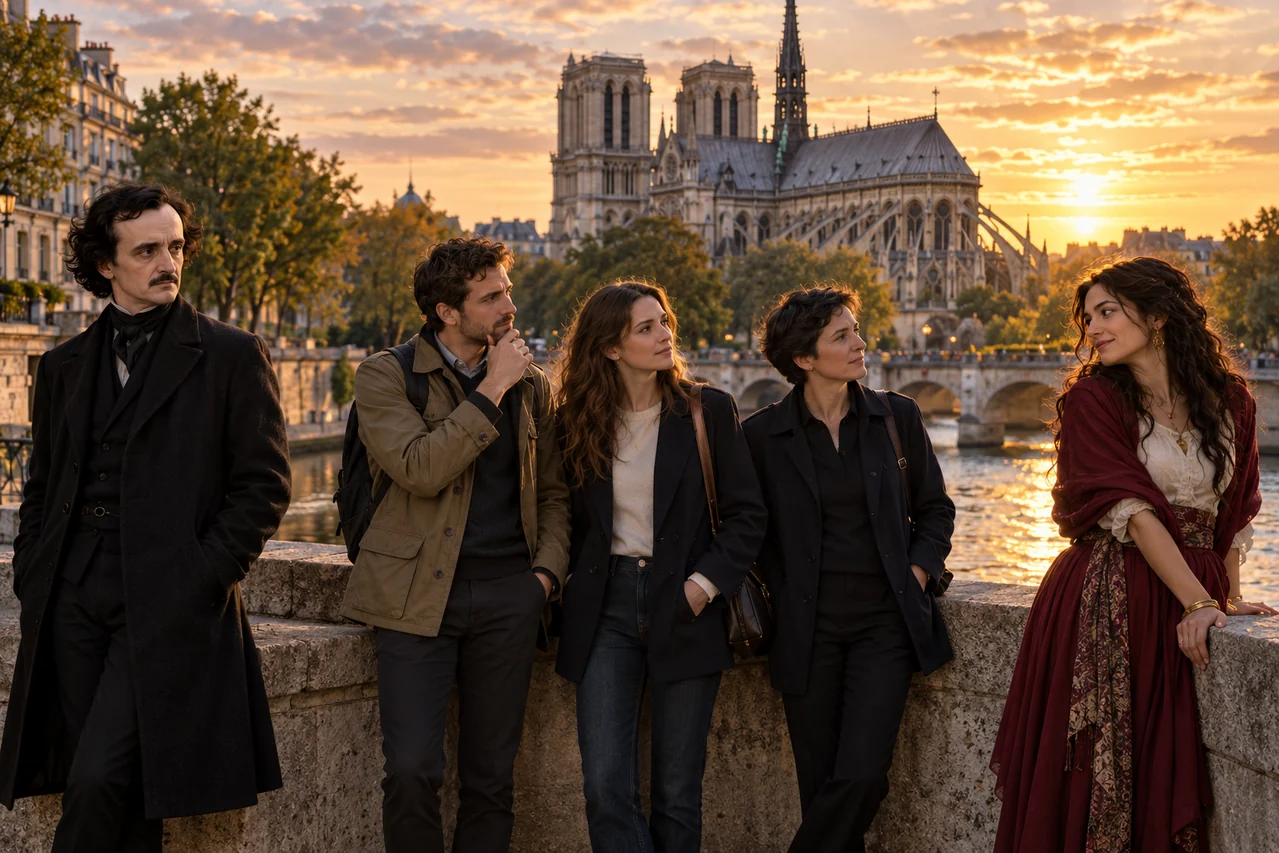
Begin with the nature of each character
Edgar Allan Poe was a historical American writer. His presence in the Paris experience is a theatrical literary device, not a reconstruction of life in the city. Esmeralda is a fictional character from Victor Hugo's Notre-Dame de Paris. That difference should be clear before comparing the experiences. One embodies an author whose imaginative world provides a method of inquiry; the other embodies a character through whom a particular novel's Paris becomes accessible.
Poe makes the city a question
The Dark Legends of Paris invites attention to stories, uncertainty and the relationship between folklore and evidence. Poe's association with mystery and detective fiction supports that approach. Guests can ask why a legend persists or what a place reveals about an account. The city becomes a field of interpretation rather than a series of verified Poe addresses. This is useful for travelers who enjoy puzzles, literary atmosphere and the process of distinguishing what is known from what is imagined.
Esmeralda makes the city part of a novel
The Esmeralda Encounter approaches Notre-Dame through the characters and world of Hugo's book. The novel appeared in 1831 and sets its story in 1482, a distinction that matters when interpreting the surrounding city. Esmeralda and the Paris of Victor Hugo introduces that literary relationship. The experience should not imply that the character was a historical inhabitant or that today's island reproduces the novel's setting without change.
For mystery readers, choose the form of inquiry
A guest interested in detective fiction may respond especially well to Poe's questions about reasoning, appearances and unreliable accounts. A guest seeking the emotional and social world of a major French novel may find Esmeralda more relevant. These preferences can overlap, but an advisor should still identify the main reason for the choice. Describing both experiences simply as immersive tours around Notre-Dame obscures the literary distinction that gives each its value.
Families need a shared point of entry
Adolescents may enjoy mystery, while others respond more readily to identifiable characters and conflicts within a story. The choice should reflect the family's reading interests and comfort with the darker material, rather than an assumption that all young guests want the same atmosphere. Both experiences can make room for conversation across generations. The advisor's role is to introduce the subject honestly and ensure that the cultural emphasis fits the group, without promising a universal emotional response.
Nationality may suggest connections, not dictate the choice
An American guest may be curious about Poe's French literary afterlife, but may equally love Hugo or cathedral architecture. A French-speaking visitor might know Hugo well and want a different perspective through Poe. Asking about reading and curiosity is more useful than assigning the experience by nationality. Why France embraced Poe explains the transatlantic cultural link for those interested in it, while leaving room for guests whose motivations are entirely different.
If both are included, give them different roles
Two Encounters in one broad area can enrich a literary journey if the program preserves their distinct subjects. They can also become repetitive if the advisor merely doubles the amount of character-led narration in a crowded day. Separating them across the stay, or pairing one with architecture and the other with reading, may create a clearer progression. The surrounding visits should deepen the selected thread rather than require both experiences to cover the same general introduction to Notre-Dame.
The best choice changes how the guest looks
Poe can leave a guest more attentive to how stories claim truth; Esmeralda can make the cathedral and its surroundings feel connected to a novel's human conflicts. Neither outcome is inherently superior. Both combine a character, a place and interaction to give a familiar setting more meaning. The advisor should be able to explain the choice in terms of this particular guest: what they care about, what they already know and what kind of discovery will reward their return to the island.
FOR YOUR GUEST ITINERARIES
Tell our team whether your guests are drawn to mystery, Victor Hugo or family literary discovery; Elyrea can help select the Encounter that best fits their Paris stay.
Discuss your itinerary