
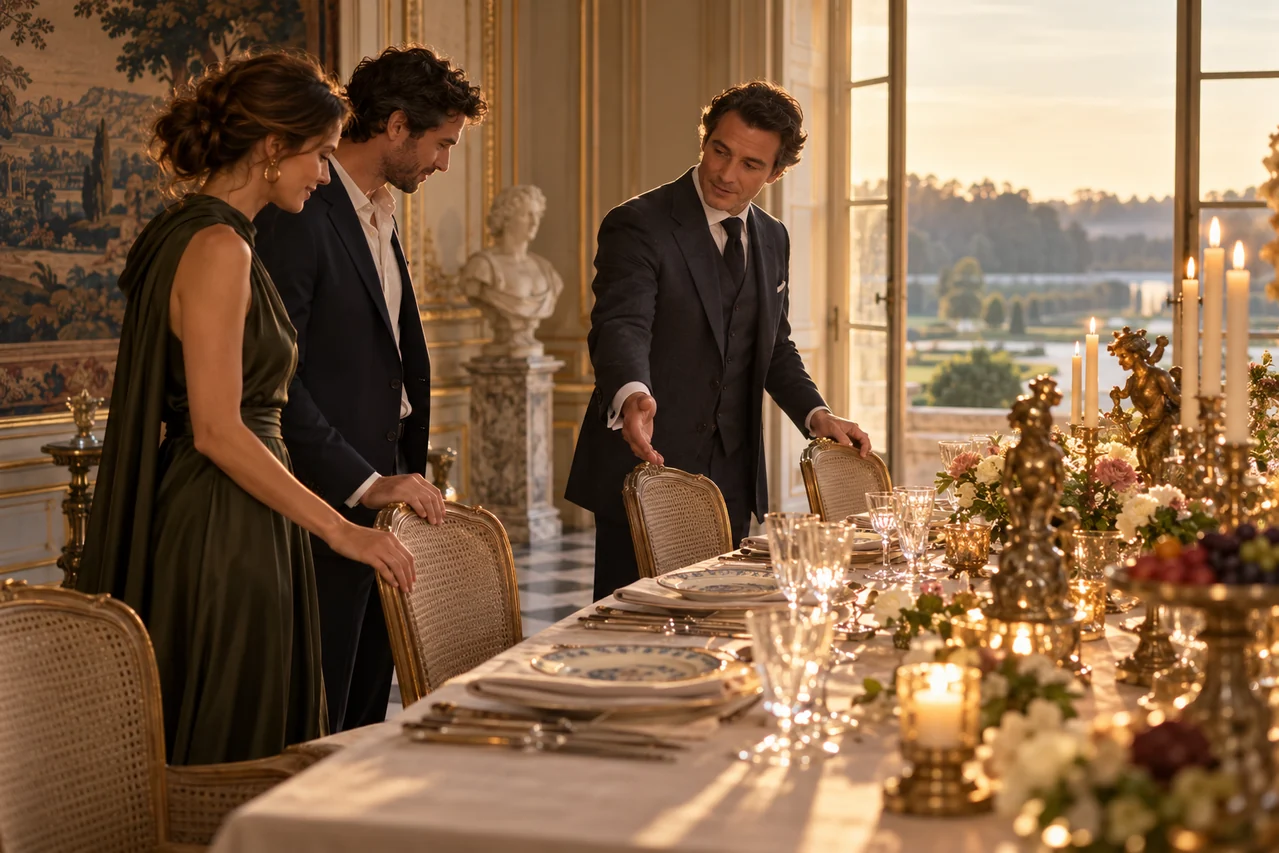
A king's routine could become public ceremony
Louis XIV's court gave political meaning to elements of the sovereign's daily life, including certain meals. This does not mean every meal followed the same form or admitted the same observers. The specific practices varied. The useful point is that activities ordinary in another setting could become occasions for organized access and display. Travelers can ask why proximity to the ruler mattered, and how a household routine became part of a political order whose participants understood visibility as consequential.
The Grand Couvert reveals more than appetite
The Grand Couvert is associated with ceremonial royal dining under conditions that changed across periods. Its significance is not exhausted by the image of people watching a king eat. The audience, access and conventions reveal relationships around the sovereign. A visit should therefore explain what the occasion made visible about court society. That approach transforms a seemingly strange custom into a historical question about authority, showing how ordinary bodily activities could help organize the hierarchy surrounding a ruler.
Being present could express position
Court life depended in part on who could approach the sovereign and under what circumstances. Access might reflect standing or favor, while exclusion also carried meaning. A meal was one of several settings in which those relationships could appear. The account should not suggest that every attendee obtained the same advantage merely by entering a room. Instead, travelers can consider the graded nature of presence. Where someone stood, how someone served and who received attention could communicate distinctions familiar to the court's participants.
Etiquette did political work
To modern observers, detailed conventions may look arbitrary. Within court society, they helped regulate competition and make rank legible. Explaining that function does not require praising the system or treating it as the natural expression of elegance. Etiquette organized access to power as well as behavior at table. A cultural experience gains depth when visitors can see why rules mattered to the people subject to them, while retaining the difference between understanding a social system and endorsing its inequalities.
A ceremonial meal still required material labor
No arrangement of precedence could replace actual food, spaces, objects and service. Officers and workers had to support the ceremonial effect. The organization behind a grand dinner connects the symbolic layer with practical constraints. Vatel is useful because his role brings that working machinery into view. The guest's attention can shift from the sovereign as the obvious center to the many people whose responsibilities made the sovereign's public table function, widening the story beyond rulers and their favored companions.
Noble hospitality could also build relationships
Aristocratic hosts used reception to display rank, cultivate networks and welcome consequential guests. Condé's reception of Louis XIV at Chantilly gives a particularly prominent setting for Vatel's story. It should not be confused with a normal royal meal at Versailles. Hospitality as an instrument of power develops the comparison without erasing differences between households. The shared theme is the table's capacity to communicate, while the particular arrangements depend on who is receiving whom and within which social and political circumstances.
The table opens social history
Who had access to rare products, who ate, who observed and who served are questions about society as well as cuisine. They also prevent a food narrative from presenting the elite meal as representative of everyone's daily life. Women participated in court relationships and social networks, and a complete account cannot reduce that world to a succession of famous men. The focus can remain manageable while acknowledging that the ceremonial scene involved varied roles and sharply unequal opportunities.
Vatel provides a useful change of viewpoint
A theatrical organizer can describe the pressures and coordination behind a meal rather than speak only from the throne. Elyrea's Encounter gives those themes a concrete setting in which guests understand quantity, timing and service from their own experience of dining. Any modern comparison with state dinners or hospitality should be offered as interpretation, not as proof of an unchanged system. For advisors, the political angle creates cultural depth for guests interested in court society, connecting a pleasurable activity with a serious account of access and power.
FOR YOUR GUEST ITINERARIES
For guests exploring Louis XIV and court society, contact Elyrea about a Vatel dinner Encounter that opens the backstage of ceremonial hospitality.
Discuss your itinerary