
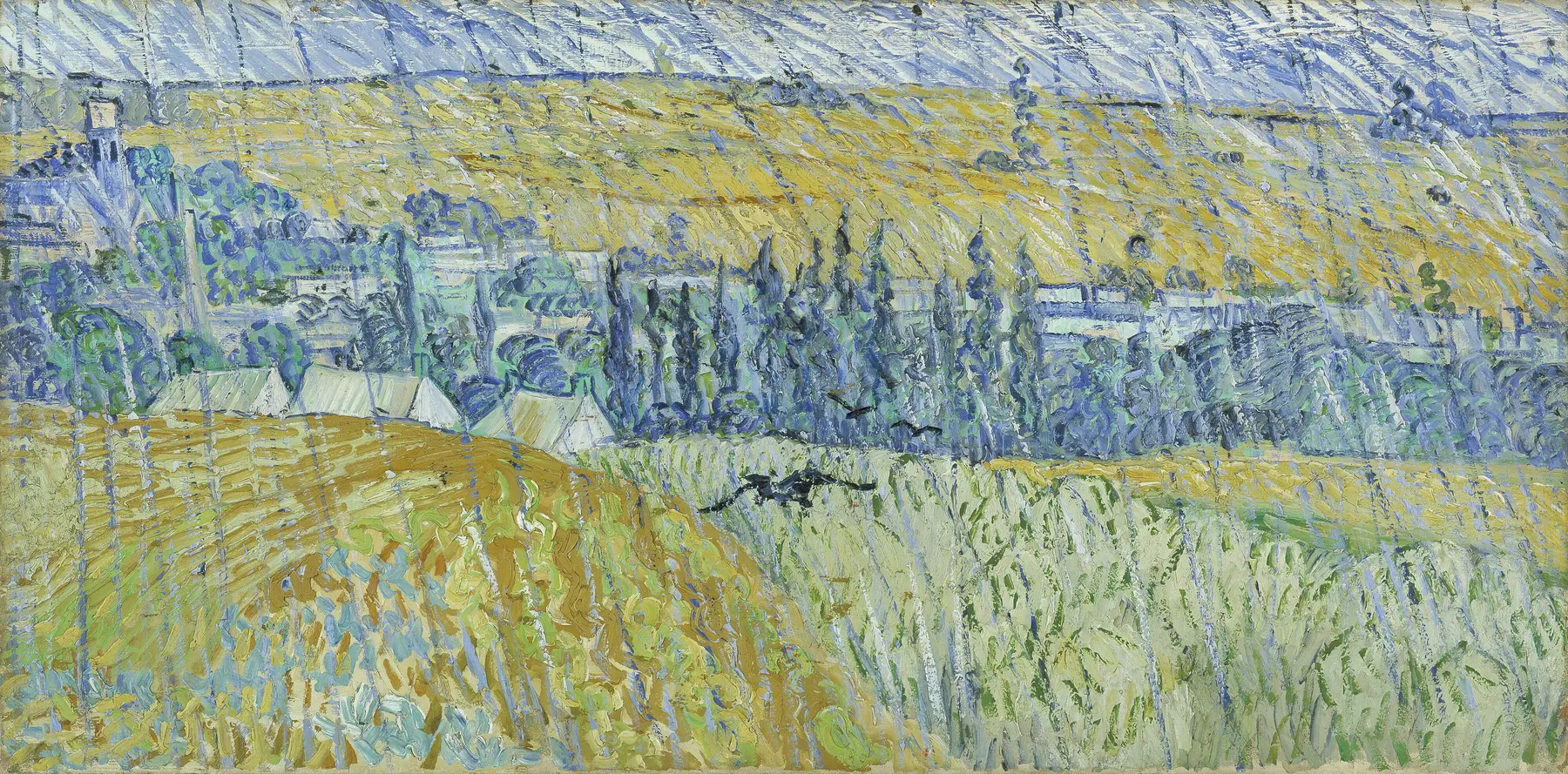
A canvas almost twice as wide as it is high
At Auvers-sur-Oise, Van Gogh used several canvases roughly fifty centimeters high and a little over one meter wide. The proportion resembles two squares placed side by side, hence “double square.” This was not simply a panoramic crop. It forced the painter to reconsider the balance among sky, horizon, fields and village. For “Wheatfield under Thunderclouds,” the Van Gogh Museum emphasizes the unusual elongated format and the grandeur it gives the landscape. Width lets the eye travel laterally while limited height concentrates tension. The format belongs to the final weeks of Van Gogh’s life, yet it should first be understood as a pictorial decision rather than a biographical code. Form offers firmer evidence than retrospective psychology.
Auvers, May to July 1890: concentrated work
Van Gogh arrived in Auvers in May 1890 and worked there until his death in July. The village, church, gardens and surrounding plain became the setting for remarkably sustained production. That short chronology has encouraged stories that search every canvas for a final message. Dates and the precise order of some works nevertheless remain debated. The double square does not prove a testamentary intention or one fixed mental state. It records an energetic investigation: how can a broad landscape fit inside a controlled surface, and how can closeness to a motif coexist with a powerful sense of space? Caution does not remove emotion. It restores Van Gogh’s ability to experiment instead of reducing every choice to the tragedy that followed.
The horizon becomes structure
In a conventional canvas, a horizon may simply divide sky from earth. In the double square it becomes an active line crossing an extended distance. Van Gogh can raise it to give fields more space, lower it so the sky dominates, or interrupt it with trees, roofs and roads. Viewers do not absorb the whole image at once. Their eyes travel, return and measure changes in color. “Rain, Auvers,” shared by Amgueddfa Cymru, shows diagonal rain marks moving across the entire width. The format turns weather into rhythm. In the actual landscape, that observation teaches guests to look beyond a single picturesque spot and notice continuity among plots, slopes, buildings and rapidly changing conditions.
Neither panorama camera nor cinema screen
Comparing the canvas to a panorama can help communicate scale, but the analogy has limits. Van Gogh was not objectively recording a field of vision. He simplified, intensified, displaced and organized. Brushwork, line and color construct an experience instead of copying one. It would be equally anachronistic to call the double square a cinema screen before cinema. The modern force of these works comes from proportion and internal movement, not a technological prophecy. Separating teaching comparison from historical fact allows travelers to appreciate composition without accepting a seductive but fragile claim. Each painting remains a specific material object made through decisions in 1890, not a universal symbol detached from its circumstances.
A group of experiments, not a final ranking
Several Auvers landscapes share the elongated support, inviting comparison as a group of experiments. Skies shift, horizons move, and fields either thicken or open. Repeated dimensions provide a stable frame for different answers. They do not establish a definitive sequence, much less identify Van Gogh’s “last painting” with certainty. “Wheatfield with Crows” often receives a terminal meaning, but the Van Gogh Museum dates it to July 1890 without treating it as conclusive evidence of farewell. Responsible interpretation can compare the works, identify hypotheses and leave chronology open where scholarship remains open. Guests then encounter a real art-historical question rather than a dramatic conclusion prepared in advance.
Using the format to look at Auvers
On site, the double square becomes a tool for looking. Guests can notice how roads divide the plain, how roofs or the church punctuate a horizon and how weather changes depth. The aim is not to recover every painted centimeter. The landscape has changed, viewpoints may be debated, and Van Gogh transformed what he saw. Our guide to following Van Gogh in Auvers helps structure the visit without confusing evocation with reconstruction. Current access, hours, group rights and conditions must be confirmed independently. A strong sequence alternates direct observation, an available work or reproduction, and unhurried time so the format becomes more than an abstract measurement.
An encounter that teaches attention
The Elyrea Encounter centered on Van Gogh can bring the painter’s questions before the landscape to life without inventing a confession about his final days. Theatrical interpretation gives rhythm to letters, gestures and work, but it remains distinct from documentary proof. For art-focused travelers, the double square offers concrete analysis: follow the horizon, compare proportions and see how a support shapes composition. For newcomers, it makes formal thinking immediately visible. The approach avoids retrospective diagnosis and the myth of a genius defined only by suffering. It returns attention to the artist who observes, tests, chooses and constructs.
B2B framing: promise a trained eye
A travel advisor can frame the excursion as learning to see a landscape through one painterly decision. The brief should cover works already known, mobility, desired outdoor time and interest in technique or biography. Auvers may connect with Paris or Giverny, but transfers need respect and the day should not become a sequence of photo stops. From Montmartre to Auvers and Giverny offers planning context. The honest promise is not to identify the exact final field or solve Van Gogh’s state of mind. It is to show how an unusual format turns an ordinary plain into a broad, rhythmic and strikingly modern visual experience.
FOR YOUR GUEST ITINERARIES
Planning a private cultural itinerary? Elyrea can help you weave this perspective into your guests’ journey.
Discuss your itinerary