
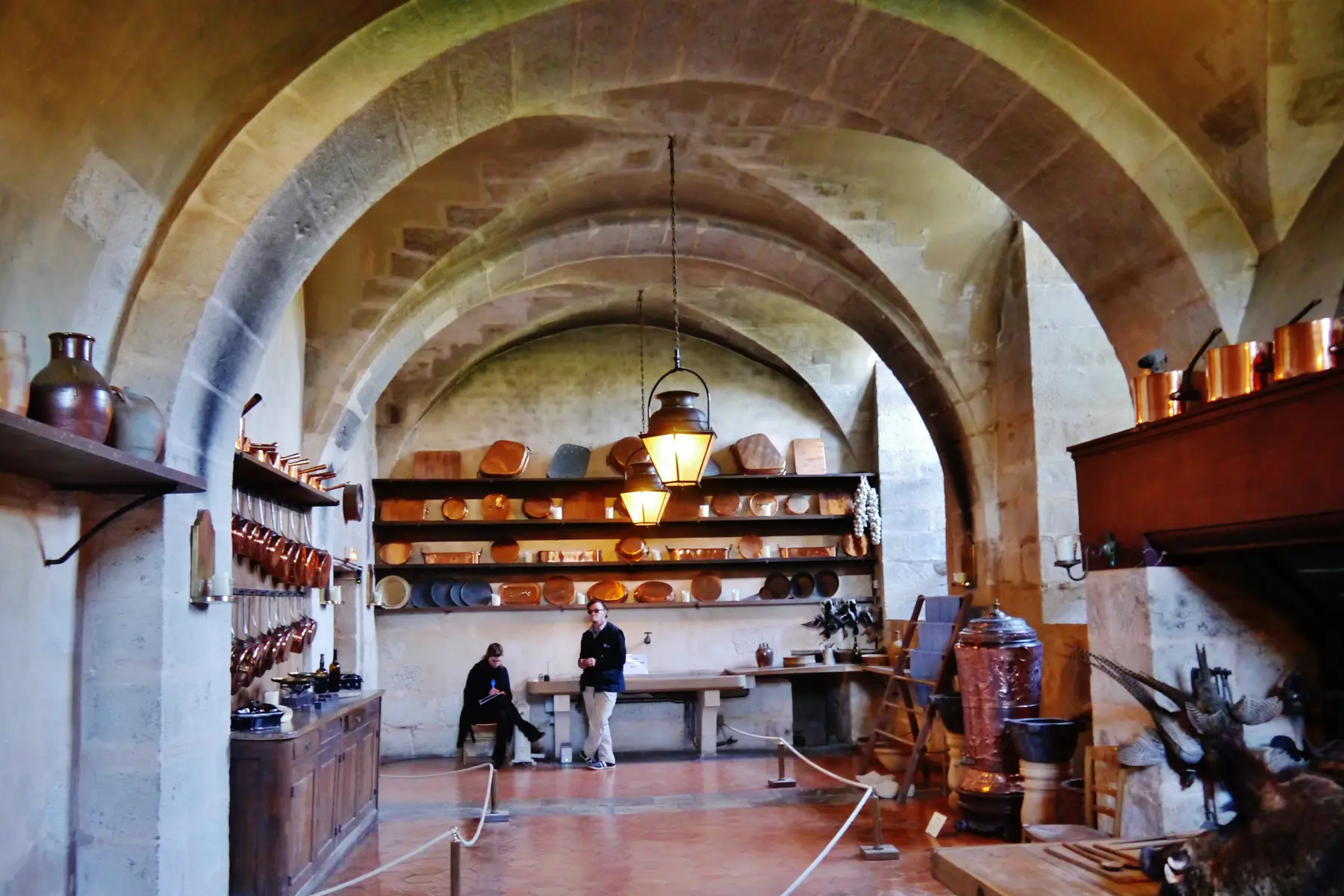
Vatel was not simply a chef
Popular memory links François Vatel with cooking, Chantilly cream and a final disastrous meal. That familiar picture sharply reduces his actual responsibility. In seventeenth-century France, a maître d’hôtel in a great household coordinated people, expenditure, supplies, spaces and ceremonial sequences. He had to make the table function while protecting the status of the person receiving the guests. Kitchens mattered, but they were only one component in a much larger operation. Vatel first served Nicolas Fouquet at Vaux-le-Vicomte and later the Prince de Condé. Understanding his work therefore changes the scale of the story. The court meal becomes a political, economic and theatrical organization rather than the achievement of one inspired cook.
A position of trust within a great household
The word hôtel referred to a noble household and its service, not to a modern place of accommodation. The maître d’hôtel worked near the center of that structure. He received instructions, allocated responsibility, watched expenditure and anticipated the needs of a potentially large company. His competence appeared in what guests never noticed as much as in what impressed them: a missing ingredient, delayed dish or incorrect place could disturb the entire display. The role demanded authority over teams and confidence from the head of the household. Who was François Vatel? places his career within the social and political networks of seventeenth-century France.
Supplying a feast without modern logistics
Hospitality required meat, fish, fruit, spices, firewood, linens, tableware and ice to arrive within deadlines that were difficult to control. Roads, seasons, weather and suppliers created continuous uncertainty. The maître d’hôtel needed several sources, replacement plans and a clear sense of which products could wait. Storage and movement between pantries, kitchens and service spaces also required coordination. This was not efficiency for its own sake. The work had to disappear so that abundance seemed effortless. Every plate arriving on time concealed a chain of earlier decisions. Pressure came from the distance between fragile supply conditions and the image of complete command expected at court, where material disruption could quickly be interpreted as social failure.
Directing teams and orchestrating time
A maître d’hôtel did not perform the work alone. He coordinated cooks, officers of the household, servants, suppliers and temporary staff assembled for a celebration. Tasks had to converge on the same moment, even though some began days earlier and others unfolded in minutes. Decisions needed to be communicated, execution checked and problems addressed without becoming visible to guests. The responsibility resembled production direction more than the solitary gesture of a modern celebrity chef. How was a prestigious dinner organized under Louis XIV? shows how seating, sequences of service and décor belonged to one order. At court, the meal followed a social clock as exacting as its culinary one.
Hospitality was a display of power
A major celebration under Louis XIV did more than feed or amuse. It made the host’s wealth, network, discipline and ambition visible. Architecture, gardens, music, light, performance and food spoke a shared language. The maître d’hôtel had to fit the meal into that larger narrative without allowing transitions to feel laborious. Fouquet’s celebration at Vaux-le-Vicomte in 1661 demonstrates this culture of magnificence, although it would be simplistic to make the event alone the cause of his arrest. Politics cannot be reduced to a menu, yet the menu participated in political representation. Vatel therefore occupied a profession in which a material detail could acquire symbolic weight and where impeccable service confirmed the authority of the household.
The Chantilly cream myth distorts the man
Vatel is frequently described as the inventor of Chantilly cream. The attribution is not supported by secure evidence and should not be repeated as fact. It satisfies a wish to condense a complicated life into a delicious, memorable invention. The problem is not merely biographical. The myth directs attention away from organizational intelligence and the collective system on which court celebrations depended. Culinary history rarely belongs to a single inventor; recipes, techniques and names circulate, change and are fixed later by print or local reputation. Removing the claim does not make Vatel less compelling. It restores the scale of his real responsibility and opens a richer discussion of labor, hierarchy and the way hospitality was produced.
Chantilly in 1671: resisting a sensational story
Vatel’s death during the reception for the king at Chantilly in 1671 permanently attached his name to tragedy. Surviving accounts, especially the letters of Madame de Sévigné, encouraged a narrative in which delay, honor and despair seem to lead inevitably to catastrophe. Evidence, interpretation and later amplification must nevertheless be separated. What the sources tell us about Chantilly in 1671 approaches the episode with care. Reducing it to a story about fish arriving late erases the social constraints of service and the pressure attached to a royal reception. Responsible interpretation neither romanticizes suicide nor treats it as a picturesque expression of French devotion to excellence.
B2B guidance: reveal the organization behind the splendor
The Elyrea Encounter centered on Vatel offers travelers a concrete route into seventeenth-century France: not only the chronology of kings, but the way a household manufactured prestige. For an itinerary designer, the subject connects gastronomy, heritage, leadership, hospitality and social history without turning Vatel into a modern management consultant. Comparisons with event production can clarify his responsibilities, but they must not erase the hierarchies of the Ancien Régime. A successful encounter makes visible the collective labor, rapid decisions and hidden discipline beneath elegance. It also preserves the contradictions of the story: beauty of display, severity of rank and the human vulnerability of those expected to guarantee an impossible perfection.
FOR YOUR GUEST ITINERARIES
Designing a private journey around seventeenth-century France? Elyrea can place the Vatel Encounter within a coherent cultural itinerary.
Discuss your itinerary