
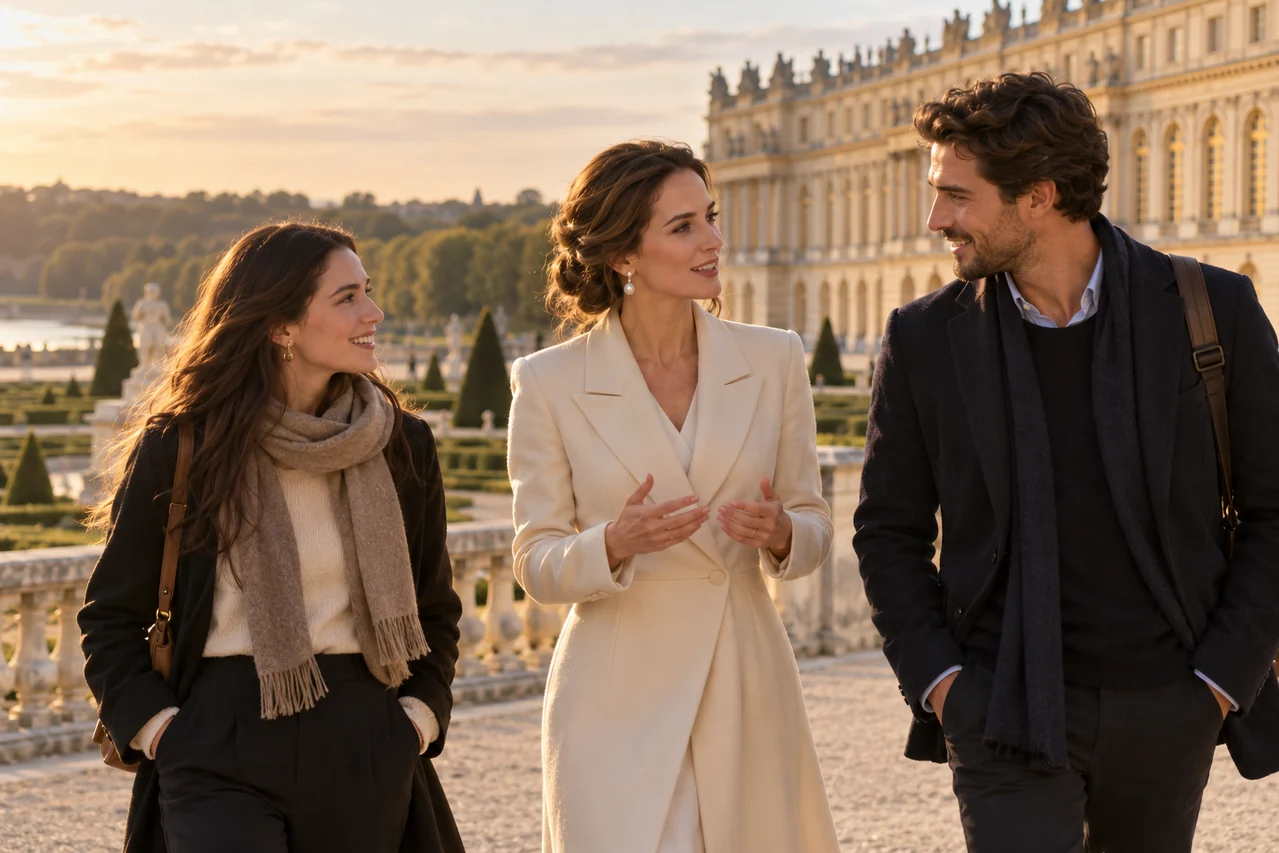
An adolescent entered a political world
Marie-Antoinette arrived in France in 1770 at fourteen, following a marriage arranged to strengthen the relationship between France and Austria. Born in Vienna in 1755, she had grown up within a dynasty for which marriage was an instrument of diplomacy. This beginning gives Versailles a different scale. Behind the later queen was a young person adapting to an unfamiliar court while carrying expectations far larger than herself. The palace becomes more than the setting of privilege when the visitor understands what her arrival was supposed to accomplish.
Understand Versailles as a system of access
The court organized status through proximity to the royal family. Ceremonies, precedence and etiquette determined who could appear, approach and participate. Rooms therefore represented relationships as well as architectural achievement. For Marie-Antoinette, ordinary acts such as dressing, dining and receiving company had a public dimension. A visitor who sees only wealth misses this invisible structure. Daily life at the court of Versailles helps explain how the ceremonial environment shaped behavior and why personal choices could have consequences for people beyond the queen's immediate circle.
A queen's intimate life carried dynastic expectations
Marriage and succession were matters of state, placing Marie-Antoinette's private life under unusual scrutiny. The absence of an heir during the early years of the marriage intensified attention to the couple. Her position cannot therefore be understood solely through entertainments or taste. The body and family life of a royal woman belonged partly to the institution she represented. This does not remove her exceptional privilege; it clarifies the particular constraints within it. A human reading of Versailles holds those two realities together instead of using one to cancel the other.
The Petit Trianon offered a different scale
After Louis XVI's accession, Marie-Antoinette was given use of the Petit Trianon, a building that already existed. There she could organize a more selective social environment and express different preferences from those of the main ceremonial palace. Why the Petit Trianon mattered to her is central to understanding her relationship with Versailles. The desire for privacy also had political costs: people excluded from the circle could interpret reduced access as lost influence. A retreat that felt personal to the queen might appear public and consequential to others.
Read the Hameau without accepting the caricature
The Hameau's rustic appearance contrasts with the monumental palace, but it remains part of a sophisticated royal environment. Its relationship with eighteenth-century tastes for picturesque landscapes and idealized nature is more useful than the familiar image of a queen simply pretending to be poor. Privilege is unmistakably present, yet the popular story does not provide a complete account of the place. The visitor can appreciate its beauty while examining why later retellings made it such a persuasive symbol of royal distance from ordinary life.
Appearance helped create a reputation beyond her control
Marie-Antoinette's clothes, hairstyles and social choices were repeatedly interpreted as messages about the monarchy. Magnificence could satisfy an expectation of royal display while also offering critics an image of excessive spending. Rumor and propaganda then widened the distance between a real person and the public figure built around her. The queen's changing reputation connects this process with foreign origins, gender and political crisis. Versailles should not become a setting for automatic admiration or acquittal, but a place in which travelers can consider how visibility shapes judgment.
The departure for Paris changes the way the palace is seen
In October 1789, the royal family left Versailles for Paris. The move was more than a change of residence: it marked a transformation in the court monarchy and the family's autonomy. A visitor looking at Versailles with that rupture in mind sees the splendor of a political world whose future was uncertain. The palace cannot be asked to tell the whole revolutionary story, but it can establish what changed. Paris then offers another chapter, tracing the altered royal position and the later experience of imprisonment.
Let the encounter connect spaces with human questions
Marie Antoinette, Rebel Queen provides an embodied interpretation through which travelers can ask about ceremony, reputation and the desire for privacy. It complements the explanation of architecture and historical context rather than replacing it. For a first-time visitor, it can establish a personal thread; for a returning guest, it can deepen a specific question. Give the surrounding estate visits their own practical arrangements and purposes. The meaningful outcome is to understand Versailles as both a monument and an environment in which a particular historical life unfolded.
FOR YOUR GUEST ITINERARIES
Planning Versailles for guests interested in Marie-Antoinette? Our team can help give Marie Antoinette, Rebel Queen a meaningful role alongside their discovery of the estate.
Discuss your itinerary