
Discover interests before assigning age categories
Age helps an advisor understand practical needs, but it does not fully predict cultural curiosity. A teenager may be deeply interested in fashion or military history, while an adult companion prefers a lighter introduction. Ask each generation what they enjoy, what they already know and which previous experiences held their attention. The purpose is to find a shared entry point, not create an impossible program that gives everyone a separate tour. A subject with several layers can support different responses within one family experience. The shared subject can be identified through a few carefully chosen comparisons. Ask whether the family has enjoyed a museum, a historical film, a novel or a conversation with a guide, and what made that experience work. One member may like visual observation while another prefers motives and decisions. These answers suggest how to introduce the same theme without dividing the group into separate cultural tracks. Also ask whether anybody is participating mainly to accompany the others. A considerate itinerary can give that person a relevant doorway into the experience, rather than expect them to display the enthusiasm of the family member whose interest first inspired the choice.
Start with a question the family can understand
A clear question often engages more effectively than a long opening chronology. Why was the Eiffel Tower controversial? Could a queen have a private life? What makes a fictional character feel present in a real city? Each invites curiosity before introducing detailed context. The historical explanation can then follow because the family wants an answer. Avoid questions that are merely quizzes with an obvious correct response; a genuine problem allows younger travelers and adults to bring their own reasoning to the conversation. The opening can also use the setting itself: invite the family to notice a structural feature or compare two spaces before offering an explanation. A child can suggest why a tall iron structure might worry people, while an adult considers the cultural image of the city. The explanation then gives them historical context and the opportunity to adjust their first idea. This sequence makes learning visible without turning the encounter into a school exercise. It also helps a family with uneven prior knowledge: someone who knows the outcome can still consider the circumstances, while someone new to the subject has a clear reason to listen. Curiosity is sustained by a real problem, not by withholding a trivial fact for a dramatic reveal.
Choose characters with several levels of interest
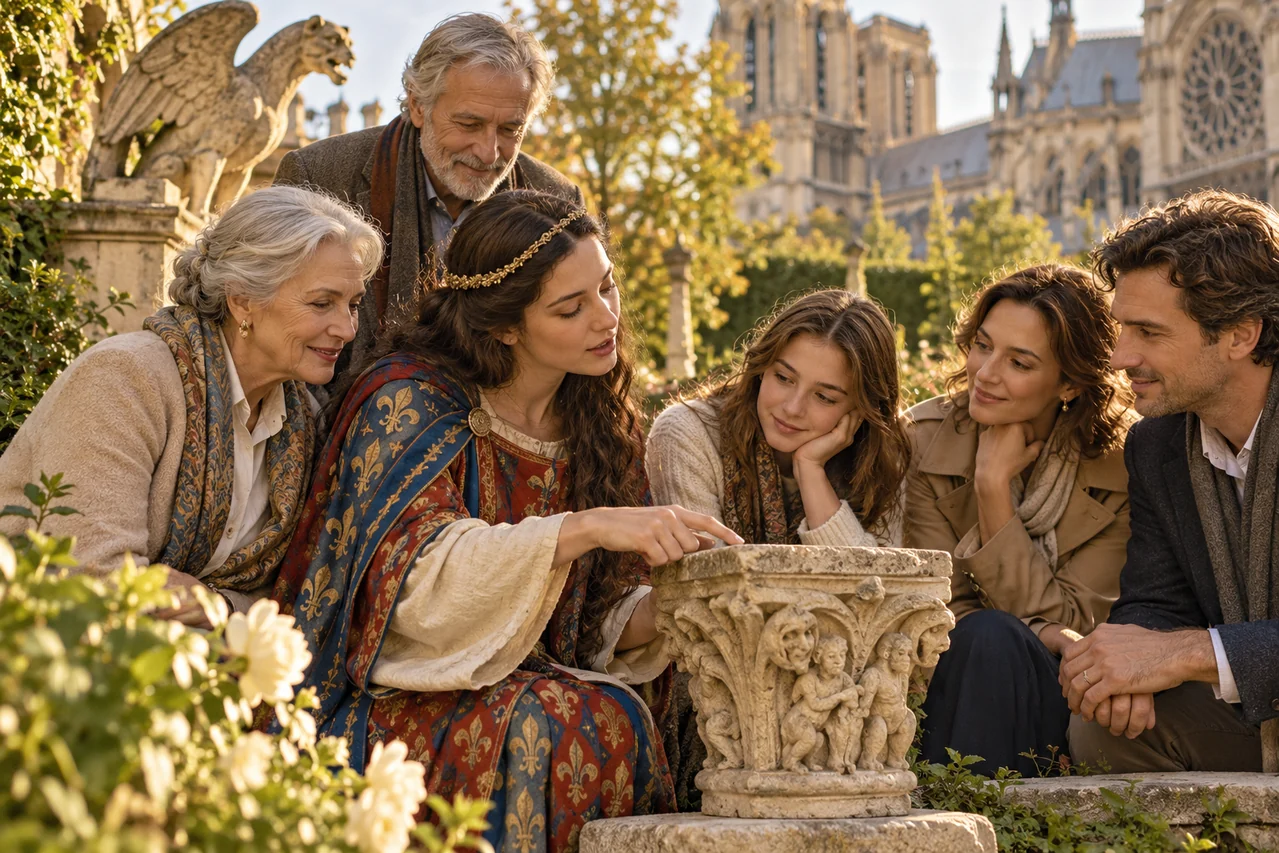
Eiffel, Marie-Antoinette and Esmeralda offer different routes into Paris. A younger visitor may respond first to the character and setting, while an adult is drawn to engineering, reputation or literature. Esmeralda must be identified as fictional, connecting the experience with Hugo's novel rather than a claimed medieval biography. Exploring Notre-Dame with children and teenagers can therefore include literary imagination and historical questions together. The character supplies a shared focus without making the content identical for every family member. The setting offers another point of access when words alone are not enough. A visible feature of a monument can hold a younger guest's attention while the conversation develops a wider historical question. A fictional character, meanwhile, needs a clear literary frame so that imagination is not mistaken for a documented biography. These distinctions can be stated in plain language and need not interrupt the pleasure of the experience. The advisor should think about which aspects family members can notice together. A common observation gives the group something to return to even when their interests lead them toward different interpretations or levels of detail later in the discussion.
Avoid making the adults spectators at a children's activity
A family experience should not assume that all cultural material must be simplified to the youngest participant's level. Clear language can communicate serious ideas, and supplementary detail can emerge through questions. Equally, adults should not be given so much specialist information that younger travelers lose the story. The balance comes from a strong central thread with room for deeper conversation. This makes the experience genuinely intergenerational: each person has something to discover, rather than one age group merely accompanying another. A strong central story can carry supplementary explanations without losing its direction. A question from an adult may briefly deepen the account, then the narrative can return to the shared subject through a place or decision everyone recognizes. The guide or performer does not need to supply the same vocabulary to every age at every moment. What matters is that nobody loses the basic relationship between person, setting and problem. This is also why clear language should not be confused with a childish tone. Teenagers and newcomers can follow substantial ideas when those ideas are introduced coherently, while experienced adults still find evidence and nuance worth discussing.
Use interaction without demanding performance from everyone
An encounter with a character can make questions feel immediate, but family members differ in their willingness to speak. Allow a shy child or a reserved adult to observe while others participate. A shared response, a question offered by a parent or a moment of looking at the setting can also count as engagement. The advisor should communicate relevant expectations beforehand. Interaction is most useful when it gives travelers control over a curiosity, not when it obliges every person to become publicly expressive. An advisor can prepare the interaction by explaining its character without prescribing how the family must behave. Guests may ask directly, respond through another family member or simply notice what is happening around them. No individual should be singled out as a problem because they prefer not to speak. This matters across cultures and personalities, not only for children. An observant grandparent or reserved teenager may take a great deal from the encounter. The program can also leave a quieter interval afterward, when a question that did not feel comfortable in the group becomes easier to raise privately. Participation is valuable when it helps the person pursue curiosity, rather than when it makes them perform enthusiasm publicly.
Alternate attention, movement and rest
A family day needs changes of rhythm. A museum visit, a walk, lunch and an interactive experience can offer varied forms of attention, provided the schedule remains realistic. Gardens or a neighborhood pause may help younger visitors move after concentrated listening, while grandparents may value comfortable breaks. Building a cultural day in Paris means considering these transitions alongside the subjects. A well-chosen activity becomes less effective if the family reaches it tired, hungry or anxious about the next transfer. Look at the whole day from the least comfortable participant's perspective. Does a transfer require more walking than the grandparents expect? Does a long interior sequence come before lunch? Will a child reach the encounter hungry after several concentrated activities? These are practical questions that determine whether excellent cultural material can be received well. They do not require reducing the whole itinerary to the lowest level of interest. A focused museum selection, a comfortable meal and space to move can support more depth later. Planning realistic transitions therefore serves the intellectual quality of the day, as well as the family's comfort and enjoyment of being together in Paris.
Leave the family with something to discuss
A successful cultural experience can continue over a meal or on the journey back. Ask what each person found surprising, or how they would have responded to a decision described during the encounter. Different answers are part of the value. The aim is not to test whether everyone retained the same dates. A family that compares perspectives has begun to make the material its own. The advisor can support this by choosing a subject that connects with several family interests rather than a narrow fascination shared by only one member. Conversation after the experience can reveal what each person actually found meaningful. The advisor can encourage this without supplying a scripted debrief or requiring everybody to produce a lesson. A simple invitation to compare what changed in their view of the character may be enough. Different memories should be welcomed: one person recalls the setting, another an unexpected decision, another a historical qualification. Their exchange can make the experience more durable because it becomes linked with the family itself. Avoid promising this as a guaranteed outcome, however. Leave the possibility open through pacing and subject choice, and allow the family to decide how much they want to continue the conversation.
Make the final choice fit the whole group
Consider language, walking preferences, existing knowledge and the balance between active conversation and observation. Matching a Paris experience to the guest's profile is particularly important when several profiles travel together. An Elyrea Encounter can serve as a common anchor, with nearby cultural stops adapted to the family's pace. The recommendation should explain why this character and setting suit these travelers. When the choice is grounded in the actual family, culture becomes a shared memory rather than an obligation built into the itinerary. When presenting the recommendation, connect the practical and cultural reasons. Explain why the subject accommodates the family's interests, why the location fits the surrounding day and what kind of participation it offers. Confirm the actual route and group arrangements instead of treating a private format as permission to redesign every element. Nearby activities can then provide additional depth for some guests and lighter discovery for others, while the Encounter remains a shared anchor. The family should recognize the recommendation as built around them, without being reduced to categories such as young children or senior travelers. That clarity also makes it easier to choose an alternative if the conversation reveals a different common interest before the program is finalized.
FOR YOUR GUEST ITINERARIES
Planning Paris for guest families with different ages and interests? Our team can help you choose an Elyrea Encounter that gives each generation a meaningful way into the story.
Discuss your itinerary