
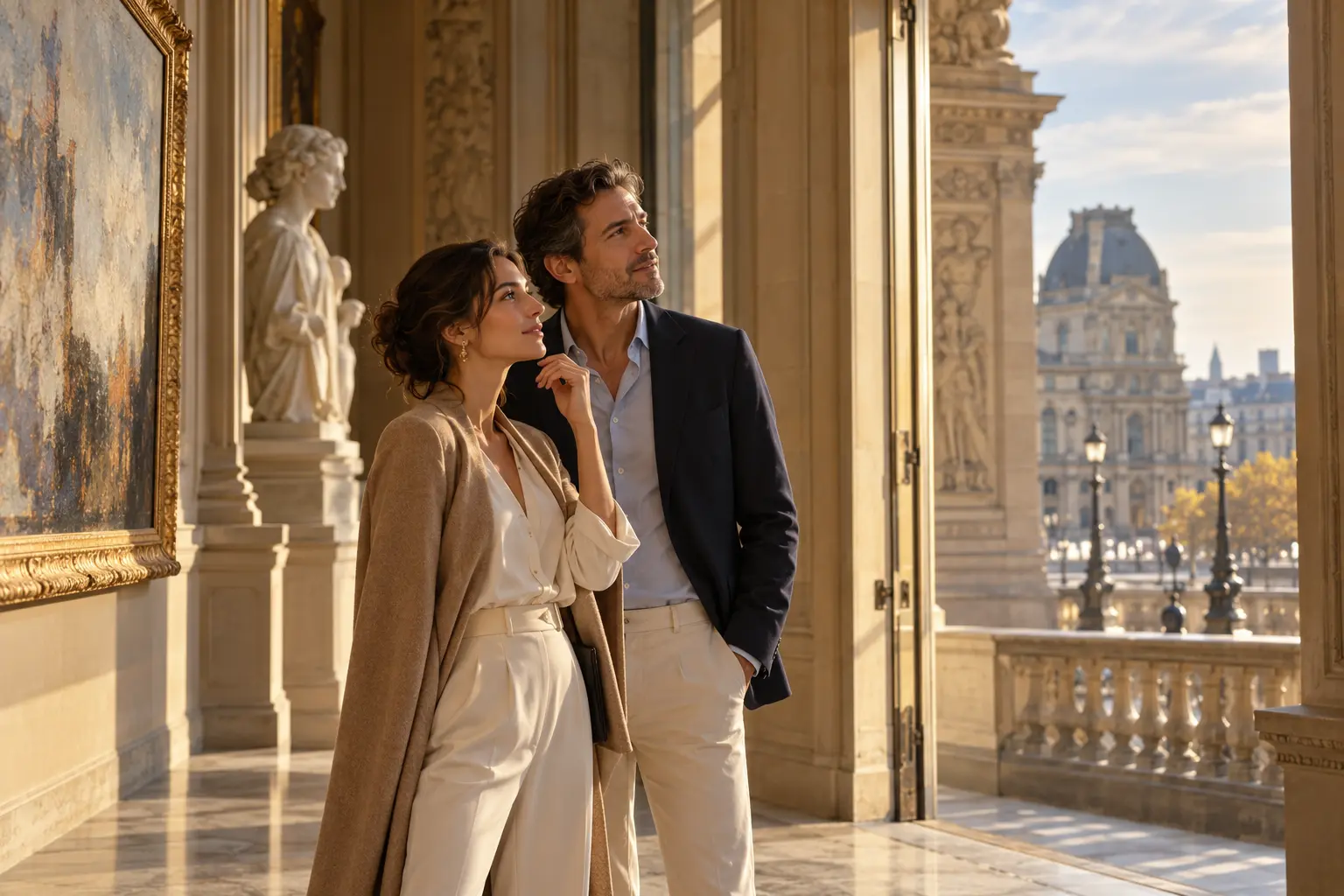
Keep the couple in one story
The obvious answer to different interests is often two parallel bookings: a museum for one traveler and a historical walk for the other. That may solve a scheduling problem, but it misses one of the pleasures of traveling together. Couples remember the question one person asked, the detail the other noticed and the story they continued over dinner. Paris is exceptionally suited to that exchange because works of art remain connected to streets, political regimes, technologies and communities. The goal is not a rigid alternation in which each partner politely endures half the day. It is to select a theme in which visual form and historical circumstance genuinely depend on each other. A painting can reveal a city under pressure; a building can explain what artists were trying to escape or celebrate. For an advisor, the shared narrative protects both individual passions while producing the kind of joint memory a private journey should create.
Define what art and history mean to these particular guests
Broad labels conceal important differences. “Art” might mean Impressionism, fashion, photography, architecture, decorative arts or simply the freedom to spend time with a handful of objects. “History” could mean monarchy, revolution, military events, social life or the making of modern Paris. A useful discovery call goes beyond categories. Ask each traveler what they hope to understand, which place has moved them before and how they like to spend time in a museum. Someone who dislikes galleries may respond to a studio, a façade or an object restored to its original use. A history enthusiast may become absorbed by a portrait once it is treated as a political image rather than decoration. These answers give the advisor a common promise: not “something for everyone,” but a specific way to see how culture and power shaped one another in the city.
Choose places where the building is part of the collection
Several Paris institutions make the bridge almost automatically because their architecture carries a story of its own. The Musée d’Orsay occupies a railway station built for the 1900 Universal Exhibition. Its great hall and its collections make it possible to connect industry, travel, urban modernity and artistic change between 1848 and 1914. The Musée de l’Orangerie can link painting, collecting and the history of the Tuileries landscape. A museum inside a former private residence adds evidence about domestic hierarchy, decoration and social performance before a guide discusses a single displayed object. Places like these prevent the day from splitting into an aesthetic lecture and a historical lecture. They offer several ways into one subject. Current galleries, exhibitions, group policies and opening hours change, so the advisor should always confirm practical arrangements directly rather than treating an editorial recommendation as an access guarantee.
Let one artwork open a door back into the city
An object becomes common ground when it changes what the couple notices outside the museum. A painting can lead to the boulevard, café, railway or studio that structured an artist’s world. A poster can reveal the growth of entertainment and consumer culture. Clothing can expose new freedoms of movement and older systems of status. Instead of receiving two competing commentaries, both travelers investigate one question: what does this image tell us about Paris at that moment? The nineteenth century is especially fertile because urban planning, illustrated media, leisure and reproduction techniques changed at the same time. Historical care remains essential. A painting is not a neutral photograph, and the artist selects, crops and transforms. Yet that distance between evidence and invention is where the two interests meet. The history lover tests the image; the art lover sees how form carries an argument.
Build echoes rather than a checklist
Coherence comes from relationships between stops, not from their quantity. A morning might begin in a neighborhood marked by urban change, move to a few carefully selected works and then allow lunch or independent time to extend the conversation. Another sequence might start with a historical figure, establish the institutions and choices surrounding that life, and then examine how painters, photographers or designers shaped the public image. Two or three strong echoes are more valuable than a parade of famous names. Our route from Montmartre to Giverny through Impressionism shows how geography can sustain such a narrative. Transfers and rest should be designed with equal care. Both close looking and historical listening require attention, and even excellent content loses force when the day becomes an endurance test.
Give each traveler an active way to contribute
A shared cultural experience should not address two audiences in turn. It should invite the travelers to bring their different forms of attention into the same inquiry. One may notice composition, material or color; the other may connect that detail to an institution, a conflict or a social shift. A skilled mediator circulates those observations instead of delivering parallel monologues. This works for knowledgeable couples with different vocabularies, but also for multigenerational families and friends whose interests do not initially overlap. Nobody becomes the patient companion. Guests with mobility or concentration needs may benefit from the planning principles in our guide to accessible cultural depth. Accessibility here includes pace, seating and varied modes of attention as well as physical movement. The common thread should remain clear even when each traveler enters it through a different door.
Protect unstructured time
Good interpretation does not fill every minute. After a concentrated visit, twenty or thirty unscripted minutes allow guests to return to an object, sit with a question or talk without an audience. That pause is not an empty line in the itinerary. It is where information becomes personal experience. Advisors should also resist placing another heavily guided appointment immediately afterward. A meal in a relevant neighborhood, a short walk or a scenic transfer can provide the necessary release. A premium cultural day in Paris depends on purposeful transitions, not a high booking count. Luxury is often the freedom to linger, the confidence to omit and the sense that the day has a readable direction. That is especially important when two guests are processing the same material through different interests.
Sell a shared conversation, not a pair of concessions
In the client proposal, describe the common value: guests will see how Paris shaped artists and how images, in turn, shaped the city’s memory. That promise is stronger than presenting the day as a negotiated balance. The advisor’s brief should include preferred periods, prior knowledge, works already seen, walking constraints and the amount of dialogue the guests enjoy. Tickets, room closures, speaking permissions and group arrangements belong to a separate operational check with each institution. An Elyrea Encounter can add the voice of a character and connect physical evidence to a human trajectory, without replacing a museum visit or implying that museum services are included. Success means that both travelers recognize their own passion in the itinerary and discover, through their partner’s attention, a dimension they would not have chosen alone.
FOR YOUR GUEST ITINERARIES
Designing Paris for clients with different cultural passions? Elyrea can help turn those differences into a coherent, memorable private journey.
Discuss your itinerary