
A hotel within a compact personal geography
The Ritz stands on Place Vendôme, close to Chanel's work on Rue Cambon. That proximity helps explain its significance in her Paris: professional activity and personal life could unfold within a small area. The hotel was also part of an international social environment associated with luxury. Its relationship with Chanel is therefore not simply that a famous person preferred an impressive address. It places her in a network of places and people that contributed to the visibility of her identity.
Living in a hotel changes the relationship with it
For most travelers, a palace hotel represents a temporary departure from ordinary life. For someone associated with it over a long period, the same setting can become an everyday environment. Service, mobility and international sociability take on different meanings when they are habitual. That contrast raises a biographical question: how did Gabrielle move from modest beginnings into a world so removed from childhood? The place helps materialize the question without requiring invented details about every private routine or preference.
A social stage as well as accommodation
Hotels create spaces where reputations circulate and people observe one another. In Chanel's story, that social dimension belongs alongside the work of fashion. A house acquires clients and recognition through networks as well as through clothes. The Ritz can be discussed as part of that environment without making every celebrated name a personal friend or every meeting a decisive career moment. Historical context is more useful than a chain of glamorous anecdotes whose documentation is uncertain.
Rue Cambon tells another part of the story
The short geographical distance between the hotel and Rue Cambon's couture history lets visitors distinguish different functions within one biography. The workplace evokes creation, collective skill and commercial development; the hotel suggests personal life and social environment. They are related without being interchangeable. The distinction also protects practical clarity: discussing historical interiors does not mean an Encounter includes access to them. The urban relationship can be meaningful on its own, observed through the streets and public setting.
The Occupation cannot be left outside
Chanel remained at the Ritz during the Occupation, when German personnel also used the hotel. Her relationship with Hans Günther von Dincklage, a German officer connected with intelligence, forms part of the serious historical questions around that period. Omitting it would create a misleadingly smooth picture of the address and its association with her. The subject deserves a measured account rather than scandal as entertainment. A hotel can carry troubling history alongside an enduring reputation for luxury.
Context is not exoneration
Understanding occupied Paris helps explain the environment in which people made decisions; it does not automatically excuse those decisions. The controversies in Chanel's wartime biography include personal and commercial dimensions requiring careful distinctions between documents, interpretation and popular narrative. Her creative influence and the difficult aspects of her life can both be recognized. Neither a promotional portrait nor a verdict delivered through theatrical dialogue is a substitute for historical examination. The encounter should preserve space for informed questions.
Let the place retain several histories
The Ritz and its surroundings span different periods of Paris, from international social prestige to war and later cultural memory. Associating the address with one creator should not make those layers disappear. A visitor can look at the building as part of a changing city, not simply as an accessory in a celebrity biography. This gives the neighborhood greater substance for repeat visitors who already know its outward appearance and want to understand how places accumulate meanings.
Take a wider view at the conclusion
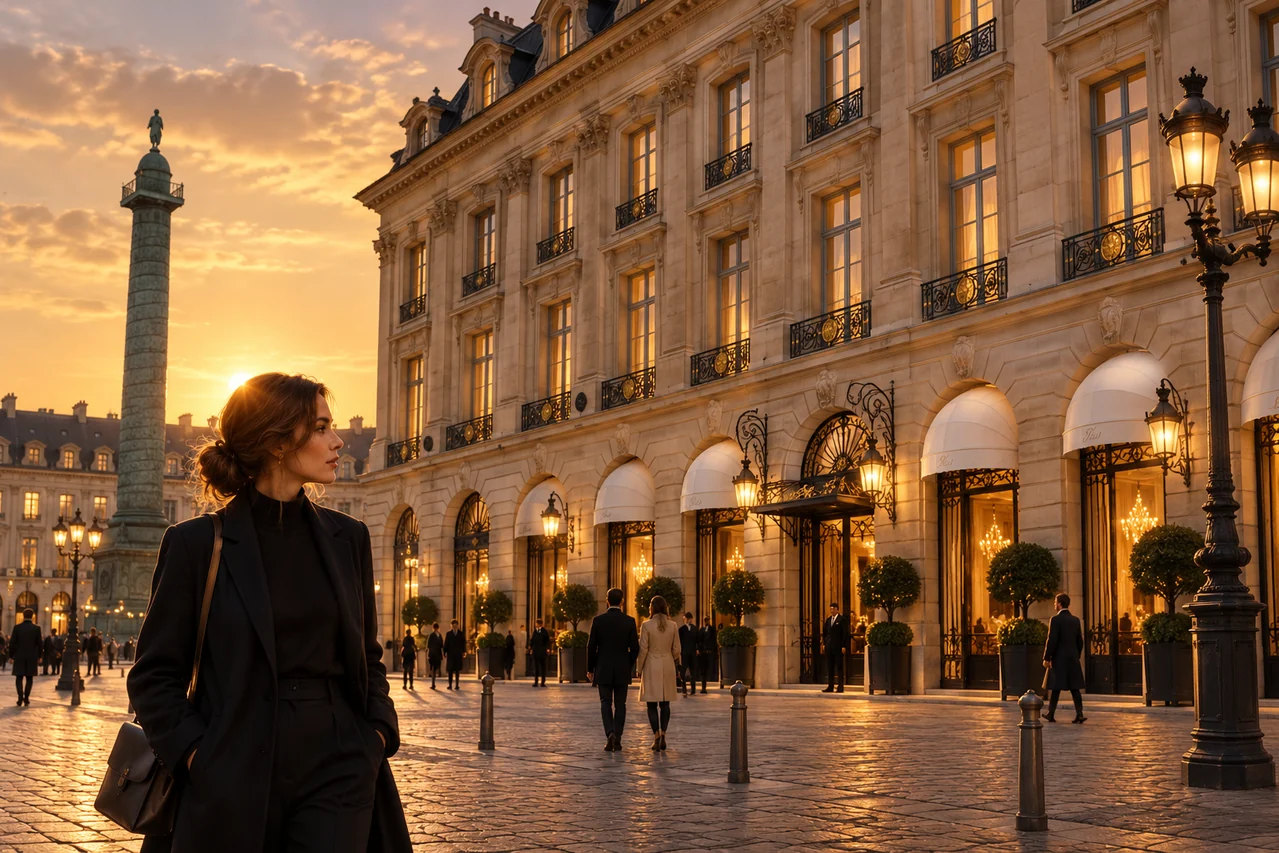
The Chanel Mystery in Paris ends at Place Vendôme, in front of the Vendôme Column. From that public setting, the hotel becomes one element in a broader view that also includes jewelry, architecture and an older monumental history. Reading Place Vendôme through Chanel extends the geography while preserving that chronological depth. Advisors can use the chapter in a fashion day or a wider exploration of French luxury, provided the narrative remains more substantial than a tour of famous entrances.
FOR YOUR GUEST ITINERARIES
For guests interested in the cultural history behind Paris luxury, ask Elyrea how the Chanel Encounter can connect the Ritz, Rue Cambon and Place Vendôme within a thoughtful itinerary.
Discuss your itinerary