
Her contemporaries did not share one interpretation
In 1431 Joan was not universally recognized as the national heroine familiar to later generations. Her supporters and adversaries understood her mission differently, and her condemnation itself formed part of that conflict. Starting with this disagreement prevents later fame from being projected backwards as if the outcome had always been obvious. The traveler must distinguish the person, what contemporaries said about her and what subsequent societies chose to remember. Those layers are related, but they cannot be substituted for one another without losing the history of the symbol.
The legal reassessment created a different foundation
The annulment of the condemnation in 1456 made it possible to tell the institutional story differently. Joan could be remembered as someone subjected to a judgment whose validity had been formally overturned. This change was important without being the instant creation of every later heroic image. How her conviction was overturned supplies the legal chapter. Her subsequent prominence developed unevenly through different periods, each selecting aspects of her life for its own religious, cultural or political concerns rather than following one uninterrupted rise toward modern celebrity.
The nineteenth century intensified national readings
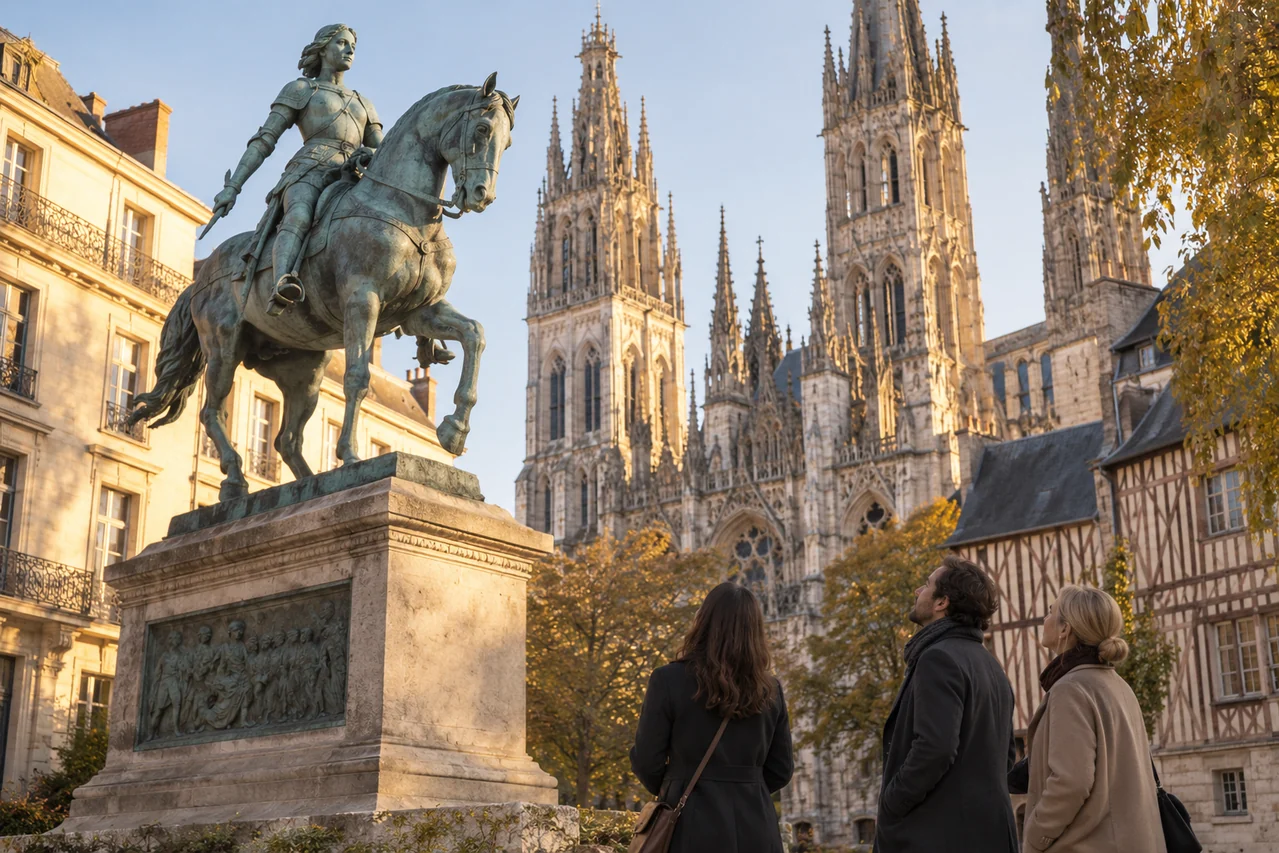
Renewed attention to medieval history, national identity and France's political transformations gave Joan particular visibility in the nineteenth century. Writers, historians and artists could find in her a figure through whom to discuss the country's past and character. That activity belongs to the history of the period interpreting her as much as to the fifteenth century represented. For travelers, it explains why a familiar public monument might tell two stories at once: the life it depicts and the later society that commissioned or celebrated the depiction.
Different traditions could claim different aspects
Joan's faith could matter to religious audiences, her modest origins to other social narratives and her role against an opposing power to patriotic accounts. Such possibilities allowed groups with differing aims to draw upon the same figure. The result was not a stable ownership of her meaning by one political tradition. A cultural itinerary can explain these variations without choosing a current partisan use as the destination's official interpretation. Her importance lies partly in the capacity of the story to sustain disagreement about what France should remember and value.
Canonization added a distinct religious recognition
The Catholic Church canonized Joan in 1920, nearly five centuries after her execution. This was a major religious event, but it should remain separate from the annulment in 1456 and from the earlier development of national imagery. The chronology helps travelers avoid thinking that her formal status as a saint belonged to her own lifetime. It also shows how different institutions can confer different kinds of recognition. Religious devotion, civic commemoration and artistic admiration may reinforce one another while retaining their own meanings and historical conditions.
Two images concentrate a complicated life
Joan in armor and Joan facing execution provide especially powerful visual forms. One emphasizes action, the other suffering; together they give the story a dramatic tension that later representation repeatedly explores. Statues, paintings, theatre and film select among those possibilities and make choices about voice, expression and emphasis. They can bring audiences emotionally close while also fixing interpretations that may later be mistaken for simple facts. Recognizing their creative role allows guests to appreciate them as cultural works without treating them as unrestricted documentary access to the person.
International appeal still needs French historical context
A young person claiming an extraordinary mission, reaching powerful figures and facing condemnation offers a story recognizable across cultures. That broad appeal does not eliminate the need to explain the Hundred Years' War, Charles VII, Orléans, Reims and Rouen. Without them, Joan becomes a generic inspirational character. Joan as heroine and political symbol is most revealing when universal themes remain anchored in particular circumstances. International mediation should make those circumstances understandable rather than modernize them so far that the original religious and political stakes disappear.
Rouen can bring the symbol back toward the person
The traveler arrives with centuries of images; the accused person in 1431 knew none of that later reception. An Elyrea Encounter can use the distance between those perspectives to reopen the trial as a human situation. Its dramatic form remains interpretation, and the city's memorial places show how remembrance developed after the events. A thoughtfully paced visit helps guests distinguish life, judgment and commemoration. The national heroine becomes more intelligible because they have considered both the young woman facing institutions and the generations that transformed her into an enduring image.
FOR YOUR GUEST ITINERARIES
Designing a French itinerary around influential historical figures? Contact Elyrea to explore a Joan of Arc Encounter that reveals the person and the changing cultural memory behind the icon.
Discuss your itinerary