
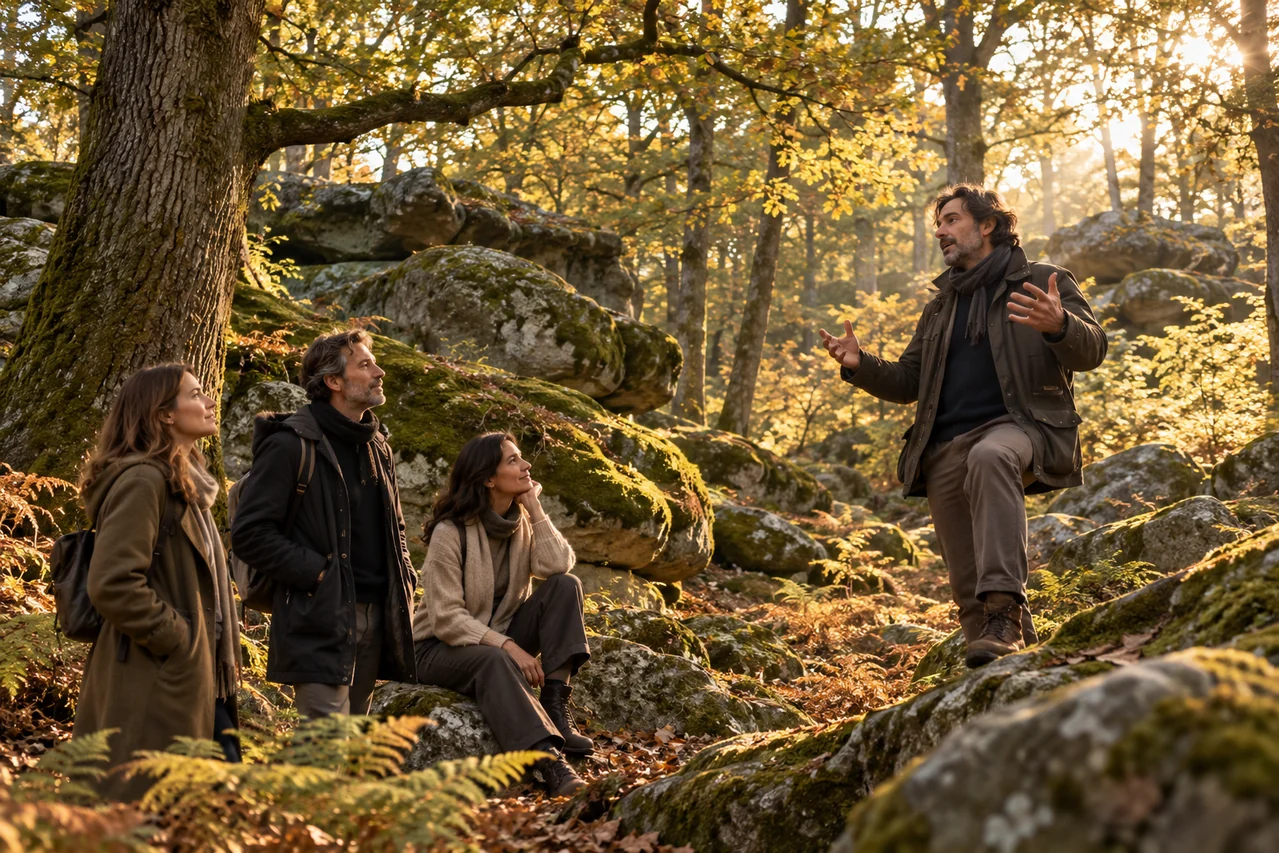
Begin with the forest, not a ghost story
The most rewarding introduction starts with the landscape itself. Fontainebleau has been inhabited, managed, worked and explored through many periods; it was never simply an empty backdrop for royal leisure. Its association with the nearby palace explains why hunting and sovereignty occupy such a prominent place in its stories. Travelers who begin by noticing paths, trees and sandstone formations have something concrete against which to understand the legend. The forest supplies the questions before the character supplies a point of view.
Why hunting mattered to the royal court
Royal hunting combined physical activity with social hierarchy and the occupation of territory. Horses, hounds and the hunting horn belonged to a practice with specialized language and defined roles. A veneur is a huntsman; the title Grand Veneur therefore sounds at home in a forest closely connected with royal hunting. This relationship gives the legend its cultural credibility. It does not prove that a supernatural huntsman appeared, but it explains why this particular figure could become attached to Fontainebleau.
Meet the Grand Veneur as a legendary figure
Stories of the Grand Veneur vary across versions and periods. A mysterious presence, an uncanny hunt and sometimes a warning addressed to a ruler form part of the tradition. There is no need to impose one definitive biography on this shifting material. A legend survives partly because successive tellers adapt it to their concerns. Asking who the Grand Veneur is in Fontainebleau's folklore leads to a more revealing discussion than treating each detail as a documented eyewitness statement.
Notice how the landscape supports the story
Sandstone outcrops interrupt the woodland with shapes, passages and changing viewpoints. Light filters through branches, while sounds may be heard before their source becomes visible. These ordinary features explain how a forest can encourage extraordinary interpretations. A visitor can enjoy that uncertainty without being asked to accept a ghost as historical fact. The distinction matters especially during an embodied narrative, when the emotional persuasiveness of the setting can make an invented scene feel like a recovered memory.
Remember everyone who used the forest
Kings were not the only people whose lives involved Fontainebleau. Forestry workers, quarry workers and local communities knew it through labor and resources, rather than ceremonial hunting. Their presence complicates the romantic picture of untouched wilderness. A single path can belong to several stories: aristocratic recreation, economic activity and the later pleasure of a walk. Bringing these perspectives together gives the excursion social depth and prevents a royal tale from standing in for the entire history of the landscape.
Follow the change from hunting ground to artistic landscape
During the nineteenth century, Fontainebleau and nearby Barbizon became important to landscape painting. Artists looked closely at trees, rocks, light and rural life, helping visitors recognize scenery as something worthy of sustained attention. Their interest also contributed to arguments for its protection. This is a different chapter from the supernatural huntsman, yet it belongs to the same territory. Fontainebleau's royal and artistic histories can therefore enrich the walk without turning every stopping point into an unrelated lecture.
Let different generations ask different questions
Families can approach the forest as an inquiry into observation, evidence and imagination. Younger travelers may notice a rock resembling an animal; adolescents may ask why versions of a legend disagree; adults may explore the relationship between power and nature. These levels of attention can coexist along one route. The aim is not constant entertainment but a shared experience in which each person contributes. Appropriate walking distances and quiet intervals matter as much as the strength of the story.
Give the Encounter a clear place in the day
In Elyrea's Les Mystères de la forêt de Fontainebleau, the Grand Veneur gives a legendary presence to this real landscape. The Encounter can complement palace history or provide a different perspective for travelers who already know the château. It works best when the day has room for both the narrative and independent observation. A walk, a considered lunch and an artistic or royal chapter can form a coherent excursion; adding every possible attraction would weaken the connections that make Fontainebleau distinctive.
FOR YOUR GUEST ITINERARIES
Designing a Fontainebleau excursion for your guests? Contact Elyrea to explore how the Grand Veneur Encounter can connect forest, royal history and folklore within their itinerary.
Discuss your itinerary