
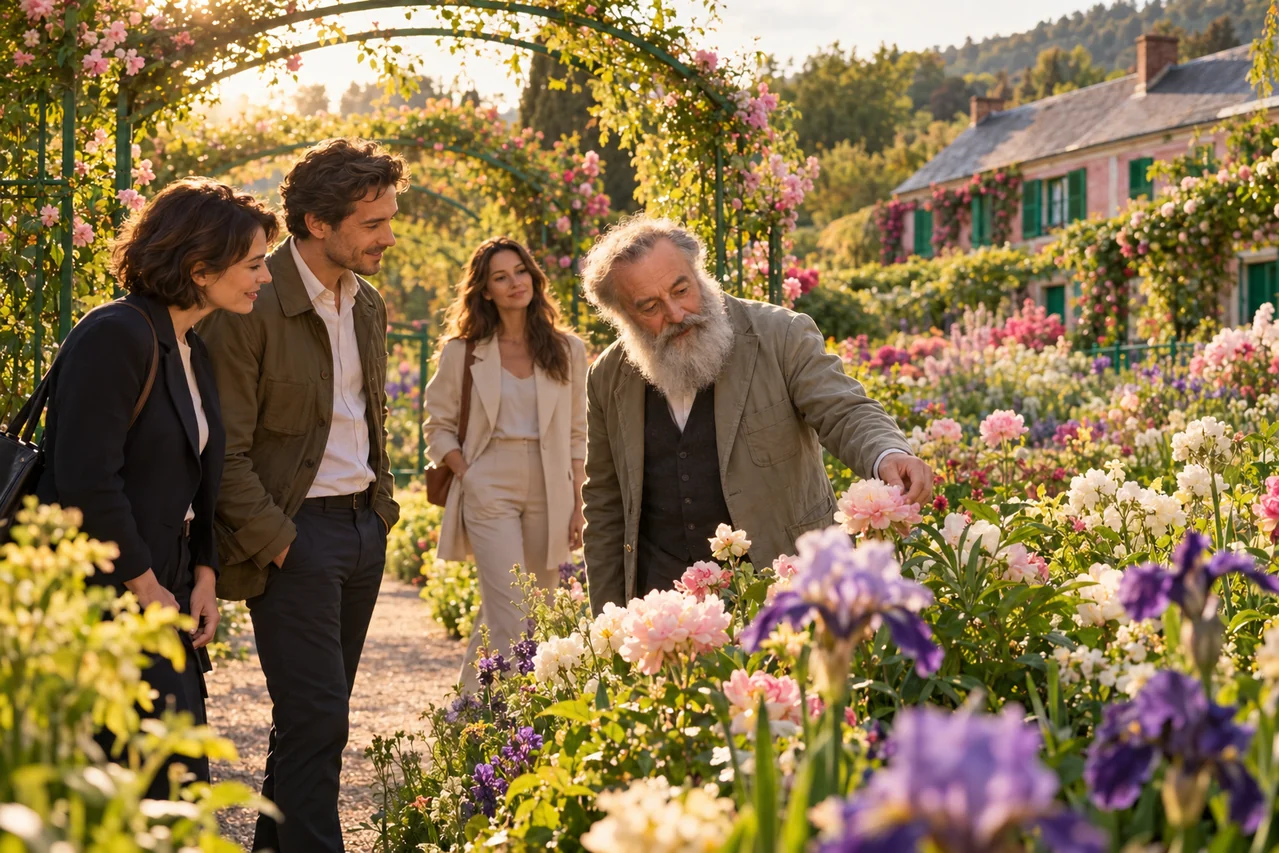
Two gardens offer different visual experiences
The Clos Normand near the house and the water garden do not work in the same way. One brings planting and color into a structured domestic setting; the other introduces water, reflected light and a different relationship between vegetation and space. Recognizing that contrast helps visitors avoid treating the whole domain as one continuous photo backdrop. Each environment supports different kinds of observation and different questions about how a living place can become an artistic subject.
Color can be arranged before it is painted
Planting allows relationships between colors to be developed in the landscape itself. The painter could consider masses, sequences and contrasts while also responding to what living plants actually did. This does not mean that the garden was a rigid canvas with flowers substituted for pigment. Its interest lies in the exchange: an arrangement produces a view, observation suggests a change, and a painting can then transform the result again through composition and color decisions of its own.
The season is part of the composition
Flowers do not remain in a fixed state, and a garden cannot preserve a single image throughout the year. Growth, weather and successive flowering make time visible in the setting. Advisors should introduce that change as part of the cultural subject rather than imply that every guest will encounter the same recognizable view. The living landscape helps explain Monet's attention to variation. What seems to be a repeated motif becomes different when its conditions are examined closely.
Water opens the landscape toward reflection
The pond adds a surface on which physical plants and reflected surroundings can overlap. The eye can move between water, flowers and an image of the sky without a conventional horizon organizing the view. That visual complexity made the garden particularly rich for painting. Monet's repeated Water Lilies investigations develops the subject through framing and perception. At Giverny, the visitor can begin with the physical experience of seeing those layers occupy the same space.
The Japanese bridge belongs to a wider interest
The bridge should be read alongside Monet's collection of Japanese prints and the broader fascination with Japanese art in his environment. It is one element of a cultural and visual relationship, not a complete explanation of the garden. A thoughtful visit can consider framing and perspective without claiming that a single culture supplied a ready-made design for all of Monet's work. The prints and the planted landscape offer different evidence of how artistic attention moves among images and physical places.
Labor made the artistic environment possible
Gardening requires continuing maintenance, and the domain did not sustain itself through Monet's inspiration alone. The people who worked on it belong within the account. Including that labor makes the garden more tangible and counters the impression that an artist simply dreamed an environment into existence. The practical care of plants and water was part of the conditions of the paintings. A garden can be an artistic project while remaining a workplace involving skills beyond the painter's own activity.
Control always met the limits of a living place
Monet could organize and develop the garden, but he could not stop weather, growth or changing light. That limit is culturally important. The setting provided a way to encounter variation rather than eliminate it. Visitors interested in gardening may recognize this immediately, while photographers can consider how the same perspective changes without the observer moving. The garden's value as a subject lies partly in the impossibility of making it permanently identical to itself.
Look beyond the emblematic photograph
An advisor can give guests time to observe lines of sight, color relationships and reflections before pursuing the familiar bridge image. Giverny for returning visitors offers a deeper framework for people who already know the gardens. Inside Claude Monet’s Giverny can connect those observations with an embodied artistic voice. The experience becomes a conversation about creating and seeing a landscape, allowing the physical garden and the paintings to retain their differences while illuminating one another.
FOR YOUR GUEST ITINERARIES
For guests who love gardens, art or both, Elyrea can help shape a Giverny day in which the landscape's design and Monet's visual questions receive equal attention.
Discuss your itinerary