
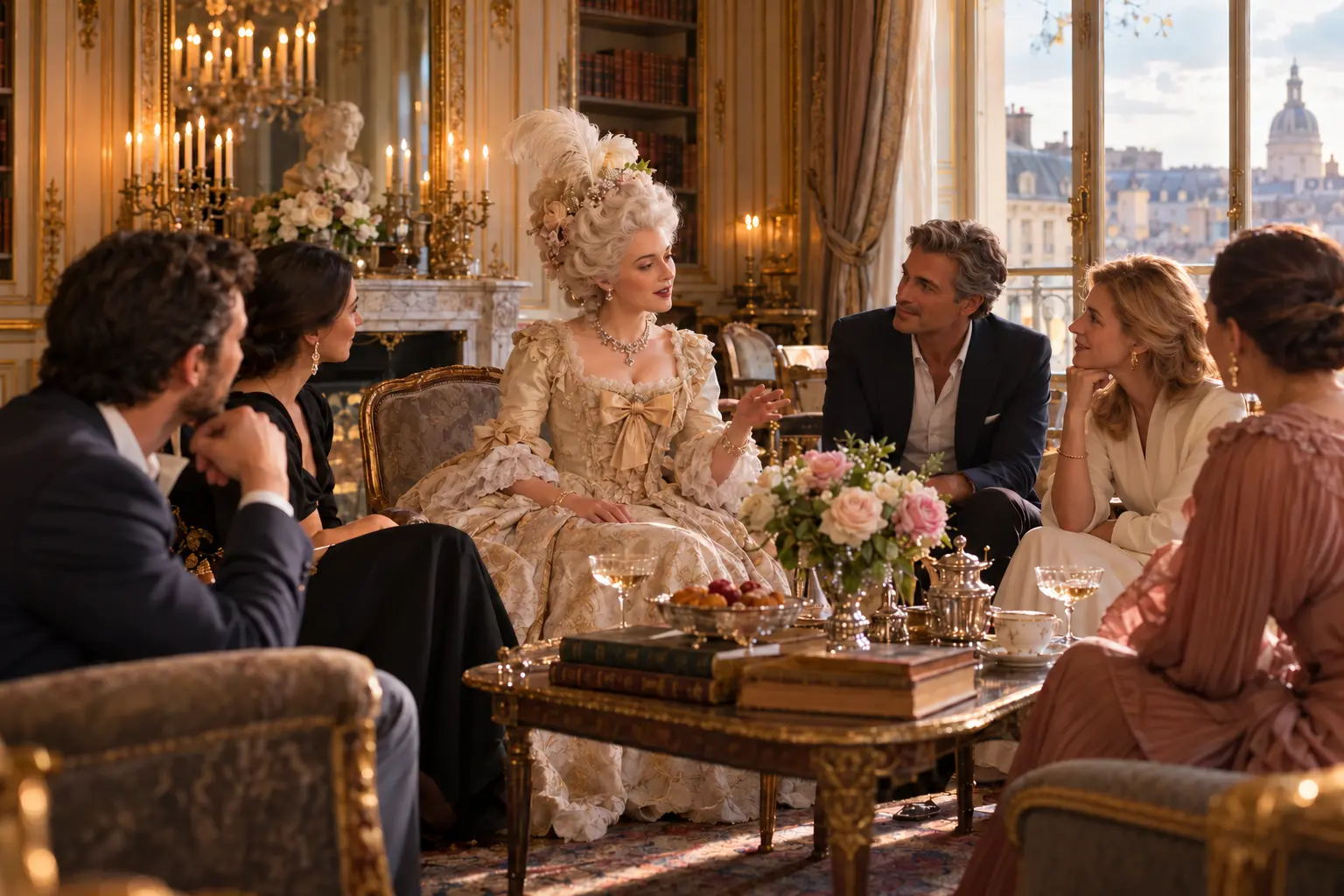
A literary salon, not a replica of Versailles
Drouant is not an eighteenth-century palace and should never be described as one. The restaurant on Place Gaillon belongs to another Paris story, shaped by writers, juries and discussion around a table. The Académie Goncourt has met there since 1914, long after Marie Antoinette’s death, in a room associated with French literary life. That historical distance is an advantage. It avoids false reconstruction and lets several forms of Paris memory meet honestly. A professional actress embodying the Queen receives contemporary guests in a setting that retains its own identity, rather than asking the room to pretend that the group has been transported physically to Versailles. The setting therefore places two centuries in dialogue without collapsing them together. Historical honesty gives guests freedom to compare forms of sociability instead of accepting an invented continuity.
Why conversation matters for this Queen
Few historical figures are covered by as many images, disputed quotations and retrospective verdicts as Marie Antoinette. Conversation slows that machinery down. It can explore her arrival in France, the demands placed on a foreign dauphine, the representational labor of court and the process by which a queen became a fiercely contested public figure. The format does not need to acquit her, nor should it use one life to explain the French Revolution. Instead, guests can test the distance between woman, sovereign, pamphlet and legend. That exchange is difficult to reproduce through a rapid sequence of labels and dates in an itinerary already full of celebrated rooms. Guest questions become a genuine part of the experience. They move the discussion from a fixed portrait toward the pressures, choices and contradictions of a monarchy approaching collapse.
The Goncourt room and the practice of deliberation
The Académie Goncourt was formally established at the beginning of the twentieth century and, according to its own history, first met at Drouant on October 31, 1914. The upstairs room therefore carries a tradition of deliberation: readers compare judgments, defend interpretations and listen to one another. This creates no direct historical connection with Marie Antoinette. It does, however, provide a fitting acoustic and social scale for an Encounter based on narrative and response. Books, service and the dimensions of the salon create an intimacy unlike that of a monumental gallery. Guests discover that a cultural place can matter not only because of objects displayed there, but because of the conversations repeatedly held within it. The room’s literary history should remain proportionate; the Goncourt Prize does not become the main subject. It explains why the space supports exchange and why French cultural life often connects literature, table and debate.
Distinguishing the historical Queen from her afterlife
“Let them eat cake” should not be presented as a securely documented statement by Marie Antoinette. Her clothes and spending cannot explain the crisis of the monarchy or the French Revolution on their own. Responsible interpretation restores royal finance, political conflict, court culture and the circulation of hostile print to a much wider frame. The Encounter may use first person and theatrical presence, yet it must keep evidence, interpretation and dramatic voice legible. That distinction protects the credibility of the character. It also allows guests to examine caricature and misogynistic attack without recasting the Queen as either an innocent modern heroine or the sole author of her period’s failures. Nuance also applies to Axel von Fersen: closeness is documented, while the exact nature of the relationship remains debated. Acknowledging that debate is stronger than using romantic certainty to heighten the story.
Hospitality as a way of thinking
Tea, table and service are more than decorative accessories. They recall how access, etiquette and acts of reception structured social relations, even though Drouant belongs to a later age. Sharing a table also creates time: people settle, listen and formulate a response. That slower rhythm can support more nuance than a panoramic walk through famous addresses. Its nature should remain explicit. Afternoon Tea with Marie Antoinette is a theatrical Encounter in a Paris salon, not a reconstruction of a court meal and not an included visit to Versailles. Service can support the conversation without becoming historical proof. Food and drink should be described only according to confirmed current arrangements, never as a certain reproduction of the Queen’s personal habits.
Positioning the Encounter within Paris
The conversation can anchor a day devoted to fashion, women in history or the changing representation of monarchy. It may prepare guests for decorative arts or extend questions raised at Versailles, provided the schedule leaves enough room between major experiences. Nearby Opéra, Rue de la Paix and Place Vendôme offer additional ways to think about public image and French style, but none should be presented as automatically included. A travel advisor should choose one primary thread and let the other references support it. The resulting day becomes a progression — observation, context and exchange — rather than a catalogue of prestigious addresses assembled because they happen to be close together. A transition toward Place Vendôme or a museum still needs realistic travel time. It works only when it continues a question already opened, such as the making of public image or the social role of fashion.
Guests who will value this approach
The subject suits travelers who already know Marie Antoinette’s familiar images and want to examine how they were made. It can engage families with teenagers, fashion-minded guests, readers of history and returning visitors looking for a more intimate counterpoint to major heritage sites. Advisors should explain the theatrical form without revealing scenes or promising unlimited improvisation. Language, party size, interests and previous knowledge help the actress calibrate the conversation. Where history is politically or emotionally charged, attention to evidence matters more than manufacturing easy sympathy with the character. The Encounter also gives professionals an alternative to visits in which guests remain permanent spectators. Speaking with the character creates personal involvement while preserving cultural framing and interpretive responsibility.
A note for travel advisors
Present the Encounter as an embodied cultural conversation, not as an authentic royal audience or a comprehensive historical show. Explain that Drouant contributes its own literary identity and that this difference is part of the design. Confirm venue conditions, food and beverage arrangements, language, party size and any associated service before communicating them to clients. The appropriate call to action is not “Book now,” but an invitation to place the Encounter intelligently within a private journey. Contact Elyrea with the guest profile to align salon, character and itinerary without revealing the dramatic progression. A concise note about the party’s interests is more useful than a long historical summary sent beforehand. It leaves the actress room to shape progression and allows travelers to discover their own questions.
FOR YOUR GUEST ITINERARIES
Planning a private cultural itinerary? Elyrea can help you weave this perspective into your guests’ journey.
Discuss your itinerary