
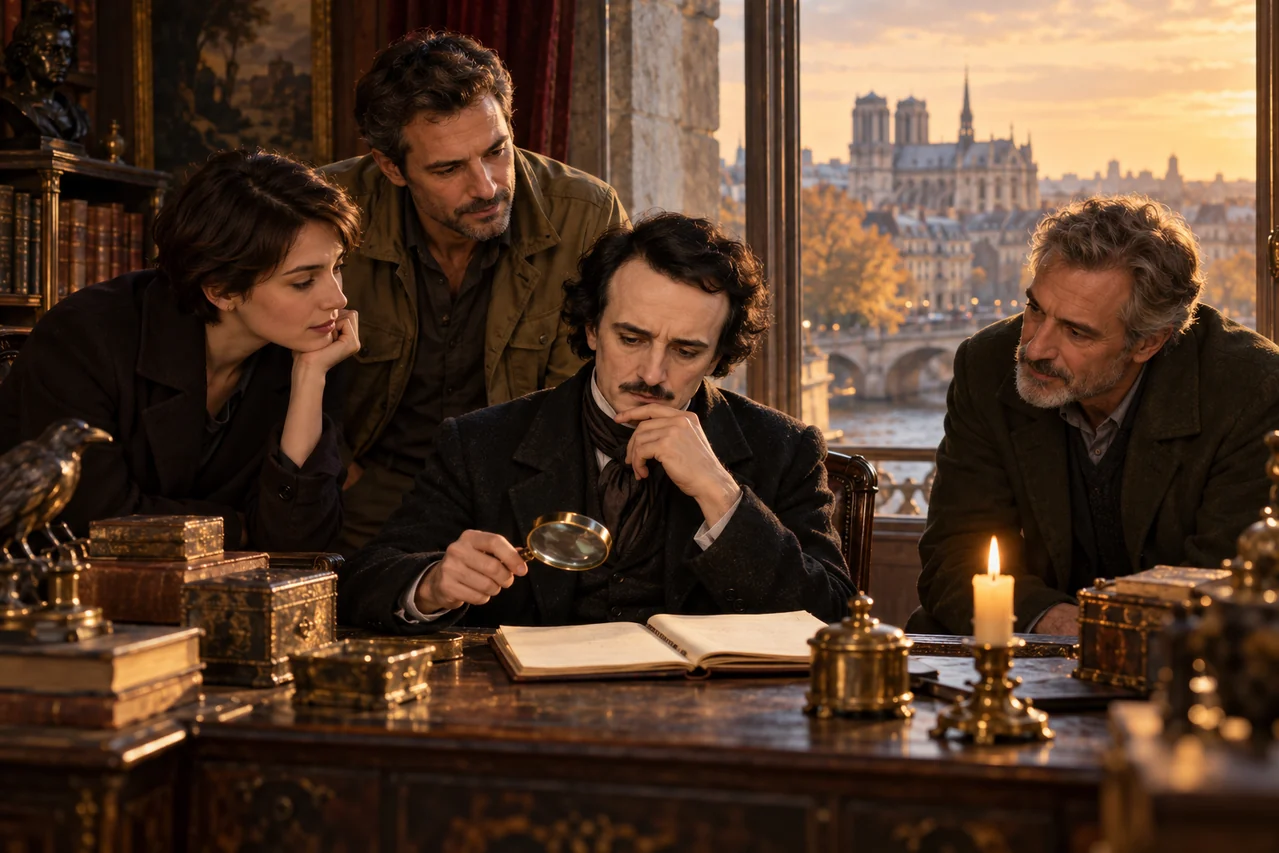
Dupin makes the investigator the central fascination
Crime narratives existed before Poe, but C. Auguste Dupin, introduced in The Murders in the Rue Morgue in 1841, places a particular kind of mind at the center of the story. The reader follows someone who notices what others miss and reconstructs an explanation through reasoning. This changes the focus from a crime alone to the process of understanding it. Calling Poe a founding figure of modern detective fiction recognizes that contribution without suggesting that all earlier storytelling about crimes and investigations began with him.
Paris functions as an imagined urban setting
Dupin belongs to a fictional Paris, where streets, rooms and social relationships become the environment of an investigation. This does not make the stories memoirs of Poe's experience in the city: he did not live there. The setting shows instead how a writer can use another place imaginatively. For a traveler, the interesting connection is between urban observation and literary construction, not a search for a documented Paris residence or the presumed real address of every fictional scene.
An apparently impossible event invites reasoning
In The Murders in the Rue Morgue, an extraordinary crime challenges ordinary explanations. The puzzle asks the reader to reconsider assumptions and attend to details that seem confusing or irrelevant. That approach became influential because it gives a narrative structure to uncertainty. An experience inspired by it can invite guests to think about how a story is interpreted without claiming to stage the actual event or turning a fictional location into a confirmed historical crime scene.
The police and the independent mind play different roles
Dupin's reasoning is contrasted with official approaches that fail to resolve the problem. This literary arrangement helps make the investigator's method visible to the reader. It is not a general historical judgment that police work is always unimaginative or that solitary brilliance is sufficient in real investigations. Keeping fiction and practical reality distinct allows the convention to be appreciated for what it does in a story: it gives a character and the reader a particular route through the puzzle.
The companion narrator guides the reader
A narrator alongside the investigator makes room for explanation and surprise. The reader can share a less complete understanding before the reasoning is revealed. This relationship became a recognizable feature of later detective fiction, including the pairing familiar from Sherlock Holmes. Its value lies in perspective: a brilliant character does not need to explain every thought as it occurs, and the audience can experience the gap between what is observed and what is understood.
The three Dupin stories explore different puzzles
The Murders in the Rue Morgue, The Mystery of Marie Rogêt and The Purloined Letter show that investigation can operate through different kinds of material. A dramatic crime, the interpretation of reports and the problem of something hidden in plain sight place different demands on attention. The variety prevents Poe's contribution from being reduced to a single spectacular twist. Guests can consider how expectations themselves become part of a mystery and how an apparent clue may mislead.
The legacy continues without a simple line of invention
Later detective writers developed conventions in their own ways. Poe's contribution can be recognized without treating Holmes or other fictional investigators as copies of Dupin. The genre changes with different authors, societies and readers. For visitors interested in the movement of literature across cultures, Poe's French reception offers another continuation, showing how the same author can matter through translation and critical influence as well as through the structures of a particular genre.
Turn the city into an exercise in attention
A Poe-led Encounter can use mystery to encourage looking, questioning and distinguishing claims. Paris's legends and their origins provide material for that inquiry: what does a place show, and what does a story ask us to imagine? The approach can engage adolescents and experienced readers alike without becoming a superficial game. Its cultural purpose is to make interpretation visible, giving guests a literary way to understand how uncertainty acquires a narrative shape.
FOR YOUR GUEST ITINERARIES
For guests who love detective fiction and literary puzzles, Elyrea can help integrate a Poe-led Encounter into a Paris itinerary built around their curiosity.
Discuss your itinerary