
The 1961 comeback actually began in 1960
The engagement remembered as “Olympia 1961” opened on December 29, 1960. The Bibliothèque nationale de France preserves a bibliographic record of that evening, while scholarly chronology distinguishes it from the official premiere on January 2, 1961. Piaf was returning after a long health-related absence. The engagement extended into spring, with interruptions, and cannot be reduced to one miraculous night. That correction makes the story more compelling. The drama lies in the sustained return to work before an audience that already knew her legend but could not be certain that she would command the stage again.
The Olympia relationship predated the comeback
Piaf did not arrive on the Boulevard des Capucines as a stranger. BnF catalogs document live Olympia recordings from 1955-56, 1958, 1961 and 1962. A 1958 television archive also captures her warm praise for the venue’s director, Bruno Coquatrix. The hall is therefore better understood as the setting for a long relationship among performer, impresario and Paris audience than as the backdrop to a sudden rescue. Discover Paris through Édith Piaf places that stage within a larger geography, from working-class streets to the major rooms that transformed a local voice into an international cultural reference.
Real vulnerability without melodrama
News footage from December 1960 presents an artist preparing her return after more than a year away because of ill health. That documented fact is enough; every weakness need not become an omen. Piaf rehearsed and rebuilt a program. The audience’s tension came from the contrast between physical fragility and immediate vocal authority. A responsible account avoids two familiar caricatures: the invincible heroine who conquers everything in a night and the victim defined only by suffering. Onstage, she remained a professional who calibrated intensity, silence and direct address with experience accumulated across decades.
A renewed repertoire for a new chapter
The comeback is inseparable from songs brought to Piaf by Charles Dumont, including “Non, je ne regrette rien,” with words by Michel Vaucaire, and “Mon Dieu.” INA archives let modern audiences hear this material in early 1961, though not every surviving excerpt can be tied with certainty to the same Olympia evening. The distinction matters. What is clear is that the songs converged with Piaf’s public image: rejection of regret, absolute love and emotion stated without disguise. How a street singer became a global icon explains why this alignment between perceived biography and repertoire intensified the force of her performance.
Did she really save the Olympia?
The most satisfying version says that Piaf returned in 1961 and single-handedly saved a venue on the edge of bankruptcy. Scholars do connect her engagement with the Olympia’s recovery, yet institutional accounts do not all place the decisive contribution at the same moment; some emphasize her long 1958 series. It is more accurate to describe a repeated, crucial relationship than one night of financial magic. This does not diminish Piaf or Coquatrix. It recognizes that theaters survive through programming, ticket revenue and loyalty built over time. Legend compresses that process because it wants one clean image: an artist returns, sings and keeps the curtain from falling.
The power of visual restraint
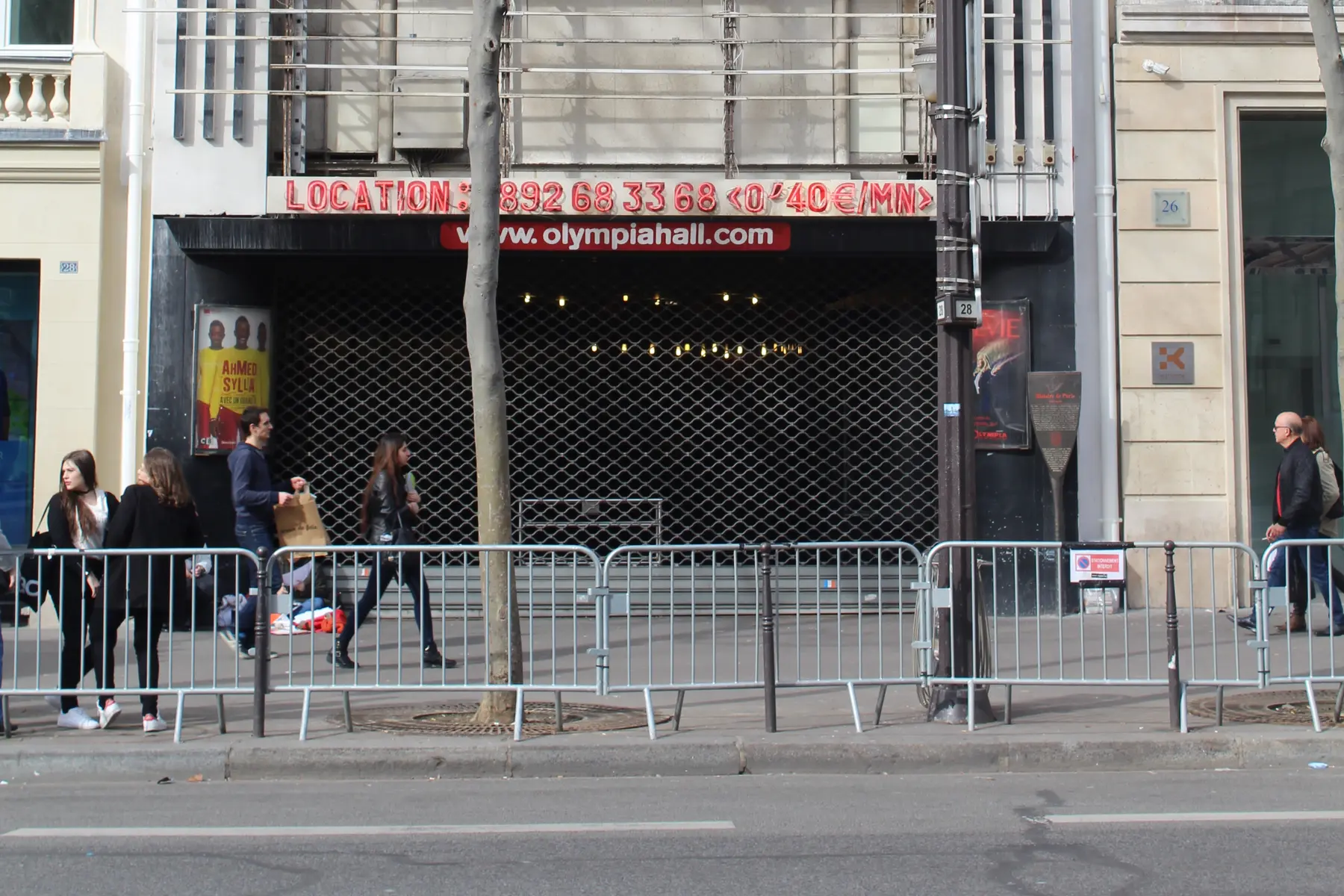
The red Olympia facade shown here was photographed in 2017. It documents the venue, not the 1960 opening night. Piaf’s historic stage image depended on an opposite economy: dark silhouette, limited gesture, concentrated light and an orchestra supporting the words. Restraint directed attention toward phrasing and diction. The performance felt spontaneous because technique disappeared from view. Thousands could experience each song as a private confidence, a paradox in which a large room seemed to contract around one voice. That is one source of the comeback’s enduring power: Paris was not reconstructed through spectacle, but evoked through disciplined presence and sound.
An icon confronting the new 1960s
Piaf returned as French popular culture was changing rapidly. New stars and rhythms were beginning to address a youth audience that would soon dominate the media. She did not attempt to become a yé-yé singer. Instead, she reaffirmed a chanson tradition built on narrative, articulation and dramatic emotion. The Olympia engagement can therefore feel like both a rebirth and a handover between cultural eras. Does Piaf’s working-class Paris still exist? extends the question. Cities, trades and audiences change, but certain venues allow cultural memories to meet rather than simply replace one another.
B2B guidance: use legend as an interpretive key
For international travel advisors, the strongest approach is not to promise special access to the Olympia or reenact one exact night. Prepare guests to distinguish among documented dates, surviving performances and later legend. The Elyrea Édith Piaf Encounter can animate those distinctions through the character, her repertoire choices and her relationship with Paris. The comeback then opens conversations about the performer’s craft, the economics of entertainment and the making of an icon. Sophisticated travelers receive more than another anecdote: they gain a way to see a facade, hear a familiar song and understand a city with greater depth.
FOR YOUR GUEST ITINERARIES
With Elyrea, connect Piaf’s voice to the stages and streets of Paris through a documented, emotionally intelligent narrative for discerning travelers.
Discuss your itinerary