
A royal portrait was a public act
At court, a queen’s portrait was never merely a family keepsake. It could be copied, engraved, displayed and exchanged to communicate rank, dynastic continuity and the virtues expected of a sovereign. Marie Antoinette entered a public arena in which almost every choice became material for commentary. Her Austrian birth, alleged spending and preference for less ceremonial forms of sociability quickly fed hostile narratives. Painting her likeness therefore meant entering a contest over reputation. The image had to persuade while still appearing to be an effortless statement of royal presence.
Vigée Le Brun became painter and trusted interlocutor
Élisabeth Louise Vigée Le Brun became Marie Antoinette’s official painter in 1778. Versailles records roughly thirty portraits of the queen over six years and notes the sovereign’s support for the artist’s admission to the Royal Academy in 1783. Their proximity did not erase the enormous difference in status between painter and sitter, but it created unusual continuity in the construction of a public appearance. Vigée Le Brun understood court portrait conventions and could also lend the face an immediate softness. Her achievement depended on balancing official majesty with a convincing impression of human presence.
The muslin dress produced the opposite effect
At the Salon of 1783, the queen appeared in a light white muslin gown with studied simplicity. The dress belonged to an aristocratic private fashion, but public exhibition disturbed the boundary between intimacy and sovereign representation. Critics considered the queen insufficiently dressed for her rank, and some compared the garment to an underdress. The canvas was withdrawn and replaced with a version in silk more closely aligned with expectations. How clothing operated as power at court helps explain why an apparently graceful choice could become a political problem rather than a successful gesture of accessibility.
Repairing the image without abandoning likeness
After the controversy, the task was not simply to return to a more formal costume. The portraits still needed a recognizable, elegant and contemporary woman while restoring the signs of her office. Fabrics, jewelry, posture and setting reintroduced ceremonial distance. Vigée Le Brun was not inventing modern propaganda in a simple sense; she worked through dynastic portrait conventions and the public expectations of the Salon. The resulting images did not refute every accusation one by one. They offered a competing visual proposition: a composed, dignified woman capable of embodying the monarchy.
In 1787, motherhood became an argument
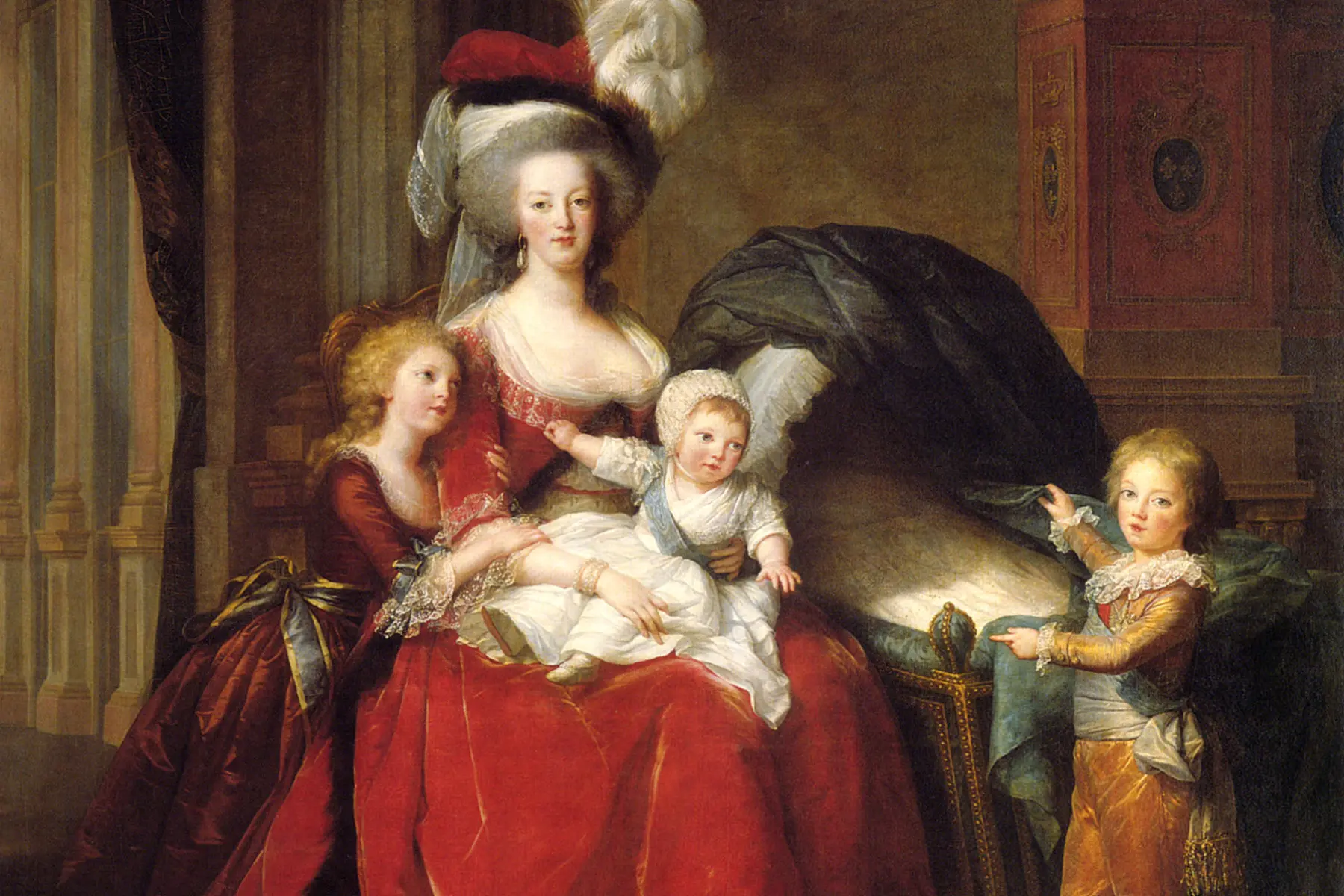
Marie Antoinette and Her Children, shown at the Salon of 1787, makes motherhood the center of the composition. The queen does not dominate the canvas alone; she gathers her children and gestures toward an empty cradle that recalls the recent death of Sophie Béatrice. The detail combines dynastic continuity with private grief without turning the work into an ordinary domestic scene. Velvet, furniture and the setting at Versailles preserve the royal frame. Maternal tenderness thus becomes a political virtue, intended to answer the image of a foreign, frivolous sovereign detached from the kingdom she represented.
A painting could not cancel a crisis
However carefully designed, the 1787 composition could not reverse opinion by itself. The Diamond Necklace Affair, pamphlet culture and financial crisis had produced hostile stories that were easier to repeat than a nuanced reading of a painting. Viewers also knew that an official portrait was commissioned and could interpret its intention as evidence that the monarchy felt vulnerable. The canvas was therefore not an automatic remedy. It is more revealing as a statement of what the crown needed audiences to believe at the very moment when it was losing the power to define the queen’s image on its own.
Reading Versailles through this visual strategy
Connecting portraits with the places where Marie Antoinette lived moves the story beyond the familiar opposition between fashion icon and tragic victim. Meeting the woman behind the queen shows how demands of representation structured her days. The Petit Trianon and the Hamlet are more than charming settings; they illuminate her desire to control part of her environment. Was the Queen’s Hamlet a royal whim or a search for freedom? extends the question. Portraits then become evidence to compare with spaces, practices and contemporary criticism.
B2B guidance: turn the portrait into an investigation
For travel advisors, this angle creates a richer experience than treating the canvas as an isolated masterpiece. Guests can compare intention, reception and context, then watch a detail of costume or setting change the political meaning of an image. The Elyrea Marie Antoinette Encounter at Versailles can connect that investigation with places and human choices. Documented facts should remain distinct from interpretation: Vigée Le Brun clearly built a favorable representation, but no one can measure its precise effect on every viewer. That caution makes the story more credible, not less compelling, and gives sophisticated travelers room to form their own reading.
FOR YOUR GUEST ITINERARIES
Designing a private Versailles journey? Elyrea can place this reading of royal portraiture within a Marie Antoinette Encounter.
Discuss your itinerary