
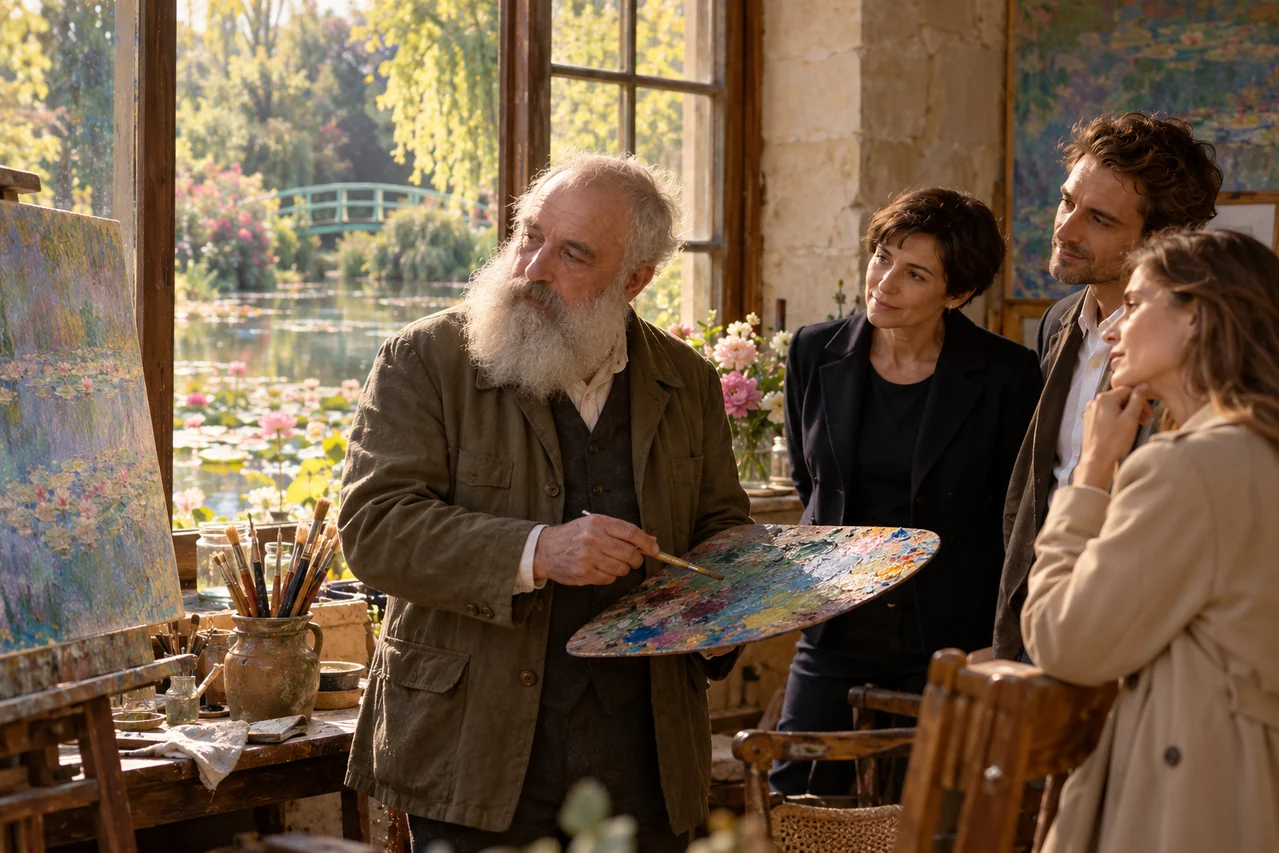
A visual difficulty entered an established practice
Monet's declining vision affected an artist who had already spent decades investigating how the world appears. The problem therefore entered a developed working life rather than explaining the origin of his interest in light or color. A responsible account holds those facts together. His vulnerability mattered, but the painter also brought experience, habits and intentions to the work. Visitors should not be asked to choose between seeing a fully unaffected master and an artist whose paintings were only products of a condition.
Cataracts can alter the experience of seeing
Changes to the eye's lens can affect the clarity and appearance of what a person sees. That general context helps explain why the condition posed a practical difficulty for a painter. It should not become a casual medical assessment of every canvas. A work contains decisions about pigment, framing and technique as well as the effects of perception. The historical question concerns how Monet continued working amid changing circumstances, not whether a viewer can read an exact diagnosis from the image.
Monet's awareness complicated the problem
The painter knew that his vision was changing, so the account is not simply that he unknowingly reproduced a different visual world. Memory, previous work and the knowledge of materials could all influence decisions. This awareness matters because it restores agency alongside impairment. A guest can ask how an experienced artist responds when perception becomes less reliable, rather than imagine an entirely passive process in which a medical condition translates itself directly into color on a canvas.
The 1923 operation belongs within a longer story
Monet underwent an operation in 1923, an important event in his later circumstances. It should not be used as a simple dividing line that makes all the works before it medically distorted and all those afterward objectively correct. His response to altered vision and the practical conditions of work remained complex. The historical episode is useful because it makes the vulnerability tangible, while the paintings still require attention as artistic objects rather than illustrations of a treatment chronology.
A painting is not a visual test
Calling a late painting false because its colors or forms differ from a naturalistic expectation misunderstands the artistic task. Monet was not producing an instrument's measurement of a scene. The work transforms a motif through material decisions, and its value cannot be assessed solely by resemblance to what another eye would see. The physical garden at Giverny can help guests recognize that transformation, including in works whose differences cannot reasonably be attributed to vision alone.
Later viewers bring a different artistic history
Modern audiences may see some late paintings as approaching abstraction, but that response is shaped by a century of later art. It should not imply that Monet consciously worked in order to predict future movements. The distinction permits a richer discussion of reception: a work can gain meanings its maker did not set out to create. The continuing Water Lilies inquiry provides the larger context, allowing late experimentation to remain part of an evolving practice rather than a predetermined step toward somebody else's art.
Age and vulnerability did not end experimentation
One of the compelling aspects of late Monet is his continued engagement with difficult pictorial questions. Recognition and an established home did not remove every uncertainty. The garden remained a source of variation, while his own perception introduced further challenges. This account makes the painter human without reducing him to illness. For guests interested in art and the body, the discussion can remain focused on historical experience and artistic work, avoiding speculative diagnosis or generalized medical advice.
Return to the motif without reducing the image
A Giverny Encounter can let guests observe the pond and ask how a physical view becomes a painted environment. Monet's investigation of light helps explain why that transformation was already central to his practice. Advisors can use the late-work theme for experienced guests, or begin with the accessible question of continuing to paint when sight changes. The strongest outcome is a more careful interpretation, in which vision, experience and choice remain related without one being made to explain everything.
FOR YOUR GUEST ITINERARIES
For guests interested in late Monet, perception or the relationship between art and the body, Elyrea can help connect a Giverny Encounter with a carefully framed discussion of the paintings.
Discuss your itinerary