
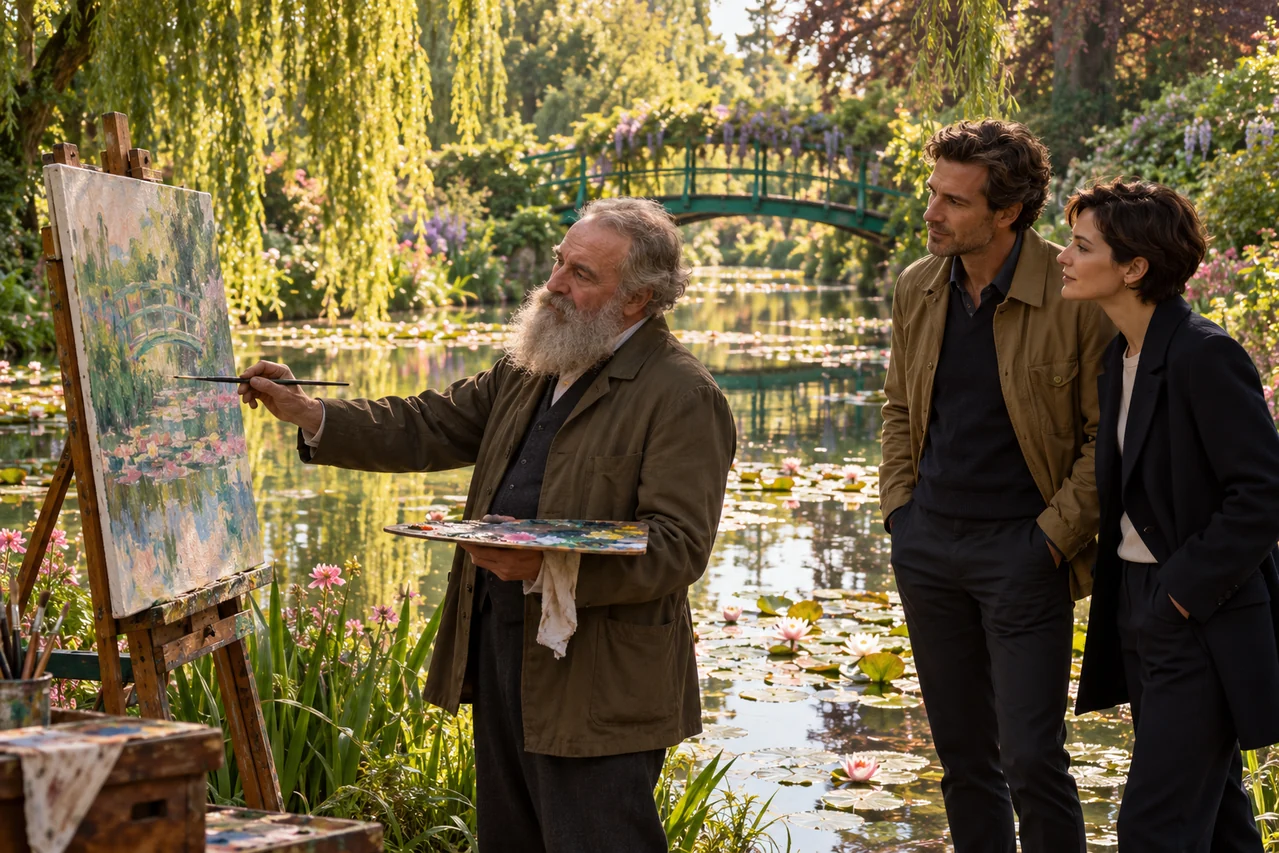
Repetition was already part of Monet's method
Monet's interest in series preceded the Water Lilies. Returning to a subject allowed changing light and perception to become central rather than incidental. The method asks a different question from a search for a new scene each time. If the physical motif remains familiar, the visitor can notice how the painting changes. This makes repetition a form of attention rather than evidence that the artist had run out of subjects or was simply reproducing a successful image.
A pond contains several visual layers
Flowers sit on or near the water, while reflections bring sky and surrounding plants into the same apparent surface. Looking involves moving among these layers, which may become difficult to separate. The garden therefore offered more than a botanical subject. It created a complex field of perception. A guest at Giverny can begin with that ordinary experience, noticing how physical and reflected forms overlap before considering how Monet rearranged them in paint.
Removing the horizon changes orientation
Many landscapes tell viewers where ground ends and sky begins. In the Water Lilies, that division can recede or disappear, leaving a field in which the eye searches for another kind of organization. The effect is not identical in every painting, and it should not be reduced to a single formula. It reveals how framing can transform a recognizable subject. Visitors can consider whether they are seeing water, reflected space or a surface of color, and how those possibilities coexist.
Larger scale changes the spectator's experience
The monumental works are not merely small pond studies enlarged. Scale can alter the relationship between the viewer and the painted environment, encouraging a more encompassing form of looking. The spectator's time and movement then matter alongside the motif. This is particularly relevant when connecting Giverny with the Orangerie in Paris. The physical garden offers the source, while the large paintings show an artistic transformation that should not be judged only by how closely it reproduces a remembered view.
The Orangerie introduces another historical frame
The great Water Lilies decorations have a relationship with the aftermath of the First World War and ideas of peace. That context can enrich their interpretation without requiring every color or reflection to symbolize a political message. An advisor can keep the different layers clear: the artist's long investigation, the circumstances of the works' presentation and the visitor's experience of the space. A Paris viewing should be planned separately, with practical conditions confirmed independently of the Giverny Encounter.
Changes in vision matter without explaining everything
Monet's cataracts affected his experience, but the paintings cannot be treated as simple medical records. Long practice, material choices and artistic decisions also belong to the account. Monet and cataracts develops that distinction with particular care. The Water Lilies are more interesting when vulnerability and deliberate experimentation remain together, rather than when the late work is either dismissed as impaired vision or retrospectively diagnosed through every visible change in its colors.
The sequence can begin in either place
Seeing the Paris works before Giverny can give guests a question to bring to the garden. Seeing the garden first can make the transformation in the paintings more immediately apparent. Neither order is obligatory. The advisor should choose according to the guest's prior knowledge and the rhythm of the trip. Planning a Monet day from Paris helps give the physical excursion its own structure, with enough time to look rather than simply confirm the famous motif.
The method offers a different lesson in travel
Monet's repeated attention suggests that discovery need not depend on the accumulation of new sights. A known subject can become richer through a change in conditions or a more patient look. An embodied Encounter can make that question accessible even to guests with little art knowledge. The Water Lilies then become more than an iconic image associated with a destination: they provide a way to consider how seeing changes, and why a place can sustain curiosity across many returns.
FOR YOUR GUEST ITINERARIES
For guests intrigued by the Water Lilies, Elyrea can help connect a Giverny Encounter with a Paris viewing that reveals the relationship between physical motif and painted environment.
Discuss your itinerary