
A studio that left the riverbank
During the 1870s, Claude Monet did more than observe the Seine from a quay. At Argenteuil, he used a small vessel adapted as a studio boat. It allowed him to work on the water, alter his position and study the surface at close range. This was not a room floating in perfect stillness. Light shifted, current rearranged reflections and river traffic disturbed the view. That instability was part of the artistic problem. Water retains neither shape nor color; it continually transforms what it receives from sky, foliage, sails and buildings. Mobility gave Monet a way to enter that changing system rather than look at it only from outside.
Argenteuil was a modern landscape
Monet lived at Argenteuil from 1871 to 1878. Rail connected the town to Paris, while sailing, bridges and industry shared the Seine. The landscape was not untouched nature. It brought leisure and modern infrastructure into the same field of vision. From the boat, Monet could frame sails, banks, houses and smokestacks without accepting the fixed viewpoint of a promenade. Mobility did not remove the material reality of the place; it allowed him to reorganize it. A motif became an encounter among atmospheric conditions, activity on the river and decisions made in front of a landscape undergoing visible change.
Daubigny’s precedent, Monet’s particular use
Charles-François Daubigny had already fitted out a studio boat, known as Le Botin, for painting along rivers. Monet knew that precedent and adapted the solution to his own investigation. Acknowledging the connection avoids the convenient myth of isolated invention. Artistic practice also develops through shared tools, observed methods and devices redirected toward new questions. Monet’s boat became closely associated with the changing effects of the Seine and with Impressionist work at Argenteuil. Borrowing a working arrangement did not produce the same pictures. Its importance lies in the different visual problem Monet asked it to solve.
Seeing from the level of the water
A view from the bank naturally separates observer and river. Inside the boat, the horizon drops and water occupies more of the visual field. Reflections cease to be a secondary copy of the landscape and become colored shapes interrupted by movement. This vantage point helps explain how Monet changed the way we see light. He did not paint light as an isolated object. He studied how it altered the relationship among sky, surface, depth and touch, then organized those unstable relationships into a coherent pictorial sensation.
Manet looks at Monet
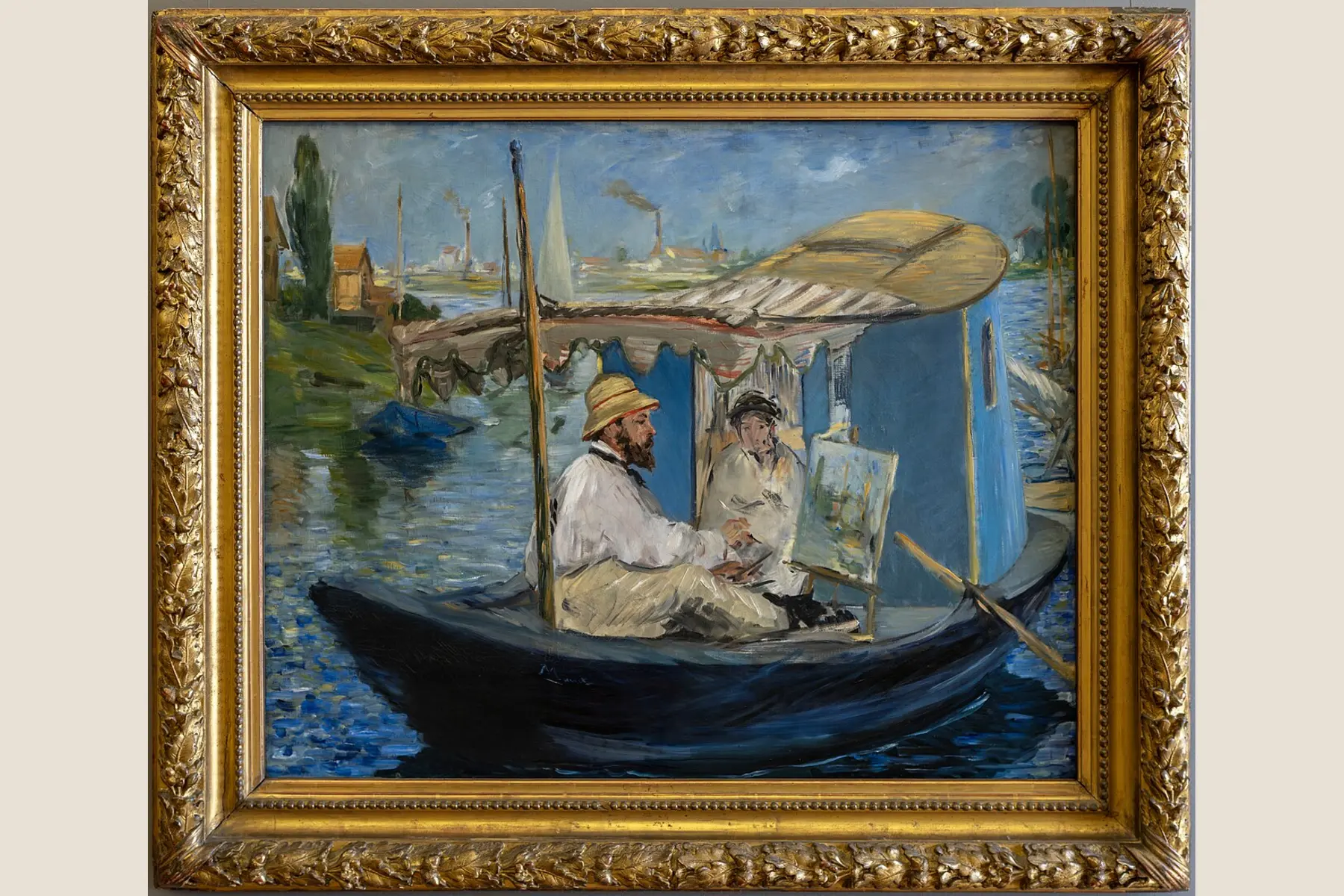
In 1874, Édouard Manet painted Monet working aboard the boat with Camille nearby. The image reproduced here documents Manet’s representation of his fellow painter on the water; it is not a photograph or a precise inventory of every fitting. That distinction makes the work more interesting. Monet appears as a modern artist placed within his motif rather than withdrawn inside an academic studio. Manet depicts a colleague, a method and a new image of artistic labor. The painting reveals elements that Monet’s river landscapes usually leave outside the frame: a body at work, the vessel and the material conditions behind a way of seeing.
Painting outdoors did not mean finishing everything afloat
The studio boat brought Monet closer to the motif, but it did not make every picture an instantaneous capture. Musée de l’Orangerie material notes that he could begin works from the adapted boat and then rework them indoors. Open-air sessions supplied observations, color relationships and an experience of change; the studio allowed selection, revision and construction. This alternation complicates the myth of Impressionism as pure spontaneity. Rapid atmospheric change actually demands memory and later decisions. The convincing sensation of one moment may be the result of a process that lasted far longer than the moment represented.
From Argenteuil to Giverny: a question persists
The studio boat did not mechanically lead to the water garden at Giverny, and almost two decades separate early Argenteuil work from the creation of the lily pond. A careful continuity can still be traced. Monet repeatedly approached water as an unstable surface, constructed conditions for observation and changed his framing to renew the problem. Why did Monet settle at Giverny? restores the family and professional context. The opposition to Monet’s water garden then shows that the celebrated landscape was negotiated infrastructure, not scenery discovered intact.
B2B guidance: make viewpoint the itinerary’s thread
For international advisors, the studio boat provides a more precise narrative than a sequence of masterpieces. Ask what changes when an artist works low, mobile and inside the motif; compare Manet’s portrait with Monet’s painted surfaces; then encounter another deliberately constructed way of observing water at Giverny. The Elyrea Monet Encounter at Giverny can animate that investigation without promising a boat ride, private access or an original work unless separately confirmed. The journey connects places through one durable question: how does an artist create the position from which the world becomes a painting?
FOR YOUR GUEST ITINERARIES
With Elyrea, connect Monet’s Argenteuil studio boat with his sustained investigation of water, light and viewpoint through to Giverny.
Discuss your itinerary