
A famous gesture reduced to the wrong story
On December 2, 1804, at Notre-Dame in Paris, Napoleon took the crown from the altar and placed it on his own head before crowning Joséphine. The episode is often compressed into a cinematic claim: he snatched the crown from the pope to declare that he owed everything to himself. Accounts assembled by the Fondation Napoléon are more precise. Pius VII attended, the ceremonial arrangement had been negotiated and the pope accepted the self-crowning. This was not a spontaneous insult in the middle of Mass. It was a prepared, spectacular and highly legible political sequence. Napoleon received religious consecration while preventing the ceremony from suggesting that the pontiff personally granted his authority. The enduring power of the moment lies in that coexistence, not in a simple story of one man humiliating another.
Napoleon was emperor before he entered Notre-Dame
The coronation did not legally create the Empire. Napoleon had been proclaimed Emperor of the French on May 18, 1804, more than six months before the ceremony. That chronology changes the question. He was not asking Pius VII for a title that the Church might give or withhold. He wanted an established political fact to acquire historical depth, religious solemnity and European visibility. Notre-Dame connected the new regime to older traditions while providing a stage on which it could invent its own vocabulary. The title “Emperor of the French” also emphasized a nation and a plebiscitary claim rather than mere possession of territory. Self-crowning made autonomy visible. The pope’s journey to Paris offered a different kind of recognition that Napoleon considered equally useful.
Why invite Pius VII if Napoleon would crown himself?
The pope mattered precisely because the gesture was not meant to reject religion altogether. After the French Revolution’s conflicts with the Church, the Concordat of 1801 had restored an institutional relationship. Bringing Pius VII to Paris gave the event a reach that a civil proclamation could not provide. The pontiff blessed the emperor and placed the ceremony within a Christian horizon, while Napoleon kept control of its visual climax. The compromise addressed distinct constituencies. Catholics saw the head of the Church participate. Heirs to the Revolution saw political authority refuse a passive investiture. Self-crowning therefore did not erase the pope; it created a measured distance between consecration and dependence. That tension, rather than the cartoon of a papal humiliation, is what makes the episode a revealing guide to Napoleonic government.
Crowning Joséphine after himself
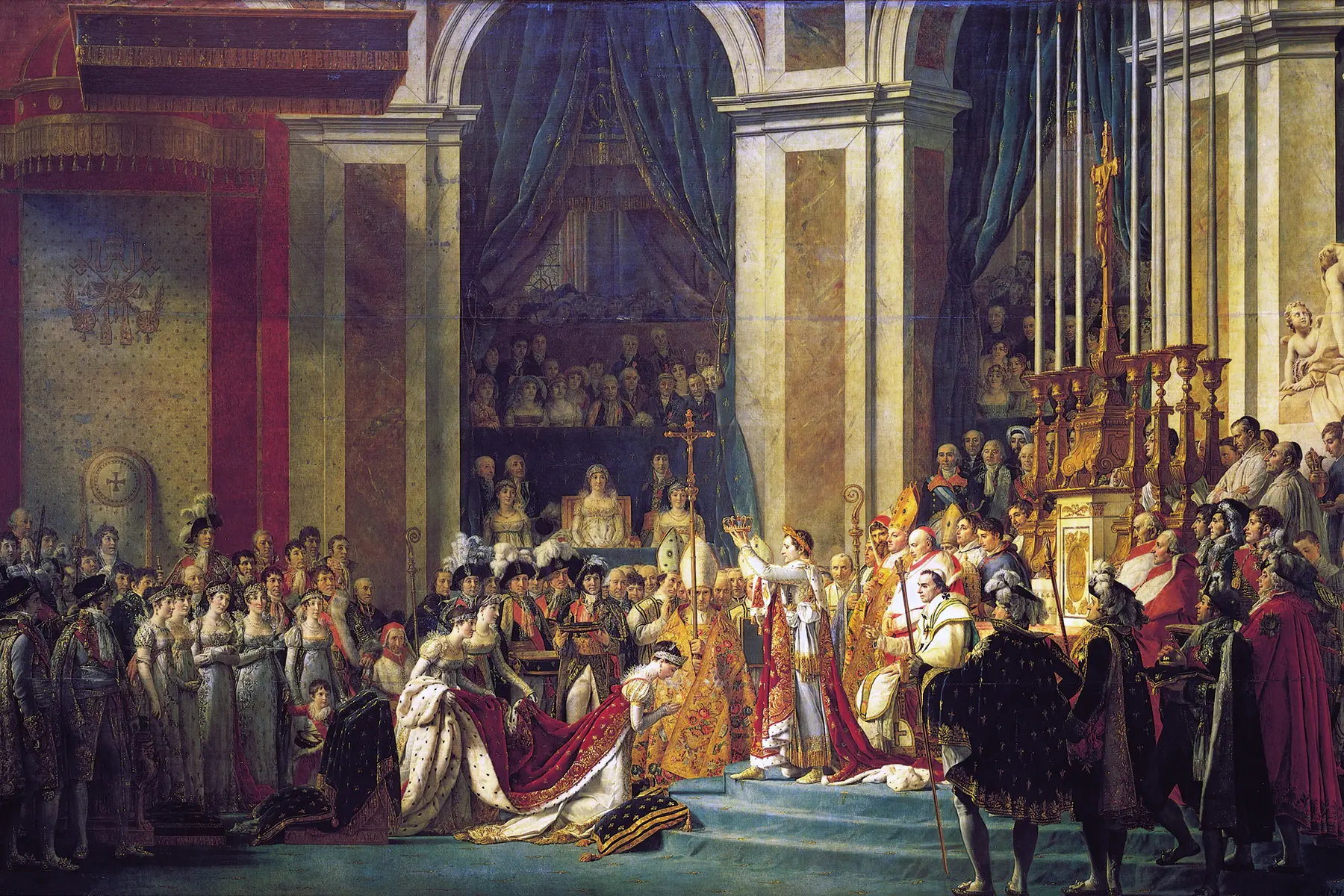
After placing the crown on his own head, Napoleon crowned Joséphine. Jacques-Louis David ultimately made this second act the center of his enormous painting. The empress kneels; Napoleon lifts the crown; Pius VII, seated behind them, blesses the scene. The moment creates a dynastic and marital image that is more generous, more collective and less provocative than a frontal self-crowning. It also presents the Empire as a family continuity, although the lack of an heir already placed pressure on the marriage. Their civil divorce came in 1809. In the painted ceremony, however, Joséphine remains at the heart of the imperial order. Her presence lets David show Napoleon’s authority in action while preventing his own crowned head from becoming the composition’s only political fact.
David turned an event into an image of state
Commissioned by Napoleon in September 1804 and painted between 1805 and 1807, The Coronation of Napoleon is roughly twenty feet high and nearly thirty-three feet wide. The Louvre describes a history painting populated by about 190 figures, more than ninety of them identifiable. Preparatory drawings show that David considered the act of self-crowning. The final canvas uses Joséphine’s coronation instead, a choice that avoided the more arrogant appearance of the initial concept and enlarged the ceremony’s collective majesty. The painting is therefore not a monumental photograph. It selects, moves and ranks. Napoleon’s bulletins and the images that built his legend reveal the wider method: political power does not merely act; it composes the form in which action will be seen and remembered.
Real witnesses and corrected absences
Napoleon’s mother, Letizia Bonaparte, did not attend the ceremony, yet David placed her in the central gallery. The real assembly was likewise organized into a legible political body in which each dignitary supports the new state. Costumes and portraits appear with astonishing specificity while the scene itself becomes more coherent than the day had been. The pope’s blessing hand also matters: it prevents Pius VII from looking like a purely passive spectator. Such adjustments do not make the work a lie in the ordinary sense. They disclose its function. An official event painting was expected to establish ideal memory, unite dynasty and Church, and give the regime a stability that reality had not fully achieved. Looking closely means asking not only “who was present?” but “who needed to appear present for the future?”
New sovereignty dressed in the symbols of an older world
The coronation combined Carolingian, Roman, Christian and Revolutionary references. Laurel, eagles, mantles, high officers and the Gothic space of Notre-Dame created a tradition that audiences could recognize immediately but that Napoleon never copied wholesale. He was neither a French king following the Reims rite nor a medieval emperor meekly receiving an emblem from the pope. The hybrid matched his project: stabilize Revolutionary change under personal and hereditary authority. The names later carved on the Arc de Triomphe would extend another dimension of that memory, this time military. In both cases, architecture, ritual and inscription convert a contested history into a public landscape that appears permanent. The political achievement is inseparable from the design of its symbols.
B2B guidance: connect Notre-Dame, the Louvre and the ambiguity
For international travel advisors, “why did he crown himself?” is an immediate opening, but the answer should preserve the compromise instead of repeating a tale of pure defiance. At Notre-Dame, guests can locate the space and dramaturgy of December 2, 1804. At the Louvre, David’s canvas reveals what the regime chose to show: Joséphine, papal blessing, an assembled family and a hierarchy of dignitaries. The Elyrea Napoleon Encounter can then set the man, ruler and legend against one another without reducing him to hero or tyrant. Why Napoleon resists a simple verdict becomes the natural conclusion. Self-crowning was not an isolated theatrical flourish; it was a miniature of his political art.
FOR YOUR GUEST ITINERARIES
With Elyrea, read the 1804 coronation as a theater of power in which every gesture, witness and silence was carefully composed.
Discuss your itinerary