
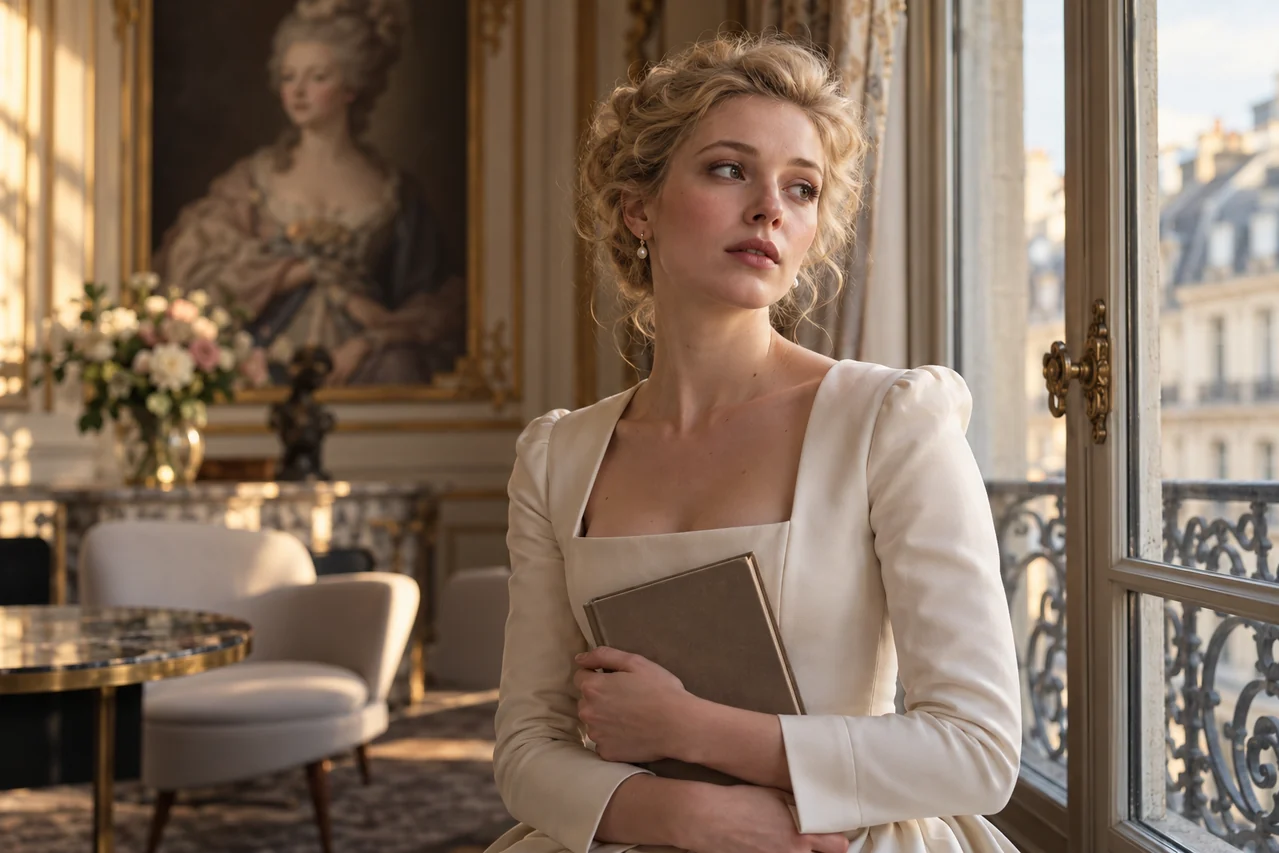
Maria Antonia before the French queen
Born in Vienna in 1755, Maria Antonia belonged to the Habsburg-Lorraine dynasty and a family whose marriages carried diplomatic significance. Her future in France was shaped by this political world before she could direct much of it herself. The transition to Marie-Antoinette was therefore more than a change of name. She had to embody a connection between courts and adapt to the expectations of another kingdom. Remembering this beginning helps restore a young person to an image often encountered only in its fully developed royal form.
An adolescent in a highly visible marriage
Her marriage to Louis-Auguste in 1770 made her dauphine and placed her private life under public and diplomatic scrutiny. Producing an heir was a dynastic responsibility, not simply a family hope. Court etiquette also shaped daily behavior and the distribution of access around her. The combination of youth, foreignness and ceremonial expectation provides important context for her later choices. It should not be used to invent feelings beyond the evidence, but it clarifies why life at Versailles cannot be understood only as luxury and entertainment.
Becoming queen and seeking personal space
When Louis XVI became king in 1774, Marie-Antoinette was eighteen. Over time she developed more personal social circles and an attachment to the Petit Trianon. These offered some distance from the main ceremonial environment, while creating resentment among people excluded from them. Her relationship with the Petit Trianon captures a central contradiction: the effort to gain privacy could itself become public controversy. A queen's personal preferences were interpreted through the political and social functions that others expected her to fulfill.
A public appearance that acquired its own life
Clothes, hairstyles and portraits helped make Marie-Antoinette an aesthetic reference far beyond the court. Rose Bertin contributed to this world of fashion, and the queen's visibility amplified it. Admiration and hostility could grow from the same image. A striking appearance might communicate royal magnificence to one audience and excessive spending to another. Even simpler dress could challenge expectations. Her story illustrates how celebrity involves meanings that the subject cannot fully control, with appearance repeatedly turned into an argument about character and political legitimacy.
Fersen and the difference between intimacy and certainty
Marie-Antoinette's closeness with Axel de Fersen is an important part of her story. Their relationship and correspondence indicate significant emotional intimacy, while its precise nature remains debated. Neither dismissing Fersen as irrelevant nor presenting a complete romantic account as settled fact gives the reader a reliable understanding. Marie-Antoinette and Fersen through evidence and interpretation offers a more careful approach. Their connection can be historically meaningful without every question about the private relationship being answered conclusively.
The revolutionary transformation of her position
The move of the royal family to Paris in October 1789 changed the setting and limits of their lives. The attempted flight of June 1791, ending at Varennes, further damaged trust in the monarchy. After its fall, Marie-Antoinette was imprisoned, tried and executed on 16 October 1793. This trajectory should be connected with wider political change rather than told as an isolated tragedy. Her life became dramatically constrained, but she also held political views and acted to defend the monarchy and her family.
Several identities rather than a single verdict
The queen's story includes dynastic expectations, motherhood, public image, political agency and revolutionary violence. A portrait built around only one of these will be incomplete. Likewise, the absence of evidence for the brioche phrase does not remove all political questions, and acknowledging her suffering does not require idealizing her choices. The reasons for her changing reputation show how interpretation shifted over time. A mature account allows a person to be vulnerable and influential, criticized and misrepresented, within the same historical life.
Discover the person through different settings
Tea with Marie-Antoinette at Drouant provides a Paris setting for a present-day conversation with an interpreted historical character. Versailles contributes the actual spaces of court and retreat. These approaches can complement each other without reproducing the same overview. An advisor might emphasize reputation in Paris and the relationship between ceremonial visibility and privacy at Versailles. The useful outcome is a more precise set of questions about Marie-Antoinette, replacing the assumption that recognition of her name already amounts to understanding who she was.
FOR YOUR GUEST ITINERARIES
Designing a Paris or Versailles itinerary around Marie-Antoinette? Our team can help use an Elyrea Encounter to connect the queen's life with your guests' particular interests.
Discuss your itinerary