
An Austrian teenager sent into a political alliance
Marie-Antoinette was born in Vienna in 1755 and married Louis-Auguste, the future Louis XVI, in 1770 at fourteen. The marriage belonged to the diplomacy of European dynasties rather than a private romantic story. Arriving in France meant learning another court's expectations while embodying an alliance between France and Austria. Her foreign origins later became a powerful weapon against her. Understanding that beginning changes the familiar image of a queen seemingly born into the effortless enjoyment of Versailles: her position carried political meaning before she had much personal experience.
A royal life conducted under observation
At Versailles, appearing in public was part of governing. Dress, meals and ceremonies were shaped by etiquette, and proximity to the royal family mattered to the status of courtiers. Marie-Antoinette's desire for smaller circles and more personal space therefore had consequences beyond her own comfort. A retreat from ceremony could be read as a rejection by people who expected access to the queen. The contrast between magnificence and constraint is central to her story, revealing why privilege and freedom were not necessarily the same thing.
Style as a language she could not fully control
Working with the fashion merchant Rose Bertin, Marie-Antoinette helped make certain silhouettes and elaborate hairstyles widely visible. Her status amplified choices that were then copied, admired and criticized. Simpler dress could also provoke controversy when it challenged the expected representation of a queen. This is more revealing than a catalogue of beautiful clothes. Marie-Antoinette's development as a fashion icon shows how appearance became a public language, with meanings imposed by observers as well as intentions expressed by the wearer.
The famous quotation and the life of a myth
There is no solid basis for presenting the brioche phrase, usually rendered in English as 'Let them eat cake,' as a statement by Marie-Antoinette. Rousseau's Confessions includes an anecdote about an unnamed great princess, not a documented speech by the queen. The attribution endured because it seemed to fit a hostile picture of royal indifference. Its historical interest lies partly in that power. A short, memorable line can become more influential in popular memory than the evidence that should make people question it.
A reputation larger than the financial reality
The queen's spending contributed to her public image, but the monarchy's financial crisis cannot be explained by her wardrobe. War costs, debt, taxation and difficulties of reform belong to the wider account. The necklace affair also damaged her reputation even though she had not ordered the necklace at the center of the fraud. These examples make her an illuminating subject for discussing public judgment. Once a picture of extravagance had taken hold, events could be interpreted through it even when the facts did not support the accusation.
Why the Paris tea changes the relationship with history
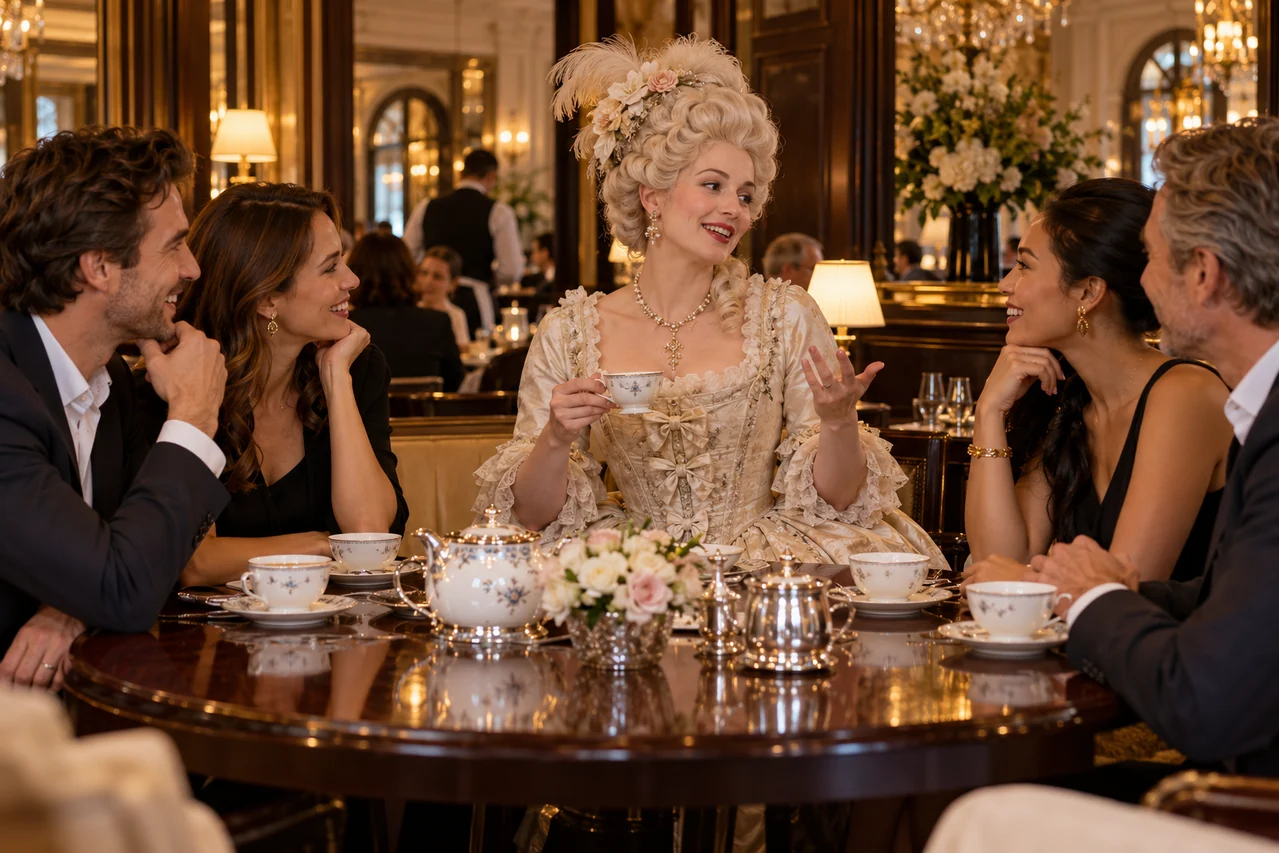
Tea with Marie-Antoinette takes place at Drouant, providing the setting for a present-day cultural encounter rather than a claim that the historical queen visited the restaurant. The theatrical convention gives travelers someone to address. They can consider court life, image, style and political change through a conversation instead of hearing only a chronological overview. The encounter is an interpretation of a historical figure; its atmosphere supports inquiry without replacing evidence. The tea creates a pause within the Paris day in which the person can emerge from the familiar caricature.
Who may find the subject especially rewarding
French history enthusiasts are an obvious audience, but the subject also speaks to guests interested in fashion, public reputation or the changing possibilities available to women. Returning travelers can approach Marie-Antoinette without repeating a full Versailles visit. First-time visitors may use the conversation to establish questions before exploring the palace. The choice depends on what the guest wants to understand, not simply whether they recognize the name. The woman behind the Marie-Antoinette legend offers further context for those wishing to deepen the encounter.
Give the encounter a distinct place in the itinerary
An advisor can place the tea within a day about French style, women's lives or monarchy, connecting it with another subject rather than repeating the same introduction. A Chanel or Dior chapter can explore how clothing communicates in a different period; Versailles can provide the actual court environment that Paris does not. Choosing between Paris and Versailles for Marie-Antoinette helps clarify these roles. The point is not simply to add a royal theme, but to help the guest understand how one historical person acquired so many competing images.
FOR YOUR GUEST ITINERARIES
Planning Paris for guests interested in French history, fashion or remarkable women? Our team can help integrate Tea with Marie-Antoinette into their private cultural itinerary.
Discuss your itinerary