
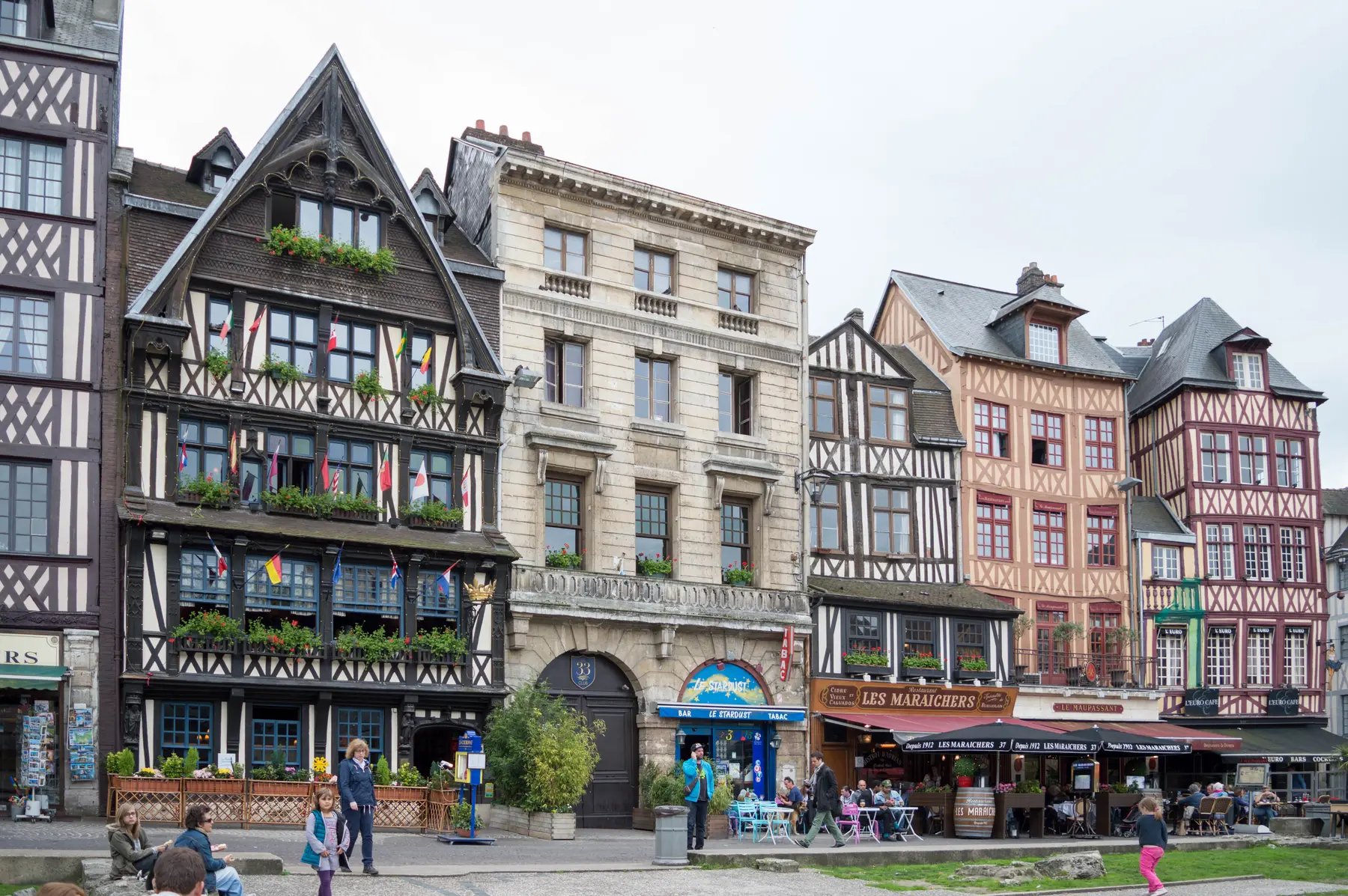
A historical site beneath a reconstructed cityscape
Place du Vieux-Marché preserves an essential address in the history of Joan of Arc, but it is not a medieval set left intact. Joan was burned here on May 30, 1431, in a city then held by the English. The square visitors see today is the result of destruction, reconstruction and later urban choices. Beginning with that distinction prevents two opposite errors: presenting the current scene as an exact survival from the fifteenth century, or assuming that historical meaning disappeared with physical change. The ground, local memory and modern monuments maintain a connection with the event. They need to be read in layers, with each element assigned its own date and purpose.
The fifteenth-century square was smaller
The City of Rouen explains that the medieval space was less extensive. It contained the churches of Saint-Sauveur and Saint-Michel as well as a market hall, and it was customarily used for executions. Those facts alter the visitor’s mental picture. Joan was brought not to a broad commemorative plaza but to a working urban space shaped by commerce, religion and public justice. The buildings surrounding the event were not those photographed today. A large cross now marks the location traditionally associated with the stake, but it functions as a modern memorial reference. On its own, it cannot reconstruct the complete topography of 1431.
From condemnation to rehabilitation
The execution did not end the legal history. In 1456, a rehabilitation trial annulled Joan’s conviction after a new inquiry. That decision should not be confused with the immediate and unanimous recognition of the figure later centuries would create. Her memory changed with religious, political and national contexts. For travelers, the square offers a particularly clear way to examine the distance between an event, the later reversal of a judgment and monuments created much later still. What the Joan of Arc trial records can actually establish helps separate documentary evidence from reconstructed quotations and familiar cultural images.
1979: a church and a civic memorial
The large building inaugurated in 1979 combines two functions that Rouen states explicitly: a church honoring Saint Joan of Arc and a civic memorial to the national heroine. That double role explains why it belongs both to worship and to the city’s public narrative. Architect Louis Arretche drew on the form of an overturned boat, leaving the wooden structure visible above the nave. The modern exterior, covered in slate and copper, deliberately rejects the idea of a medieval imitation. The monument does not claim to date from 1431. Instead, it demonstrates how the twentieth century chose to give contemporary architectural form to a much older memory.
Renaissance glass inside modern architecture
The church contains Renaissance stained glass from the former church of Saint-Vincent. Its presence adds another layer of time: sixteenth-century works are installed in a late twentieth-century building. The windows were not created to illustrate Joan’s trial or execution, and treating them only as decoration for her memorial would erase their own history. That tension is valuable for cultural interpretation. The building brings together rescued material, modern architecture and a commemorative purpose without pretending that all three belong to one moment. Guests learn to distinguish the relocation of heritage, architectural creation and the evolving public memory of a historical person.
Market life and commemoration occupy the same square
The present square remains a lived urban place, with a market, shops, restaurants and terraces. Daily activity does not profane the site; it also continues its long commercial identity. Official memory appears through the cross, a municipal plaque installed in 1979, the church-memorial and commemorations held around May 30. Those signs do not create one frozen scene. They coexist with ordinary use and ask visitors to shift registers within a few steps. Planning a Joan of Arc day in Rouen can connect this square with other evidence without turning the historic center into a single-theme itinerary.
Embodied interpretation without a false reconstruction
The Elyrea Encounter centered on Joan of Arc can bring voice and presence to the story, but it does not turn the modern square into an authentically preserved 1431 stage. Responsible dramaturgy identifies what comes from evidence, what is interpretation and what the current cityscape says about memory. It avoids presenting invented dialogue as quotation. It also leaves room for uncertainty, urban change and the choices later generations made when honoring Joan. A conventional tour or an encounter with Joan of Arc in Rouen? helps advisors select the appropriate degree of embodiment for their guests.
B2B guidance: teach guests to read the layers
For a travel advisor, the rigorous promise is not to “relive the stake,” but to understand how Rouen makes a 1431 event visible in a reconstructed square. The sequence can begin with medieval topography, move to trial evidence and then examine the cross, plaque, church and contemporary uses. Opening hours, access and group conditions should be confirmed directly because they can change. The brief should include ages, prior knowledge, religious sensitivities and the desired emotional intensity. A grave subject requires restrained storytelling. Precision, rather than sensationalism, allows the place to become moving while respecting both the historical person and the modern city.
FOR YOUR GUEST ITINERARIES
Planning a private cultural itinerary? Elyrea can help you weave this perspective into your guests’ journey.
Discuss your itinerary