
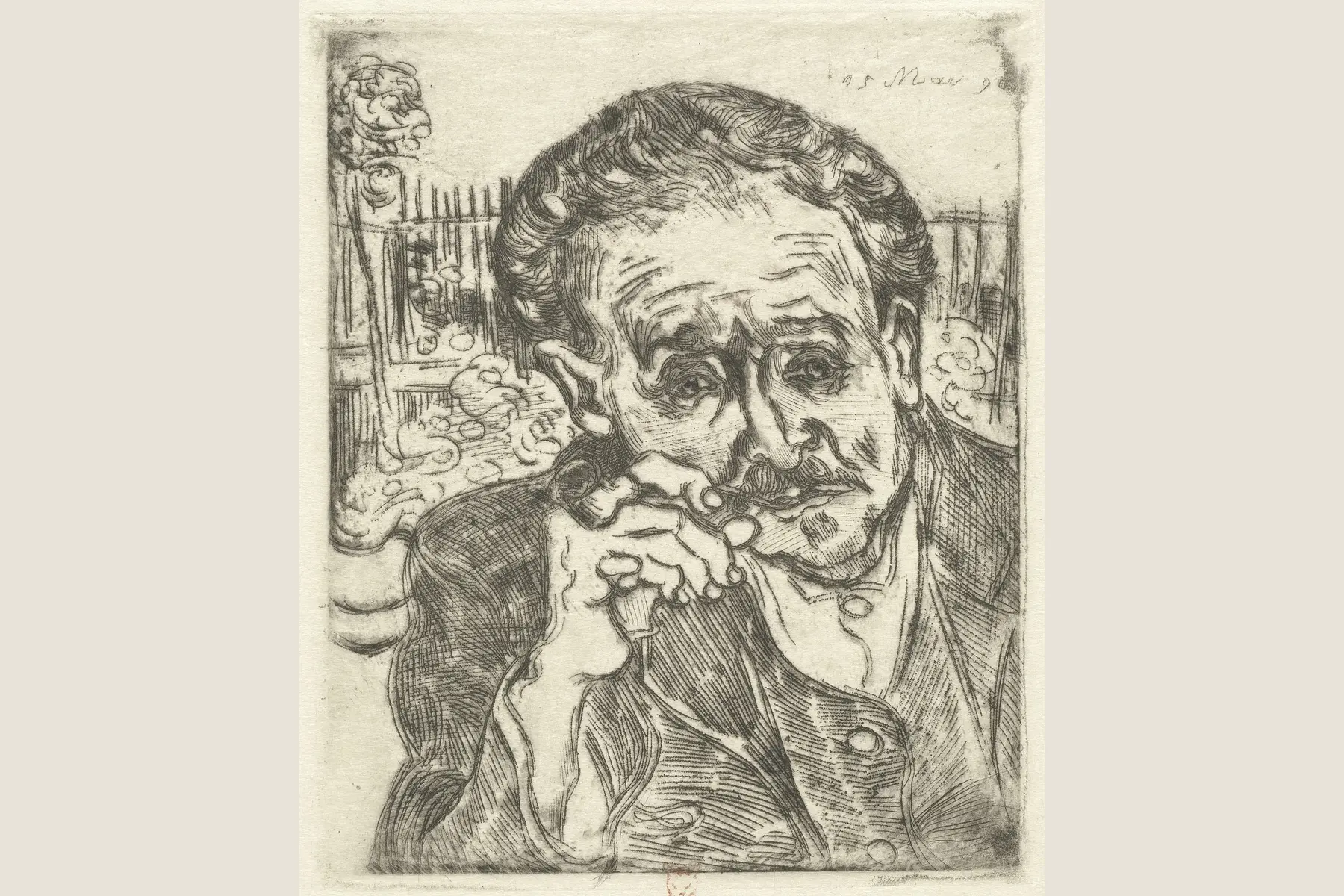
An exception within a painter’s extraordinary output
Vincent van Gogh is identified with painting and drawing: saturated color, urgent marks and landscapes that have become visual shorthand for an artist. Printmaking barely enters that familiar picture. The portrait of Dr. Paul Gachet made at Auvers-sur-Oise in 1890 was Van Gogh’s first and only etching. Its rarity encourages a more useful question than whether he might have become a great printmaker. What specific circumstances made this experiment possible at that moment? The answer brings together a village, a personal relationship and access to a press. It turns a small work on paper into evidence of the social and material conditions behind artistic innovation.
A new working environment in May 1890
Van Gogh moved to Auvers-sur-Oise in May 1890 after leaving the asylum at Saint-Rémy. The village kept him close to Paris and his brother Theo while offering subjects and a community already connected with art. Dr. Gachet was expected to watch over his health, but he was also a collector, draftsman and amateur printmaker. That combination mattered. Why did Van Gogh move to Auvers-sur-Oise? explains the decision without turning it into a medical footnote. Auvers was a place of intense work, and Gachet could introduce Van Gogh to a process beyond painting.
Dr. Gachet’s practical role
Gachet owned a press in his house and had experience making prints. Van Gogh Museum research describes him as the guide for Van Gogh’s first attempt at etching. The resulting portrait therefore carries the trace of an exchange between sitter and artist rather than an impersonal workshop commission. Gachet appears with a pipe, enclosed by short, restless lines that build his head, coat and surroundings. Dr. Gachet and Van Gogh: physician, friend or portrait subject? considers his overlapping identities and the limits of each label. In the etching episode, facilitator is another role worth adding.
How an etching is made
An etching begins with a metal plate protected by an acid-resistant ground. The artist draws through that coating with a needle, exposing the metal. Acid bites the open lines; ink is then worked into them, the surface wiped and the plate passed through a press with paper. This indirect sequence differs fundamentally from drawing straight onto a sheet. It also makes multiple impressions possible. Van Gogh’s command of line could transfer to the needle, but the process required him to anticipate reversal, biting and pressure. The portrait feels immediate, yet that immediacy was achieved through a technical collaboration and a matrix designed to be printed.
Black impressions and experiments in color
The Van Gogh Museum documents impressions in black ink as well as trials in colored inks. That variation matters because a print is not a single object in the same way as a painting. One plate can yield several impressions, and a change of ink alters mood, emphasis and visibility. Van Gogh’s sustained interest in color makes the experiments especially suggestive, though they should not be described as paintings in another form. They demonstrate how one engraved matrix could be tested. For clients accustomed to a single masterpiece reproduced endlessly, the existence of materially different impressions offers a valuable introduction to the vocabulary of states, editions and printmaking choices.
Why did he stop after one?
The record does not support a simple answer such as failure or rejection. Van Gogh encountered etching very late, during the roughly seventy days he spent at Auvers. He was already working rapidly in painting and drawing, producing portraits, landscapes and unusual formats. The print also depended on Gachet’s equipment and practical knowledge. It is safer to say that an opportunity opened than to invent a settled verdict on the medium. Van Gogh died in July 1890, leaving no time for this first experiment to develop into a series. The uniqueness of the work reflects a compressed chronology at least as much as personal preference.
A print that exposes the Auvers network
The sole etching challenges the cliché of an artist creating in complete isolation. It required a sitter, an equipped house, shared know-how and the physical work of pulling impressions. Auvers emerges as a network of care, collecting and artistic practice, even if its relationships were complicated. The print also sits beside painted and drawn portraits of Gachet, allowing viewers to compare how posture and expression change across media. Van Gogh’s double-square canvases at Auvers provides another material lens on his last works. Format, tool and support reveal deliberate decisions that a purely biographical reading can miss.
B2B guidance: reveal the process before the myth
For international advisors, the etching offers a precise route into Van Gogh’s Auvers rather than another generalized account of tortured genius. The Elyrea Van Gogh Encounter can connect the artist’s mark with Gachet’s house and the village’s creative ecosystem without promising access or an original impression unless separately confirmed. Invite guests to compare etched line, drawing and painted brushstroke; identify what the press makes repeatable; and consider Gachet as a technical enabler. The work then becomes more than a one-off curiosity. It demonstrates how an encounter with a person and a tool can briefly open a new path in an established artist’s practice.
FOR YOUR GUEST ITINERARIES
With Elyrea, place Van Gogh’s only etching within the artistic network of Auvers and his creative exchange with Dr. Gachet.
Discuss your itinerary