
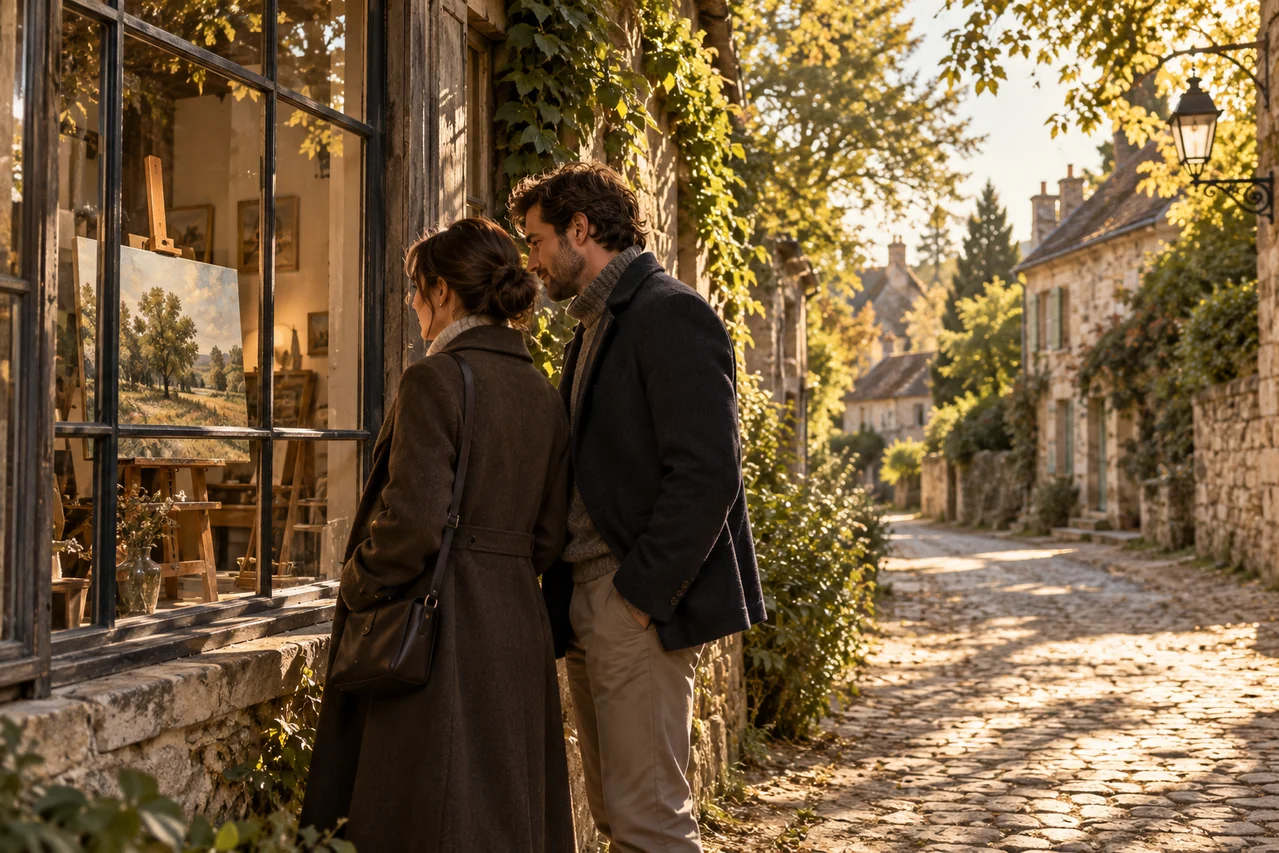
A village close to a varied working landscape
Barbizon's position beside Fontainebleau gave painters access to woodland, rocks, clearings and rural life. These surroundings offered repeated opportunities for observation rather than one fixed scenic composition. Returning to a subject allowed an artist to notice variations of light and form, while village life linked the landscape with human activity. The appeal was consequently both visual and practical. Travelers following this history should look beyond an idealized image of artists discovering empty wilderness: the environment was inhabited, used and continually changing.
The Barbizon school was not one shared recipe
The label groups artists associated with a place and with nineteenth-century landscape painting. It does not describe a formal school in which every painter followed an identical doctrine. Different careers, subjects and methods coexist beneath it. This is useful for visitors because art history becomes more interesting when classifications open questions rather than close them. One can recognize a shared attention to nature while still asking why a particular artist emphasized woodland structure, rural labor or a certain quality of light.
Outdoor observation and studio work could cooperate
Working in front of nature enabled direct study of colors, shapes and atmospheric conditions. It does not follow that every finished painting was completed entirely outdoors. A painter could bring observations and studies back into a studio and continue selecting, organizing or transforming them. The distinction reveals the creative work involved: a canvas is not simply a transparent copy of a view. For travelers, observing the actual surroundings can therefore help explain artistic choices without expecting the landscape to reproduce a painting exactly.
Rousseau gives trees a strong presence
Théodore Rousseau is closely associated with Barbizon and with attentive representations of the forest. Trees and woodland could occupy a painting with a seriousness that did not depend on a grand historical event occurring in the foreground. That shift changes what deserves a viewer's time. An old trunk, its silhouette and the space around it can become a substantial subject. This close relationship also connects with artists' role in protecting Fontainebleau, where aesthetic attention develops into concern for the real landscape.
Millet makes rural work part of the story
Jean-François Millet's connection with Barbizon opens a different emphasis: the people who inhabited and worked the rural environment. Landscape is not merely a place of leisure for the painter or visitor. It supports lives and labor, whose presence can be central to the image. This perspective corrects the idea of a wholly empty natural setting. Travelers can compare the forest as a visual subject with the surrounding countryside as a lived environment, recognizing that artistic treatments of the same territory need not share the same priorities.
Networks matter more than one inventor of modernity
The development of French landscape painting extends beyond Barbizon alone. Corot, Daubigny and other artists contributed to changing practices, while later painters encountered and transformed earlier work. Daubigny also provides a connection with Auvers-sur-Oise before Van Gogh's arrival there. These relationships are more informative than a neat sequence of movements replacing one another. An artistic journey linking Auvers and Giverny can build on them, provided each artist's period and approach retain their specificity and Van Gogh is not mislabeled an Impressionist.
Barbizon prepares questions that Impressionism answers differently
Outdoor study and the growing importance of landscape contributed to an artistic environment in which Impressionists pursued their own investigations. That connection does not make Barbizon painting identical to Impressionism. For international travelers, the distinction can clarify familiar museum labels: continuity exists alongside differences of technique, subject and ambition. A visit to Fontainebleau might begin with why nature became a sustained subject; a later Giverny chapter can concentrate on Monet's particular transformation of garden, light and repeated observation into painting.
Use the forest to make art history tangible
Walking before discussing paintings gives guests their own experience of selection and framing. Why notice this tree instead of another? What changes when the viewpoint shifts? Such questions make the landscape intellectually active without requiring technical expertise. The Grand Veneur Encounter can add a contrasting legendary reading of the same forest, while remaining clearly separate from the artists' documented lives. For advisors, the combination is strongest when the transition has a purpose: from a forest imagined through royal folklore to a forest studied, painted and valued through artistic attention.
FOR YOUR GUEST ITINERARIES
Planning a French painting journey for your guests? Discuss with Elyrea how Fontainebleau's Grand Veneur Encounter can complement an itinerary around Barbizon, Giverny or Auvers-sur-Oise.
Discuss your itinerary