
Start with a forest that people already used
Historical Fontainebleau was not a sanctuary untouched by human activity. Hunting, forestry and the exploitation of stone formed part of its life, alongside the movement of local communities. This starting point matters because preservation did not simply mean maintaining an entirely unaltered landscape. It introduced another claim upon a place already valuable for several reasons. The story is therefore about competing uses and changing priorities: a tree might be useful timber, an obstacle to management or an irreplaceable subject in an artist's eyes.
Painting gives an ordinary tree a public presence
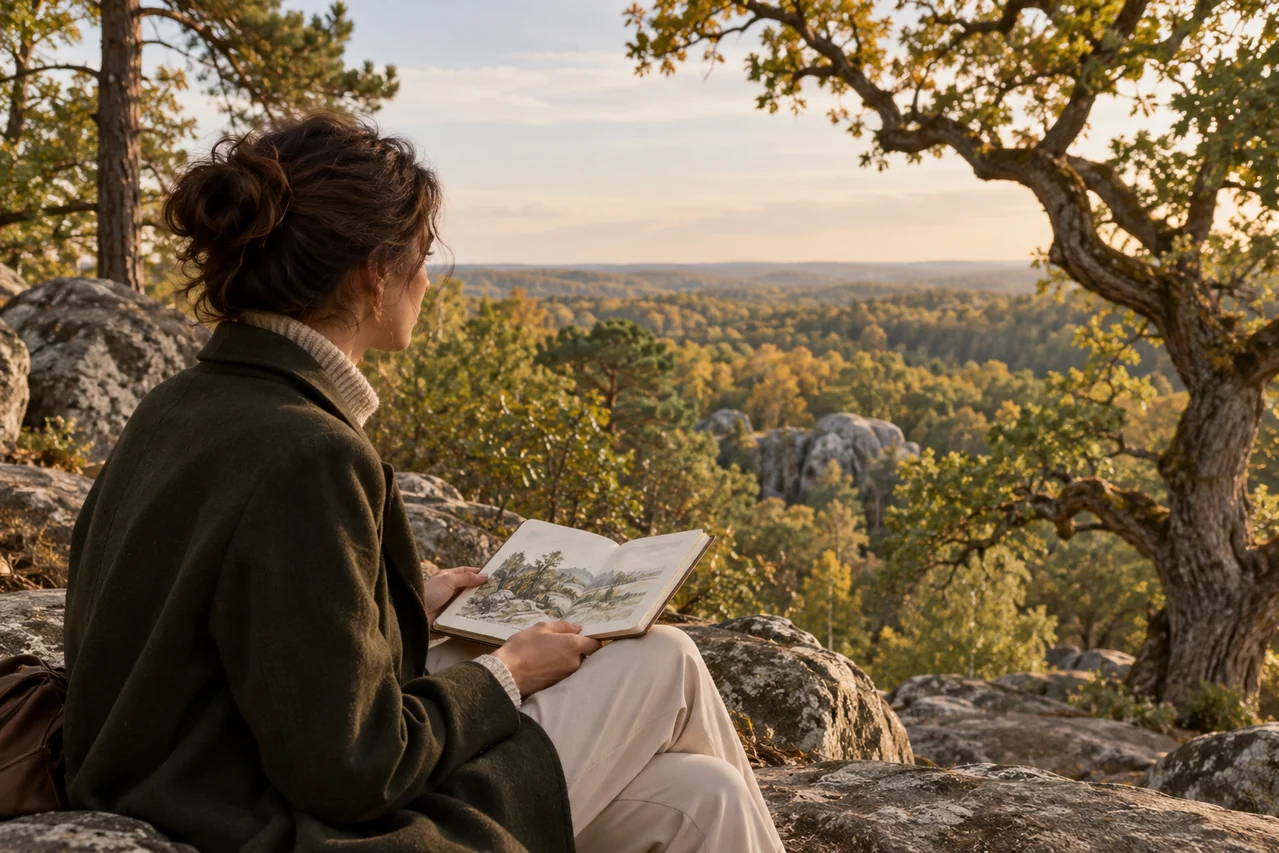
An artist selects a view, attends to it and makes it visible to people who may never have visited the forest. What appeared merely practical or commonplace can acquire aesthetic importance through that attention. The painting does not create the tree, yet it changes the way an audience values it. When the real subject is threatened, its loss may consequently be understood as a cultural loss. This connection between observation, representation and concern helps explain why painters became involved in defending landscapes they knew closely.
Barbizon created a sustained relationship with place
Nineteenth-century artists associated with Barbizon worked around Fontainebleau, finding material in the forest and rural environment. Théodore Rousseau and Jean-François Millet belong to this history, although their subjects and approaches were not identical. Their repeated attention made the territory an artistic environment rather than a convenient view encountered once. Why painters chose Barbizon is a useful companion question: proximity, varied motifs and continuing observation help explain how familiarity can become attachment, and how attachment can lead toward advocacy.
Rousseau links artistic attention with defense
Théodore Rousseau's relationship with Fontainebleau illustrates how a painter could move from studying trees and woodland to caring about their future. The important point is not to turn him into a modern environmental campaigner with contemporary terminology. His concerns belonged to the artistic and cultural conditions of his time. Nevertheless, his example shows that representation need not remain detached from the represented place. The forest that provides a subject can also become a landscape whose continued character matters to the artist.
What the idea of an artistic reserve reveals
The expression artistic reserve identifies a particular basis for protection: the beauty and visual importance of a landscape. That differs from arguments centered primarily on biodiversity or the scientific functioning of an ecosystem. It is significant because scenery is being treated as worth preserving beyond immediate economic use. The forest becomes a kind of heritage that cannot be reduced to buildings or objects. Understanding this historical vocabulary helps travelers appreciate the innovation without projecting every concern of contemporary conservation onto nineteenth-century advocates.
Walkers and named routes extended this new attention
The development of paths and guides also helped visitors discover Fontainebleau as a landscape to explore. Claude-François Denecourt is closely associated with that nineteenth-century organization of the forest's recreational geography. Identifying a viewpoint, naming a formation and directing a walk all influence what people notice. These practices do not produce the underlying nature, but they create a framework for seeing it. Painting, walking routes and published descriptions could consequently reinforce one another as a wider public came to value the forest aesthetically.
Beauty is one reason for protection, not the only one
The history invites a contemporary question: would a less spectacular environment still deserve care? Artistic value helped make particular landscapes visible, while other reasons for preservation developed through different forms of knowledge. Ecological importance cannot be judged simply by whether a place makes an attractive picture. Fontainebleau is useful precisely because it shows how motivations change and accumulate. A thoughtful cultural discussion recognizes the contribution of aesthetic appreciation while leaving room for habitats, species and processes that are not immediately picturesque to visitors.
Make preservation part of a layered excursion
The legendary Grand Veneur offers another cultural attachment to the forest: a tradition that gives the territory narrative personality. It is folklore, distinct from the documented history of artistic advocacy, yet the two perspectives can enrich one day. A cultural Fontainebleau itinerary might move from the imagined royal hunt to the painter's sustained gaze and the question of preservation. The resulting experience links story and landscape without implying that artists alone protected the forest or that a supernatural tale proves historical events.
FOR YOUR GUEST ITINERARIES
Building an itinerary around art and landscape? Elyrea can help connect Fontainebleau's layered history with a Grand Veneur Encounter and the interests of your guests.
Discuss your itinerary