
There is no universal magic number
Three museums, a monument and a private encounter may fit on a timetable without forming a successful day. The useful number depends on the group’s pace, familiarity with the subject, travel distances and the function of each stop. One defining cultural anchor plus a lighter second chapter is often more rewarding than three appointments of equal intensity. Two substantial experiences can work when they answer one another and transfers are short. This is not a medical threshold or a sales formula. It is a planning baseline that an advisor reshapes around actual guests rather than an abstract idea of productivity.
Count attentional peaks, not map pins
A two-hour reservation consumes more than two hours of attention. Approach, security, coat check, orientation, leaving the building and the conversation that follows all belong to the experience. Lunch may restore energy or become another demanding appointment. A chauffeured transfer may offer recovery or continue the interpretation. Advisors should therefore count cognitive peaks, not only itinerary lines. A museum morning followed by an embodied historical Encounter represents two dense chapters even when several photographic pauses appear between them. This method reveals pressure that a neat schedule can otherwise conceal.
What museum fatigue can and cannot tell us
Research on museum fatigue does not provide one countdown for every visitor. It covers several effects: declining viewing time, physical discomfort, satiation and the influence of expectations. Recent work also suggests that whether a visit feels appropriately long may matter more to restoration than objective duration alone. That evidence argues against a simplistic ninety-minute rule. Gallery density, route freedom, prior interest and the ability to stop all change the experience. Luxury in this context means preserving a guest’s freedom to keep looking—or to leave before distinct works dissolve into a generalized impression.
Build around an anchor and a counterpoint
The most reliable structure pairs a primary anchor with a counterpoint. The anchor gives the day its purpose: a collection, historic district, house or narrative Encounter. The counterpoint changes the mode of attention. After galleries, it might introduce a human voice; after political history, it might invite observation in a garden or street. Choosing morning, afternoon or evening helps place these chapters according to guest energy. Their relationship matters more than their individual fame. Two experiences that demand exactly the same kind of concentration compete rather than deepen one another.
Transitions are part of the product
In Paris, a short line on a map can become a long transition once traffic, security, cobblestones or a change of bank enter the equation. Premium planning makes those intervals visible instead of treating them as blank space. How much buffer time belongs between visits? protects reservations and mental availability. A margin lets guests sit, drink water, discuss what they saw and arrive without being rushed. If the itinerary works only when every car, ticket and doorway behaves perfectly, it is already too dense for a high-end service.
Match volume to the guest, not status
An intergenerational family, a collector, travelers arriving from a long-haul flight and a group of architects will not share the same stamina or priorities. Mobility, heat, jet lag and sensory needs matter as much as historical knowledge. Tailoring cultural depth to prior knowledge also corrects a frequent assumption: specialists do not necessarily want more stops. They may prefer fewer places and more time with one difficult question. A useful brief asks what guests hope to remember, not how many famous names they expect to check off.
Three workable day designs
A single-hero day suits arrival dates, families or subjects intended for deep attention: one major experience, an unhurried meal and free time. A two-chapter day places an anchor and counterpoint around a genuine pause; for many clients, this is the most dependable balance. A three-stop design remains elegant only when one component is light, flexible and geographically close. Three fixed-time visits rarely feel luxurious. Every version also needs a pressure-release decision: identify which element can be shortened or removed if the day changes without destroying the overall promise.
B2B guidance: design the memory first
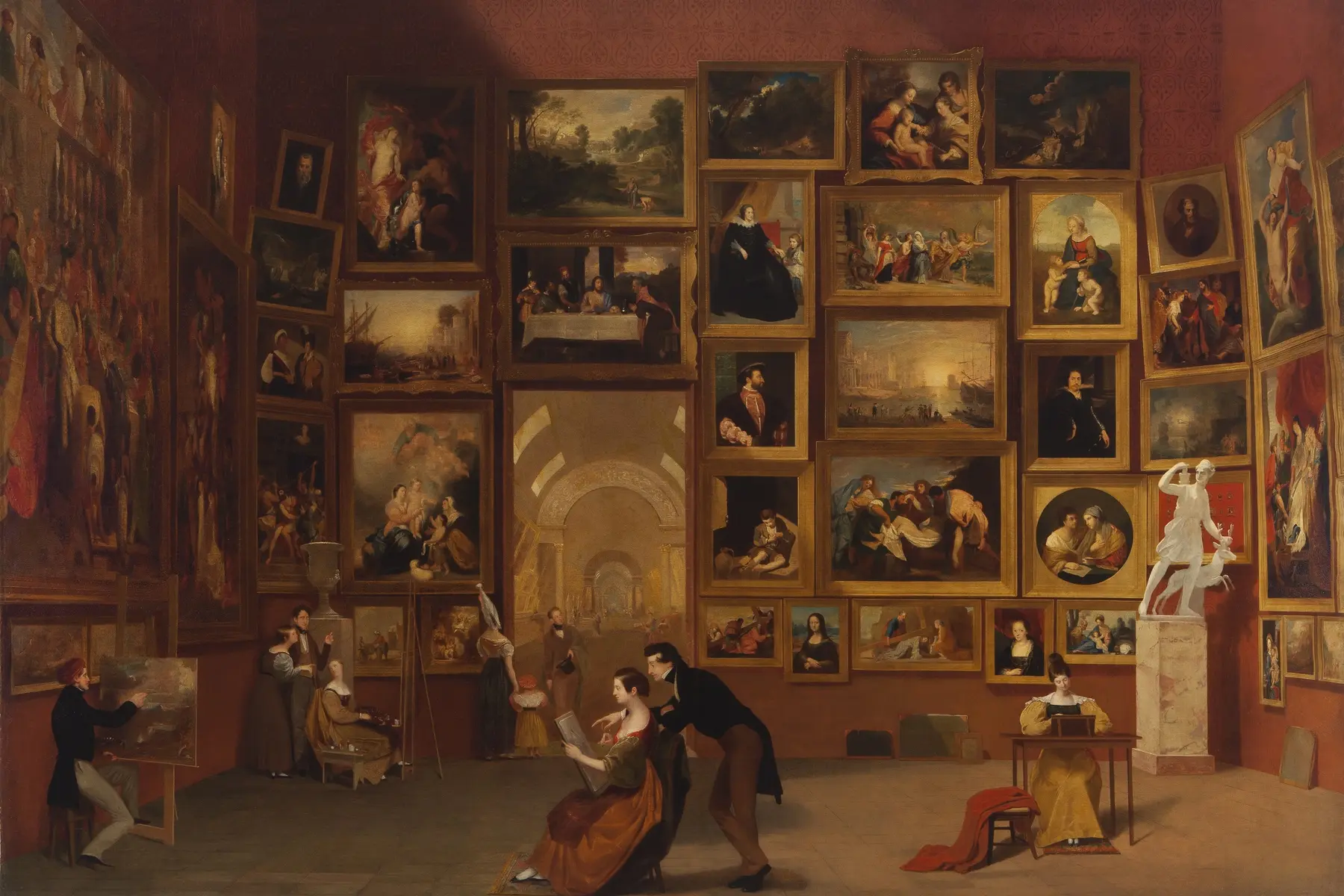
Before adding an appointment, ask four questions: what moment will guests retell, what relationship connects the chapters, where does recovery happen and what survives a delay? If the answers are vague, the extra stop is filling time rather than creating a narrative. Samuel Morse’s painting reproduced here surrounds viewers with art and other viewers; it illustrates the challenge of selection, not a present-day Elyrea service. A premium cultural day does not attempt to display everything Paris contains. It creates enough space around a few encounters for each one to remain distinct.
FOR YOUR GUEST ITINERARIES
Elyrea helps travel houses design Paris cultural days around sustained attention, purposeful transitions and stories guests can genuinely retain.
Discuss your itinerary