
A simple question with no binary answer
Asking whether Joan of Arc could write sounds straightforward, but the surviving record separates several skills that modern readers often combine. She relied on clerks to prepare letters, as many powerful people did in the fifteenth century. Three documents nevertheless carry the name Jehanne in a hand scholars attribute to her. That evidence does not establish fluent composition or effortless reading. It does show that her relationship to writing was more active than the label “illiterate” may suggest. The useful question is not whether she fits a modern literacy category, but which parts of written communication she could perform and what those acts meant.
Dictation was part of public authority
Joan sent messages to towns, commanders and enemies. A clerk’s pen did not make those messages less hers. Authority traveled through spoken instruction, formal wording, seals, messengers and the reputation of the sender. Medieval government depended on teams capable of turning decisions into documents. The records of Joan of Arc’s trial reveal a similar process: spoken answers survive because notaries selected, organized and copied them. Reading a letter therefore requires attention to every participant in its production. Authorship belonged to a chain of action rather than exclusively to the person who formed each letter on the page.
Three surviving signatures attributed to one hand
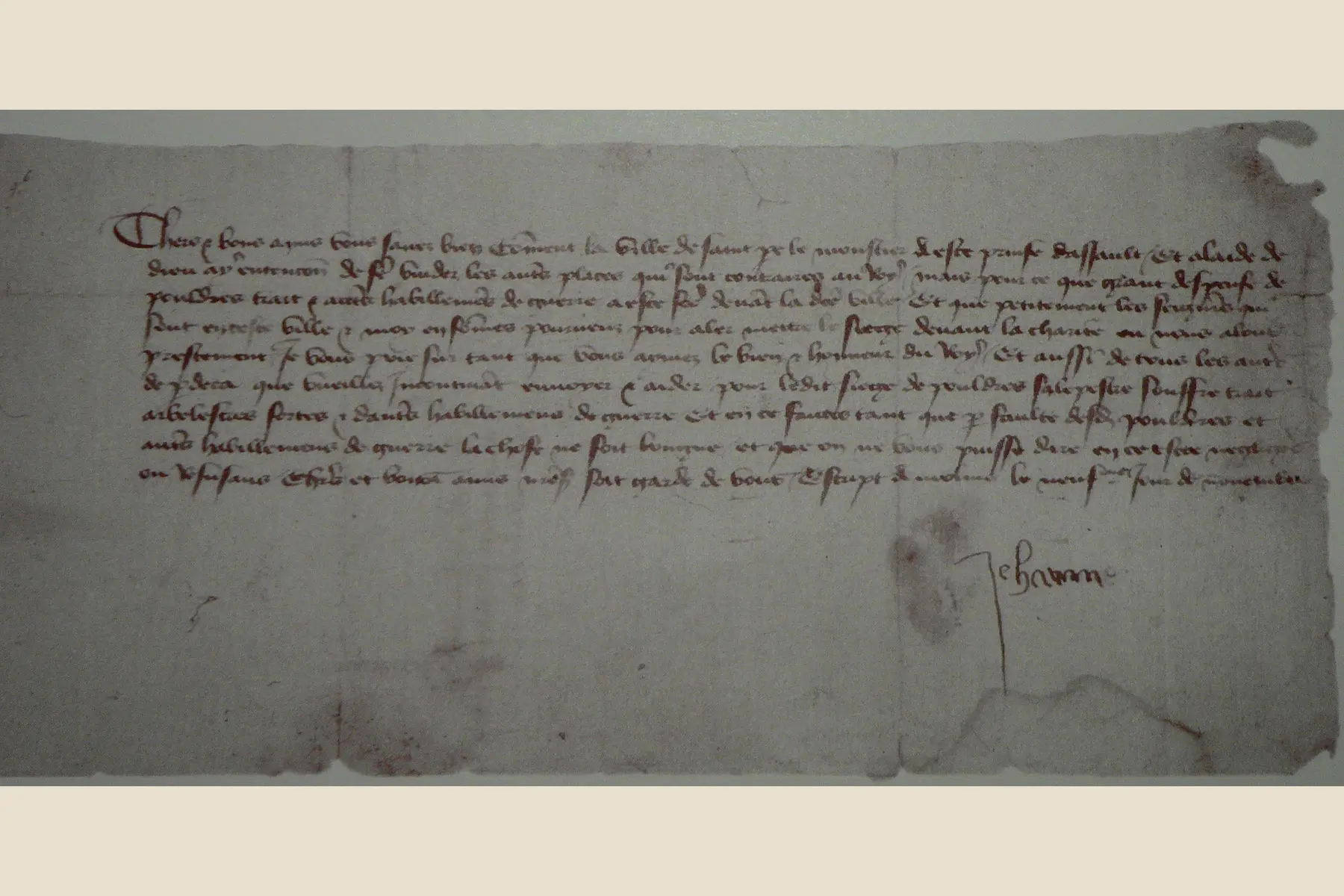
Scholars generally identify three surviving Jehanne signatures. One appears on a letter to the people of Riom dated November 9, 1429; two others belong to letters of March 16 and March 28, 1430. A paleographic study published through the Société nationale des Antiquaires de France compared their forms and argued that the same hand made them. The letters of the name vary and appear uncertain. Rather than disqualifying the signatures, that hesitation is consistent with limited practice. They preserve the movement of someone learning a narrow graphic skill while conducting military and political business.
The Riom letter was a practical request
The Riom document is not a private confession. Joan asked the town’s consuls for powder and supplies during the campaigns of late 1429. Her signature therefore belongs to operational communication. It joins a public name to a concrete request transmitted by officials and messengers. The physical document, now preserved in the municipal archives, also reminds us that letters are objects: paper, folds, ink and routing carried the message across distance. Jehanne does not replace the professional text above it. The signature adds an individual gesture to a document whose effectiveness depended on collective administrative work.
Learning a signature is not learning to draft
A person may memorize the motions of a name without gaining the ability to compose a page or read every script with confidence. Joan’s signatures therefore cannot prove that she wrote the proclamations associated with her. They are better understood as evidence of targeted learning. A recognizable personal mark would have mattered to a young leader whose identity and legitimacy were constantly tested. The gesture sits between two misleading extremes: it is neither a certificate of full literacy nor a meaningless flourish. Its importance comes from the narrow, deliberate acquisition of a written identity during an exceptionally compressed public life.
The trial reveals intelligence, not a school transcript
The trial record displays memory, verbal agility and the ability to answer hostile questioning. Those qualities do not establish formal schooling, but they expose the limits of equating intelligence with book learning. Oral culture could carry sophisticated religious, political and local knowledge. Notaries then translated Joan’s spoken performance into written proceedings, sometimes in Latin and through several stages of copying. Was Joan of Arc’s trial rigged? examines the institutional pressure behind that archive. Every apparent quotation should prompt three questions: who spoke, who wrote and which version survived?
How a signature became a documentary relic
The rarity of autograph traces gives the name Jehanne unusual emotional force. A visitor may feel that six centuries collapse into a few uneven strokes. Historical method must accompany that sensation through provenance, dating and comparison of hands. A signature is not a psychological portrait, and it cannot tell us everything Joan thought about her own image. It records one action within a particular administrative chain. At Rouen, later memorial culture repeatedly turned Joan into an immediately recognizable symbol. The Place du Vieux-Marché and Joan’s public memory shows how strongly subsequent generations shaped that encounter.
B2B guidance: begin with evidence, then recover the voice
For travel advisors, the letters create intimacy without inventing private thoughts. The Elyrea Encounter devoted to Joan of Arc can follow a message from spoken intention to clerk, seal, messenger and recipient, before pausing over the signed name. The narrative should distinguish established evidence from probability and debate. It can then restore the tension of a young commander whose words traveled farther than her own writing skills. Premium interpretation emerges when the document is not treated as a mute relic, but as the setting of a decision, an apprenticeship and an authority taking visible form.
FOR YOUR GUEST ITINERARIES
Designing a journey around Joan of Arc? Elyrea turns documentary evidence into a precise and vivid Encounter.
Discuss your itinerary