
Today's open views are part of a later city
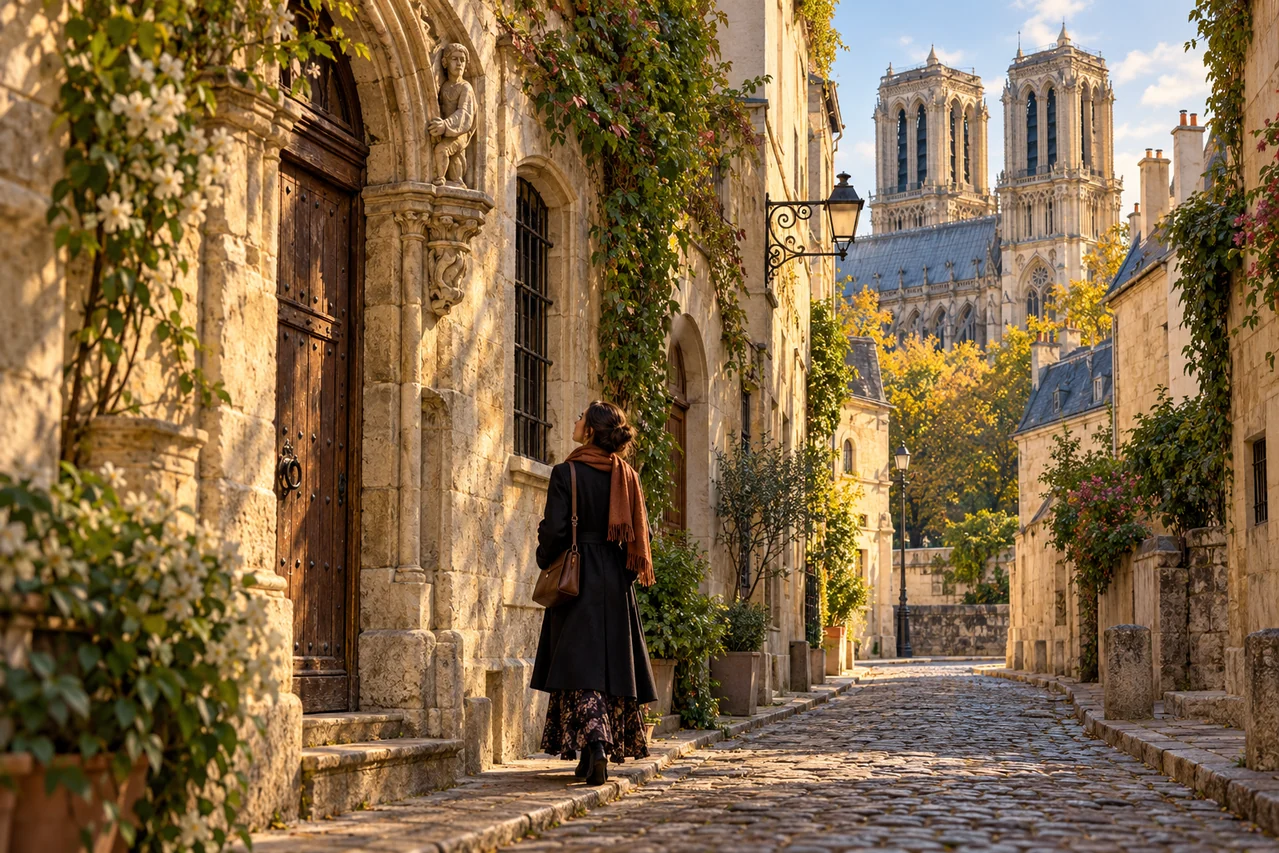
The medieval Île de la Cité was more densely built than the setting visitors recognize around Notre-Dame today. Narrower streets, houses, religious buildings and activity stood closer to the cathedral. The open space through which we now see the monument is therefore itself a historical result, rather than a neutral frame around an unchanged object. This is an effective first observation because it requires no specialist knowledge: the traveler can consider how a different density would alter light, movement and scale. Looking at what seems empty can reveal urban change as clearly as looking at a surviving facade.
The neighborhood changed through many different processes
Paris has repeatedly been rebuilt through damage, changing uses, political decisions and planned works. The nineteenth-century transformation of the city, including changes during the Second Empire, substantially affected older urban environments. No single intervention explains every absence around Notre-Dame, and it would be misleading to replace a fantasy of an untouched medieval quarter with an equally simple story of one destructive moment. A useful visit makes change legible without overloading it with every date. The traveler learns that the city visible now is a selection of surviving elements and later choices, rather than the complete physical record of one era.
Notre-Dame also contains more than the Middle Ages
The cathedral preserves medieval structure and elements, but it carries later modifications and restorations. The work associated with Lassus and Viollet-le-Duc in the nineteenth century is particularly important to its familiar appearance. After the 2019 fire, the twenty-first-century restoration added another major stage. Calling the building medieval is valid as a broad description, yet it does not mean every detail belongs to its initial construction. This distinction gives the visitor a better question: which history does a particular feature represent? It also explains why Notre-Dame after its reopening remains a subject of discovery even for someone who already knows the monument.
Nearby monuments offer different medieval histories
Sainte-Chapelle and the Conciergerie can help introduce aspects of medieval Paris, but they are not interchangeable fragments of one setting. Each site has its own chronology, later changes and cultural role. An advisor can connect them thematically through the island, monarchy, religion or urban life while preserving their differences. It would be inaccurate to imply that every old building nearby is a location in Hugo's plot or appears exactly as it did in 1482. A well-chosen route teaches travelers to compare histories rather than merge them. That comparison often produces a more durable understanding than simply calling an entire neighborhood medieval.
Hugo's map is literary rather than archaeological
Notre-Dame de Paris was written in the nineteenth century and places its story in 1482. Hugo reconstructed the earlier city through knowledge, research and imagination, but his narrative is not an archaeological plan. It tells us about his vision of the Middle Ages as well as about the period he describes. This double perspective makes the novel especially useful for cultural travel. Visitors can ask both what the actual city was like and why Hugo wanted to evoke it as he did. Notre-Dame as a literary character develops the second question, keeping the imaginative city from being mistaken for documentary evidence.
Absence can invite active participation
A vanished street or a changed perspective asks the traveler to do something more than look. They must imagine a different density, a route that no longer exists or a building partly hidden by its surroundings. A character-led encounter can give that mental reconstruction continuity: Esmeralda evokes a literary world without claiming the setting survives unchanged. The distinction between evocation and proof should remain clear. The value lies in learning how to observe a place with knowledge of what is missing. This kind of participation can be especially rewarding for guests who have already visited Notre-Dame and need a new reason to pay attention.
For families, begin with practical questions
Young visitors often respond to questions about movement, sound and space more readily than to a list of construction dates. How would people pass through a narrow street? What would be visible behind a crowd? How might a large building feel when other structures stood much closer to it? Those questions should be framed as careful imagination, with historical specifics supplied only where supported. They allow children and teenagers to see urban history as a changing environment inhabited by people. A family itinerary around Notre-Dame develops this approach and considers how literary themes can be adapted without falsifying the original story.
Build a route around layers rather than secrets
A returning visitor does not necessarily need an unknown attraction. Distinguishing the visible city, its surviving traces and its imagined past can make a familiar setting newly interesting. Plans, archaeology, monuments and literature contribute different kinds of evidence, and the itinerary should preserve those differences. The Esmeralda encounter provides access to Hugo's fictional Paris while encouraging questions about the actual neighborhood. Its promise is a richer reading of place, rather than entry to a hidden city untouched by history. That approach makes the Île de la Cité a setting for inquiry, where what has disappeared can matter as much as what remains.
FOR YOUR GUEST ITINERARIES
For returning guests or families curious about the city beneath modern Paris, ask Elyrea how Esmeralda can connect Notre-Dame with an imaginative but historically careful exploration of the Île de la Cité.
Discuss your itinerary