
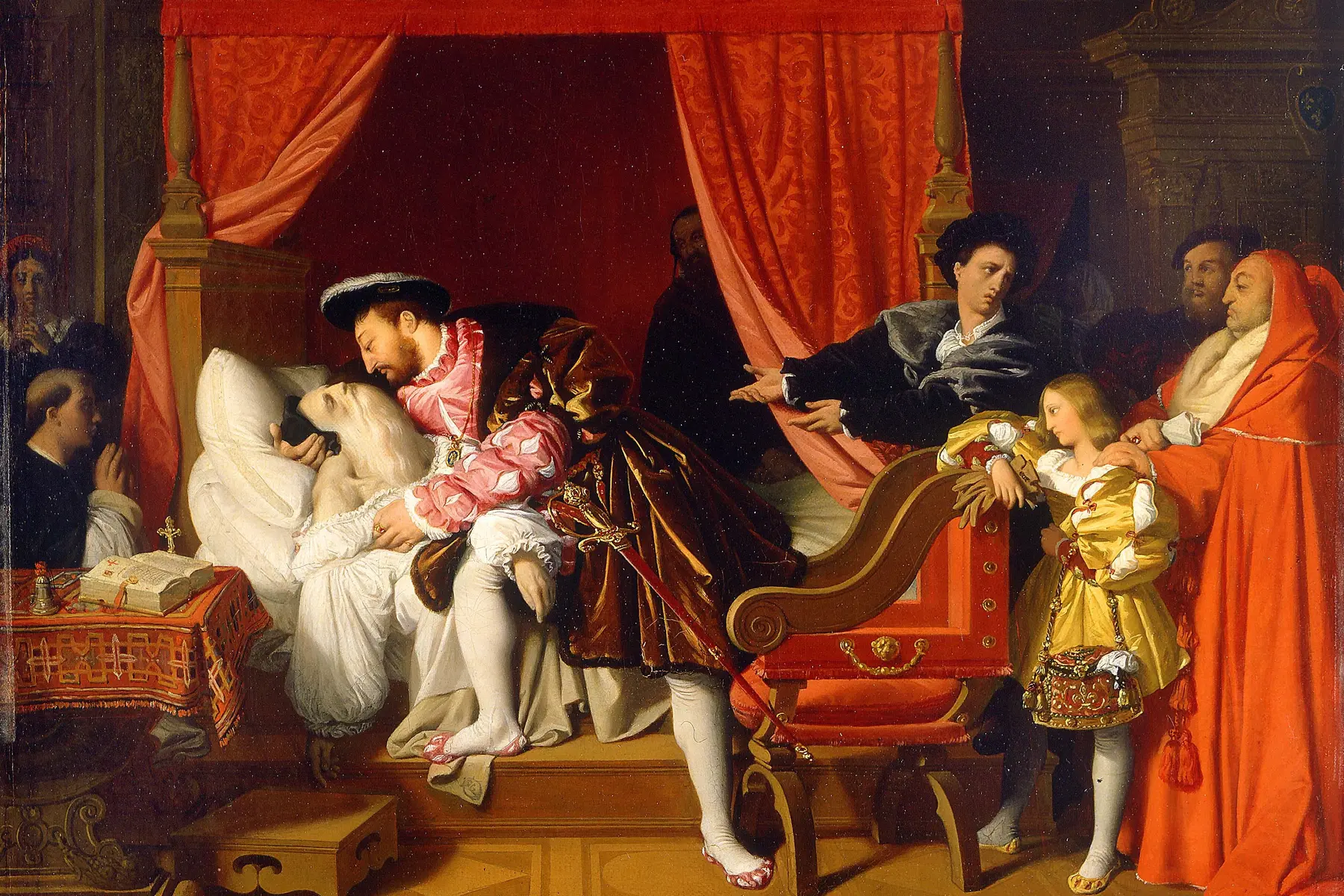
An image more famous than the event
Francis I bends over Leonardo while the dying master rests in the young king’s arms. The image feels so convincing that it is often repeated as fact. It compresses France’s admiration for an Italian genius into a moving final encounter. Yet a persuasive picture is not an eyewitness record. The Ingres painting used here was made in 1818, almost three centuries after Leonardo’s death. It expresses a Romantic vision of the Renaissance rather than an observed moment. The useful question is therefore not only whether the episode happened. It is also why artists, writers and audiences wanted it to be true, and what that desire reveals about the cultural prestige attached to Leonardo’s final years in France.
What we know about May 2, 1519
Leonardo died at Clos Lucé in Amboise on May 2, 1519, after roughly three years in France. The official Clos Lucé account places his death in his bedchamber and supplies the decisive detail: Francis I was at Saint-Germain-en-Laye, where the court was awaiting the birth of his second son. The king therefore could not have received Leonardo’s last breath in Amboise. His absence does not weaken the real relationship or the royal protection Leonardo enjoyed. It simply separates historical patronage from an imaginary ending. Leonardo’s final years in Amboise provides the physical and chronological setting needed to understand that distinction.
Vasari and the appeal of a perfect ending
The deathbed scene is closely associated with Giorgio Vasari’s Lives, his influential sequence of artists’ biographies first published in 1550 and expanded in 1568. Vasari did not witness Leonardo’s death. He wrote decades later and shaped exemplary lives in which episodes also demonstrated artistic greatness. Having Leonardo die in a king’s arms gives his reputation a perfect final form: genius receives the homage of temporal power. The motif holds symbolic truth because Francis I genuinely honored and supported Leonardo. It does not carry the evidentiary value of a contemporary record. Cultural history must read both dimensions at once—the story’s extraordinary efficiency and the documentary weakness of its literal claim.
A real royal relationship without the deathbed
Leonardo entered France at Francis I’s invitation in 1516 and settled at Clos Lucé near the royal château of Amboise. The king provided status, income and a setting in which Leonardo could continue to draw, design and converse. Their relationship was broader than the conventional role of court painter. Leonardo could be consulted as an inventor, festival designer, architect and intellectual presence. His plans for Romorantin reveal how political ambition met urban imagination. This documented closeness made the later legend believable. It also suggests a better narrative: describe patronage across three productive years instead of reducing it to one final embrace contradicted by the court’s location.
Ingres painted monarchy as much as Leonardo
When Jean-Auguste-Dominique Ingres painted The Death of Leonardo da Vinci in 1818, he was not reconstructing a room according to modern historical method. He arranged a solemn theater in which king, artist and witnesses embody a cultural order. Francis I becomes the sovereign capable of recognizing genius; Leonardo becomes the welcomed foreign master whose greatness also glorifies France. Fabric, gesture and light give death a ceremonial dignity. The work therefore offers precise evidence about how the nineteenth century wished to see the Renaissance. Its image credit is deliberately explicit: this public-domain painting illustrates the legend and its reception. It does not serve as visual proof of what happened in 1519.
Why does the legend endure?
Three forces keep it alive. First, it is memorable: two famous figures, one affectionate gesture and a terminal date. Second, it translates a complex cultural policy into an accessible scene. Third, it answers a national desire to picture France receiving the genius of the Italian Renaissance. The king’s documented absence at Saint-Germain-en-Laye seems mundane by comparison. Yet that detail opens a richer discussion of court travel, communication and commemoration. As with the mechanical lion associated with Francis I, uncertainty is not an interpretive failure. It reveals how an event acquires symbols, how later generations select what to remember, and how images can outweigh archives in popular memory.
Visiting Amboise with critical imagination
At Clos Lucé, an itinerary can begin with place: Leonardo’s bedchamber, the nearby royal château, workshops and the Loire landscape. Four levels then become visible. Dates and locations form the documented base. Later biography shows a reputation being constructed. History painting gives a subsequent interpretation physical form. The visitor’s response belongs to the present. This method does not cool the experience; it deepens it. Explaining that Francis I was elsewhere leads to a more demanding question about what it means to protect an artist. Patronage consisted in income, time, proximity, attention to projects and the transmission of work—not merely a poignant gesture invented for a later audience.
B2B guidance: make correction feel privileged
For travel advisors, the gap between legend and archive creates a powerful narrative sequence. Present Ingres’s painting before disclosing the answer, then test it against the Clos Lucé chronology. Surprise becomes a tool of attention rather than a rebuke to the guest. The Elyrea Encounter devoted to Leonardo da Vinci can connect this inquiry to objects, landscapes and the artist’s French ambitions. The guide should never replace myth with dry correction: intellectual friendship and royal patronage remain central. Cultural luxury lies in nuance—the ability to offer an emotion that becomes stronger, not weaker, because the audience understands how evidence and imagination shaped it.
FOR YOUR GUEST ITINERARIES
Let Elyrea turn Leonardo’s final French years into a documented journey through royal patronage, creative work and the making of memory.
Discuss your itinerary