
A small motif with dynastic work to do
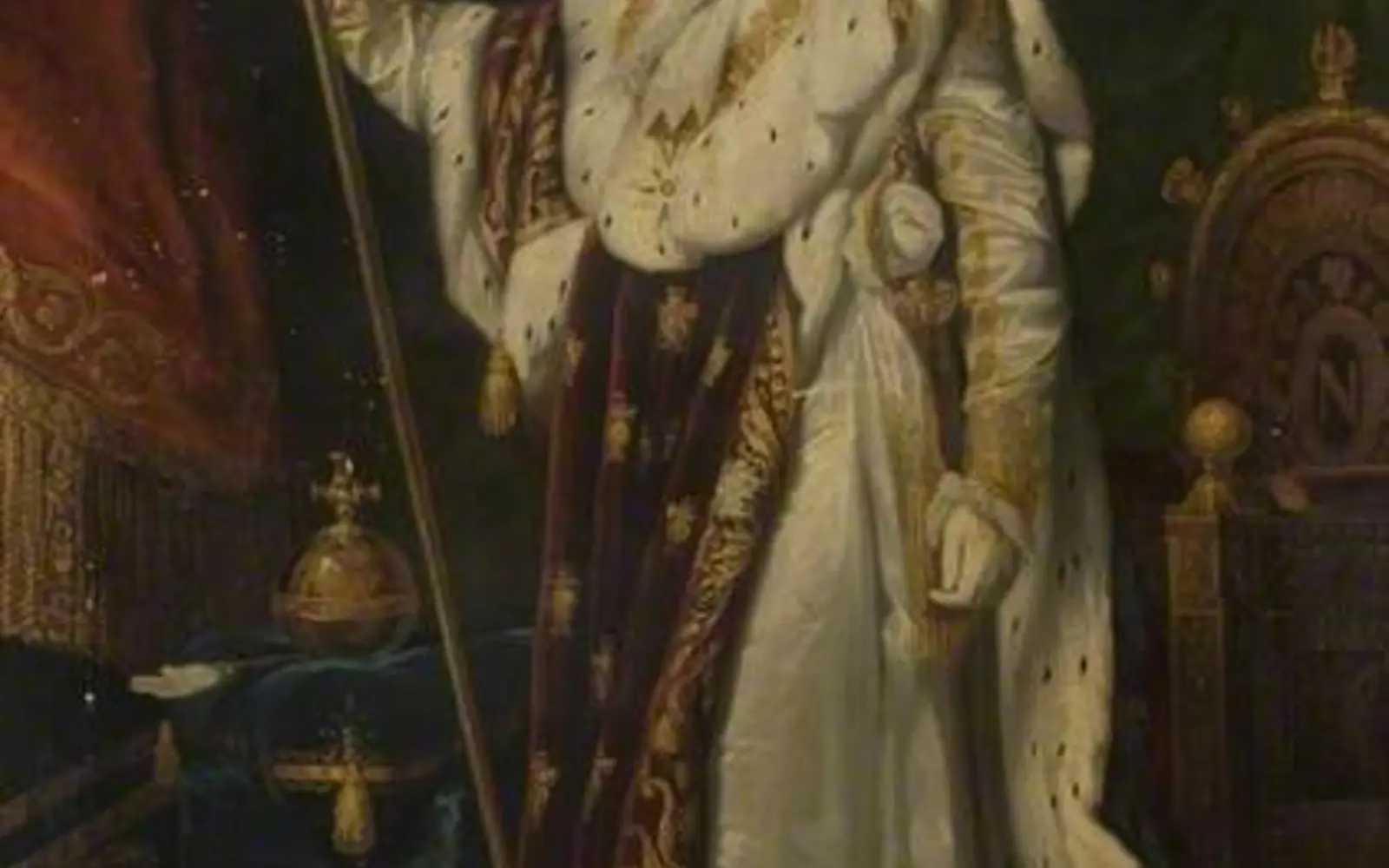
In state portraits, the bee looks modest beside the throne, scepters and eagle. Yet it repeats across the imperial mantle and throughout official interiors. The choice belonged to the construction of a dynasty in 1804. Bonaparte was not merely leading another government; the new Empire needed a visual vocabulary that could be recognized and repeated. Napoleon’s coronation explains the ceremony. The bee shows how a detail of textile design could support a much larger claim about political continuity.
Reaching behind the Bourbon monarchy
The Fondation Napoléon explains that the bee connected the new dynasty with what the regime presented as France’s earliest royal origins. In 1653, Childeric I’s tomb at Tournai yielded small gold-and-garnet ornaments interpreted as bees, although some scholars describe them as cicadas. As the father of Clovis, Childeric offered a Merovingian reference far older than the Capetian line. Invoking him allowed Napoleon’s designers to bypass the Bourbon fleur-de-lis without surrendering the authority of a deep royal past.
The bee did not replace the eagle
The Empire never relied on one emblem. The eagle became its most forceful military and heraldic sign, while bees spread across robes, apartments and ceremonial objects. Their functions overlapped but were not identical. The eagle suggested command and victory; the bee evoked dynastic continuity, order and renewal. Treating the whole system as a modern logo misses its richness. Monograms, laurel wreaths, crowns, stars, eagles and bees could occupy the same setting, creating an environment in which authority was communicated through accumulated signs.
A decision made in 1804
The emblem was debated as the Empire was proclaimed. Childeric supplied an argument from antiquity, but artists and officials still had to turn that reference into a usable visual system. That process is historically revealing. An archaeological find, scholarly interpretation and political decision were combined to manufacture tradition. On official portraits the bee appears timeless; in fact, its imperial meaning was assembled at a precise moment. For travelers, recognizing that construction is more illuminating than accepting the symbol as an inevitable inheritance.
From coronation robes to palace interiors
A Fondation Napoléon study of Empire decorative arts lists bees among the regime’s new symbols alongside the eagle, Napoleon’s initial and the victor’s laurel. The motif appeared on fabrics, bindings, porcelain, furniture and architectural decoration. Repetition turned an emblem into a setting. Napoleonic traces in Paris are therefore not limited to monumental architecture. A small recurring device on a surface or object can reveal how political identity was designed for daily visibility.
Reading Gérard’s ceremonial portrait
The portrait attributed to François Gérard used here presents Napoleon in coronation dress. Golden bees punctuate the red mantle, attracting attention through repetition rather than scale. This is an official representation, not documentary evidence of every detail worn on December 2, 1804. It nevertheless shows how the emblem functioned within an image intended to make sovereignty visible. The public-domain artwork has been center-cropped for the Journal, emphasizing the relationship among figure, fabric and symbols without altering the represented object.
An emblem inside a larger political story
The bee worked alongside bulletins, ceremonies and monuments to make the regime’s account of itself coherent. How Napoleon built his legend also cautions against confusing imperial communication with the events it framed. The motif does not prove an institutional line from Childeric to Napoleon. It asserts a symbolic genealogy selected by the new regime. That gap between historical evidence and political meaning is precisely why the bee matters: it shows international guests what power wanted viewers to recognize.
B2B guidance: let one detail open the conversation
For advisors, the bee creates a focused observation prompt without requiring privileged access. Ask guests to locate the motif, then compare it with an eagle or fleur-de-lis and consider what each sign communicates. The Elyrea Napoleon Encounter can extend that observation into a discussion of strategy, legitimacy and memory, subject to separately confirmed availability. The aim is not to memorize a single symbol. It is to see how power turns history, art and place into a persuasive language.
FOR YOUR GUEST ITINERARIES
With Elyrea, learn to read Napoleonic emblems as political language embedded in monuments, portraits and decorative objects.
Discuss your itinerary