
A name now inseparable from alchemy
For international visitors, Nicolas Flamel often arrives through fantasy: the philosopher’s stone, the transmutation of base metal into gold and the promise of an unnaturally long life. That version feels ancient because it has been repeated so often. The surviving record, however, introduces a different Parisian. Flamel worked as a public scribe and copyist around the turn of the fifteenth century, built property interests with his wife Pernelle and supported religious and charitable works. His historical life is substantial without any verified alchemical experiment. The most rewarding encounter begins by noticing the gap between a famous name and the evidence attached to it.
What the documents actually show
Legal and administrative records place Flamel inside the practical economy of medieval Paris. He prepared documents, acquired property and arranged donations. Pernelle’s assets and the couple’s financial decisions are essential to this story. Later readers sometimes treated their prosperity as evidence that Flamel had manufactured gold, yet wealth is not proof of transmutation. Professional income, property and inheritance provide a documented explanation. Why does Paris have so many dark legends? explores the wider pattern: an authentic person or place gives a story credibility, while repetition gradually hides the distance between the record and the extraordinary claim.
The alchemist appeared after the man
Chronology changes the verdict. Contemporary sources do not celebrate Flamel as a master of the philosopher’s stone. His alchemical reputation developed after his death and expanded through writings attributed to him, later editions and commentaries. The City of Paris’s account dates the emerging legend to the late fifteenth century, roughly fifty years after he died. That delay does not make the legend culturally unimportant. It does tell us what kind of object it is: not direct evidence of a secret practice, but the construction of authority around a memorable name. The historian’s task is to follow that construction rather than project it backward.
Why was the philosopher’s stone attached to Flamel?
Flamel offered unusually fertile material for mythmaking. He left visible charitable foundations and monuments. His prosperity seemed to invite a spectacular cause, and religious imagery connected with his patronage could be reinterpreted as coded alchemical instruction. Early modern alchemical culture also benefited from claiming an older, mysterious authority for newer texts. Works published under Flamel’s name made an established reputation look like authorship; that supposed authorship then strengthened the reputation. The loop is persuasive because each element appears to confirm the other. Breaking it requires asking when a text was produced, who assigned the name and whether an independent contemporary source supports the claim.
A real Paris house with carefully limited claims
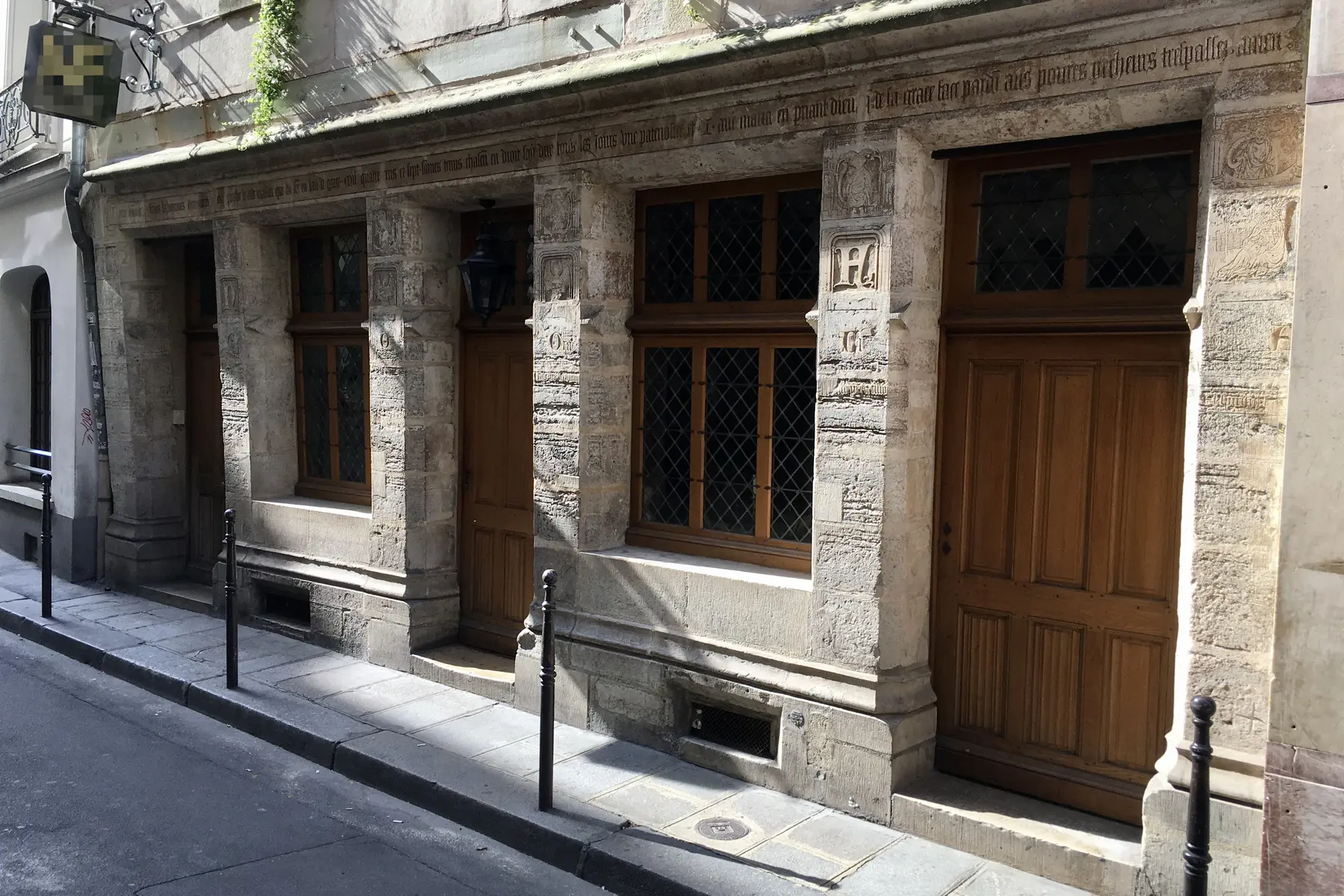
At 51 rue de Montmorency, visitors can still see the building commonly known as the house of Nicolas Flamel and often described as Paris’s oldest house. The association is genuine, but the language matters. The property relates to a charitable foundation intended in part to house people of modest means; it should not automatically be described as Flamel’s private laboratory. The photograph used for this article records the surviving façade. It does not validate transmutation, hidden rooms or immortality. For advisors designing a thoughtful Paris program, that distinction is an advantage: a tangible place can open a conversation about how monuments acquire stories without being forced to serve as physical proof of them.
From historical citizen to immortal character
The legend ultimately granted Flamel more than the ability to make gold. Stories claimed that he and Pernelle had staged their deaths or appeared in distant places long afterward. Immortality conveniently protects the legend from contradiction: absence becomes secrecy, and a grave becomes misdirection. Literature and popular culture then carried the character far beyond his medieval setting. Explore the darker legends of Paris with Edgar Allan Poe offers a useful comparison. Poe did not live in Paris, yet his fiction can frame a sophisticated encounter with the city when literary mediation is made explicit rather than disguised as biography.
The myth is also a history of reading
Separating Flamel from the alchemist does not require throwing the legend away. The transformation has its own revealing history: pseudonymous texts, collectors, publishers and readers searching monuments for hidden knowledge. It also expresses enduring desires—to explain prosperity through a secret, to discover authority in an ancient manuscript and to imagine that knowledge might defeat death. Flamel therefore becomes a mirror held up to several later centuries. Like Poe’s fictional rue Morgue, legendary Paris matters because of the techniques that make invention feel located, not because every narrative detail corresponds to a map or an archive.
B2B guidance: turn the distinction into the experience
A strong advisor briefing should not promise access to an alchemist’s secret laboratory. It can stage an investigation instead: meet the documented scribe, examine the material traces that kept his name visible and then trace the later invention of the immortal adept. The Elyrea Encounter devoted to Paris’s darker legends can animate the tension between evidence and imagination without inventing admission, availability or supernatural fact. Asking why the legend remained believable gives sophisticated guests more than a debunking exercise. It makes critical attention part of the pleasure and shows how Paris continues to be written over by every generation.
FOR YOUR GUEST ITINERARIES
With Elyrea, investigate how Paris turned a documented citizen into an alchemical legend while keeping evidence and imagination distinct.
Discuss your itinerary