
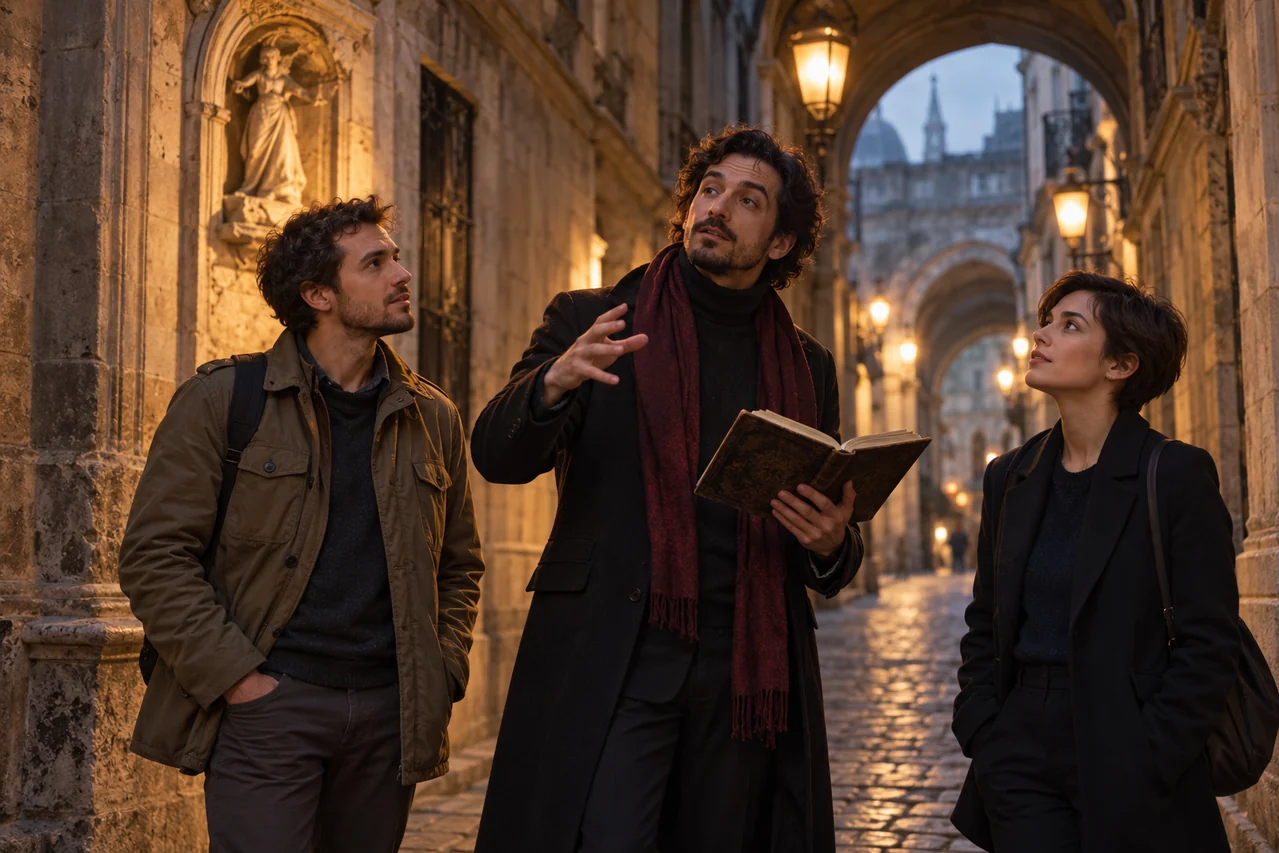
Curiosity does not require sensationalism
Visitors may be drawn to stories of danger precisely because they encounter them from a position of present safety. That curiosity can become the beginning of a cultural inquiry. The narrator can ask what frightened people, how institutions operated or why a particular story survived. Increasing the intensity of the language is not the same as deepening understanding. An account becomes more compelling when the visitor learns something about a place and its inhabitants beyond the fact that a disturbing event is associated with it.
Keep real people at the center
When an account concerns an actual crime or execution, the people involved should not be reduced to scenic details. Their lives belong to a historical and social context, even when the surviving information is limited. Respect does not require eliminating difficult subjects; it changes how they are framed. The story can explain the available evidence and acknowledge gaps without embellishing pain. A visitor should leave with a fuller understanding rather than merely a vivid image of violence.
Name a legend as a legend
Folklore introduces another problem: repeated details may sound factual because a story has been told for a long time. The narrator should identify its status clearly. That does not remove its value. A legend can reveal collective fears, moral judgments and a relationship with a particular street. The origins of Paris's dark legends explores how these narratives develop. The audience can appreciate their imaginative force while understanding that their circulation is not proof of every alleged event.
Allow uncertainty to become part of the interest
A confident declaration may produce a quick dramatic effect, but a careful question can last longer. What can be established? Which detail appears only in a later version? Why does the story attach to this place? Such distinctions turn the visitor into an attentive reader of the narrative. They also avoid a false choice between believing everything and dismissing the story entirely. Historical inquiry and literary enjoyment can coexist when the limits of knowledge remain visible.
Poe offers an intelligent framework for mystery
Poe's interest in observation and reasoning makes him more than a symbol of horror. As a theatrical host, he can encourage scrutiny of what people think they know. His presence in Paris is an imaginative device, not a claim that he lived there. This premise supports the careful treatment of stories: the writer's world gives a method of approaching mystery, while the city supplies layered places and inherited narratives that require their own historical distinctions.
Context changes the meaning of a disturbing episode
An execution cannot be understood only through its location or the emotion it produces today. Political authority, social expectations and contemporary beliefs help explain why it occurred and how it was remembered. Similar care is needed when moving from an event to its later legend. The narrative should avoid treating history as a succession of identical horrors. A particular act becomes intelligible through its circumstances, and that specificity is what gives the cultural account substance.
Adapt the approach without making it trivial
Adolescents may be interested in mystery, but that does not justify presenting every story as a scare or game. Experienced adult travelers may value restrained narration for the same reason: it lets them think. Tone, pacing and opportunities for questions can be adapted while preserving the subject's seriousness. Poe and Esmeralda as different experiences helps advisors choose whether a guest will respond better to inquiry into dark legends or to a character-led encounter with a literary novel.
An elegant experience leaves room for reflection
Silence, observation and changes of pace can carry meaning without adding theatrical excess. The Dark Legends of Paris is strongest when the guest understands why a story matters and how it has been shaped. Advisors can explain the approach honestly: literary atmosphere, historical context and a distinction between fact and folklore. This gives mystery a cultural purpose. It also respects the traveler’s intelligence by leaving space for their own questions and response rather than prescribing a succession of emotions.
FOR YOUR GUEST ITINERARIES
For guests drawn to dark history and literary mystery, Elyrea can help create a Paris program with the depth and restraint appropriate to the subject.
Discuss your itinerary