
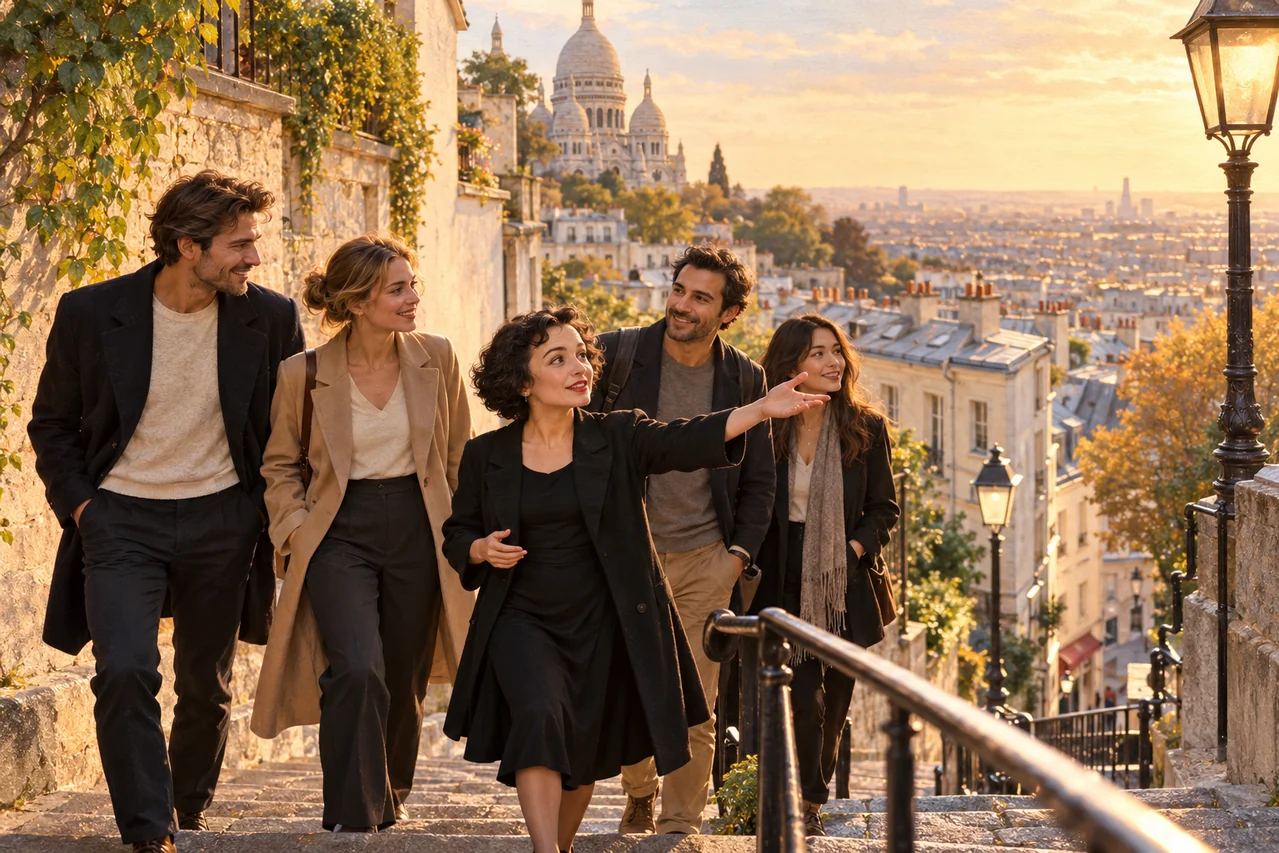
Look beyond the familiar hilltop
Montmartre's international image often centers on the Sacré-Cœur, painters and broad views of Paris. Its cultural history also includes song, cabaret and popular performance. Approaching the district through music therefore changes the subject without needing to promise an undiscovered neighborhood. For returning travelers, that can be particularly effective. A place they already recognize acquires another chronology and another group of people, showing how the same urban landscape can support several distinct cultural interpretations.
Pigalle belonged to a performance ecosystem
Theaters, cabarets and nightlife created an environment in which artists sought work and audiences encountered new performers. Piaf should be placed within that professional world rather than represented as an isolated phenomenon. Venues, managers, musicians and writers helped careers develop. The wider setting makes a biographical walk more informative because it explains what opportunities and demands surrounded a singer. It also avoids reducing the district to a colorful nightlife stereotype detached from the work that took place there.
The move indoors changed the profession
A passerby and a paying audience do not have the same relationship with a performer. Moving from street singing toward cabaret required repertoire, presentation and collaboration within an organized setting. Piaf's early transformation supplies a personal route into this change. The career becomes a way to understand professional entertainment rather than a sequence of dramatic addresses. Travelers can ask how an artist's presence changed when a room, a program and other professionals became part of the performance.
Cabaret was more than a tourist category
Historically, cabaret could support artistic experimentation, song, humor and sociability. Its function should not be assumed from the contemporary travel meaning of the word. An establishment might be important because of the performers and exchanges it enabled, not simply its decoration or notoriety. This distinction helps advisors design a culturally relevant visit. Guests interested in music can understand how careers and repertoires circulated through such spaces, while practical choices about any present-day performance remain separate and require current confirmation.
Keep Piaf's geography wider than one district
Piaf's Paris extended beyond Montmartre and Pigalle. The neighborhoods offer an entry point into the city's performance history, but they should not absorb her entire biography. Belleville and other settings belong to different chapters of that story. A strong itinerary names the relationship between the person and a place precisely, rather than relying on an impression that any bohemian corner must have been significant. The value comes from contextual connections, not from multiplying supposed celebrity associations with every façade.
Painting and music belong to different generations
A link with Père Tanguy's artistic Montmartre can reveal how the area's cultural identity developed across time. It does not imply a personal meeting between figures whose lives and careers belonged to different historical contexts. This chronological distinction creates a better narrative than blending all famous artists into a single timeless scene. Travelers can compare the networks of painters with the later world of popular performance, seeing continuities in the district's image while recognizing changes in artistic practices and social conditions.
Read the present through what changed
Tourism and urban transformation have altered the district. A visit should acknowledge that guests are not entering an intact stage set from Piaf's early career. Changes in use, audiences and neighborhood life are themselves part of the story. Remembered songs and performance themes can add atmosphere without reproducing lyrics, but they are artistic representations rather than documentary records of every street. The strongest interpretation holds current observation and historical imagination together, showing where one helps illuminate the other and where their limits remain.
Give returning guests a new cultural purpose
An Encounter with Piaf can use a recognizable character to hold together performance history, professional development and the changing city. It should be linked to the appropriate places and actual itinerary rather than promise a complete reconstruction of earlier Paris. Montmartre through French song offers a wider thematic continuation. For advisors, the musical angle supplies a fresh reason to return, with value in the story and interaction rather than in the claim that famous streets are somehow secret.
FOR YOUR GUEST ITINERARIES
Your guests already know Montmartre’s landmarks? Ask Elyrea how a Piaf Encounter can introduce the district’s musical and performance history.
Discuss your itinerary