
Begin where the guest's knowledge ends
A repeat visitor may know the famous images but remain curious about how the garden was developed. Another may understand Impressionist technique yet know little of Monet's household or collecting. Asking which questions remain prevents a second visit from repeating an introductory course. The goal is not to prove that Giverny contains hidden attractions. It is to identify a perspective that makes the familiar place worth sustained attention for this particular traveler.
Read the garden as a composition
A knowledgeable guest can focus on lines of sight, relationships between planted areas and the way a route changes what is visible. Seasonal growth becomes part of the subject rather than an inconvenience compared with a remembered photograph. The design and life of Monet's gardens gives this inquiry a foundation. Advisors can allow enough time for looking at less emblematic details, so the second visit gains depth instead of simply a new set of facts delivered at the same pace.
Ask what the painting leaves outside the frame
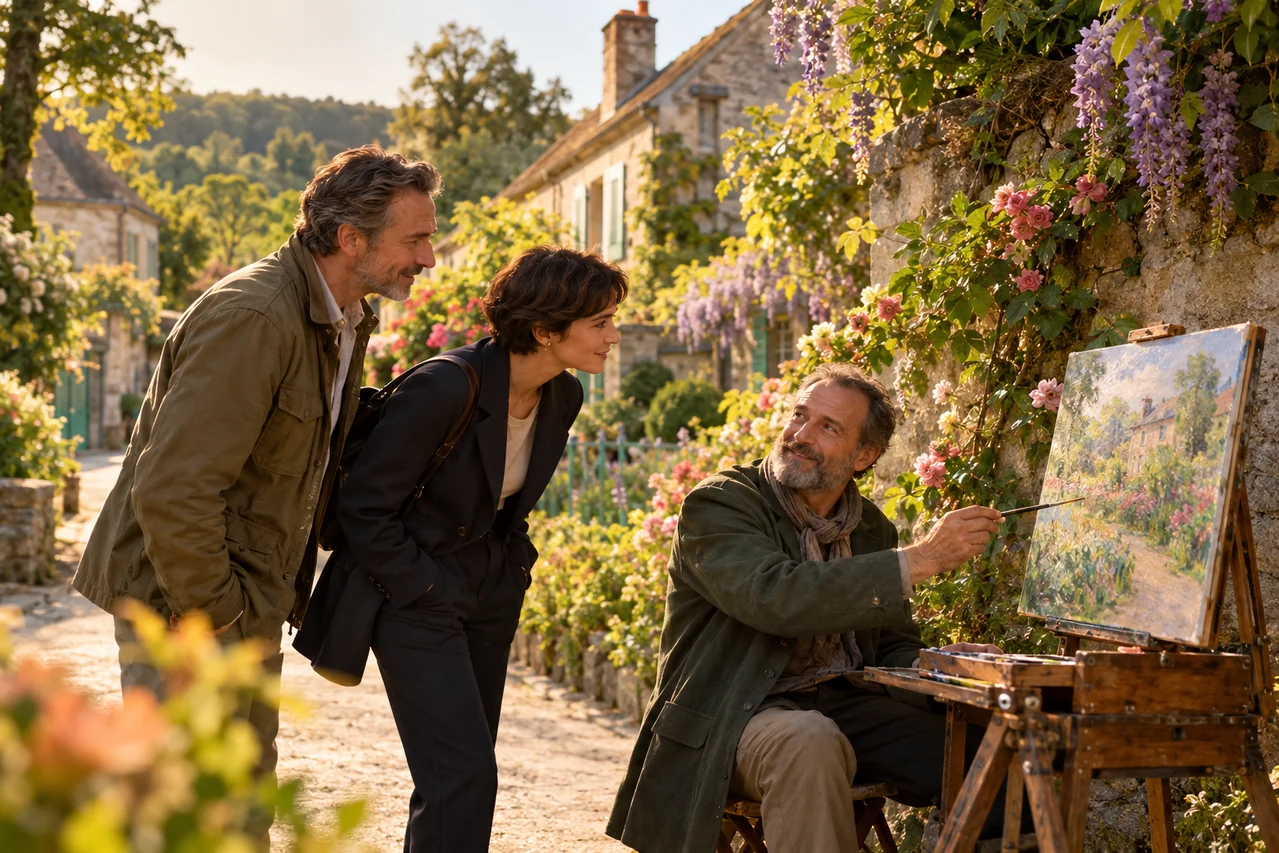
Comparing a work with the setting does not need to revolve around finding the exact spot for a recreated photograph. What does Monet omit, compress or emphasize? How does the image reorganize a view? These questions are especially useful for guests already familiar with the works. They restore artistic choice to the relationship between garden and canvas, showing that a painting is not simply the inevitable image produced by standing in front of an attractive motif.
Give the Japanese collection a full place
The prints in the house can support a discussion of looking across cultures, composition and the circulation of images. This widens the focus beyond the bridge without treating it as unrelated to the garden. An expert guest may enjoy considering different types of visual evidence and the limits of simple influence claims. The account should remain nuanced: collecting, admiring and responding to images do not mean copying a single tradition mechanically into another artistic practice.
Look at the household as well as the master
Alice Hoschedé and Blanche Hoschedé-Monet, the family setting and the people who maintained the domain can give a returning guest a less familiar view of Giverny. Including them counters the impression of a single person creating and sustaining the entire environment alone. The house supplies a different kind of depth from the garden: a lived place of relationships, tastes and ordinary work. The visit becomes fuller without losing Monet's paintings as its central cultural thread.
Reconsider the late work carefully
A guest who knows early Impressionism may find the later Water Lilies a particularly rewarding subject. Scale, reflection and the reduced role of a horizon change the relationship with the image. Cataracts belong within the account but should not dominate it. A careful discussion of Monet's changing vision explains why medical experience and artistic decisions must remain distinct. The returning visitor can then examine the late paintings without assuming that every difference represents illness or a simple anticipation of abstraction.
Let the village widen the international story
Giverny's artistic presence included Americans and other visitors, providing a wider context around Monet's long residence. This connection can be meaningful for US travelers, though nationality should not determine the entire interpretation. A collector might prefer questions about reception and reputation; a gardening enthusiast might remain with planting and seasonal change. The advisor should choose the continuation that fits the guest rather than make every experienced visitor follow the same advanced itinerary.
Use the Encounter to deepen rather than multiply
Inside Claude Monet’s Giverny can encourage specific questions and attentive observation in a place the guest already recognizes. A later viewing in Paris may then bring the same inquiry back to the paintings. It is not necessary to add another major excursion merely to prove that the second visit is different. The cultural value lies in an altered understanding of the known setting: more precise attention to the choices, people and conditions through which a garden became a continuing artistic world.
FOR YOUR GUEST ITINERARIES
For guests who already know Monet's gardens and paintings, Elyrea can help develop a Giverny Encounter around the particular questions that will reward a return.
Discuss your itinerary