
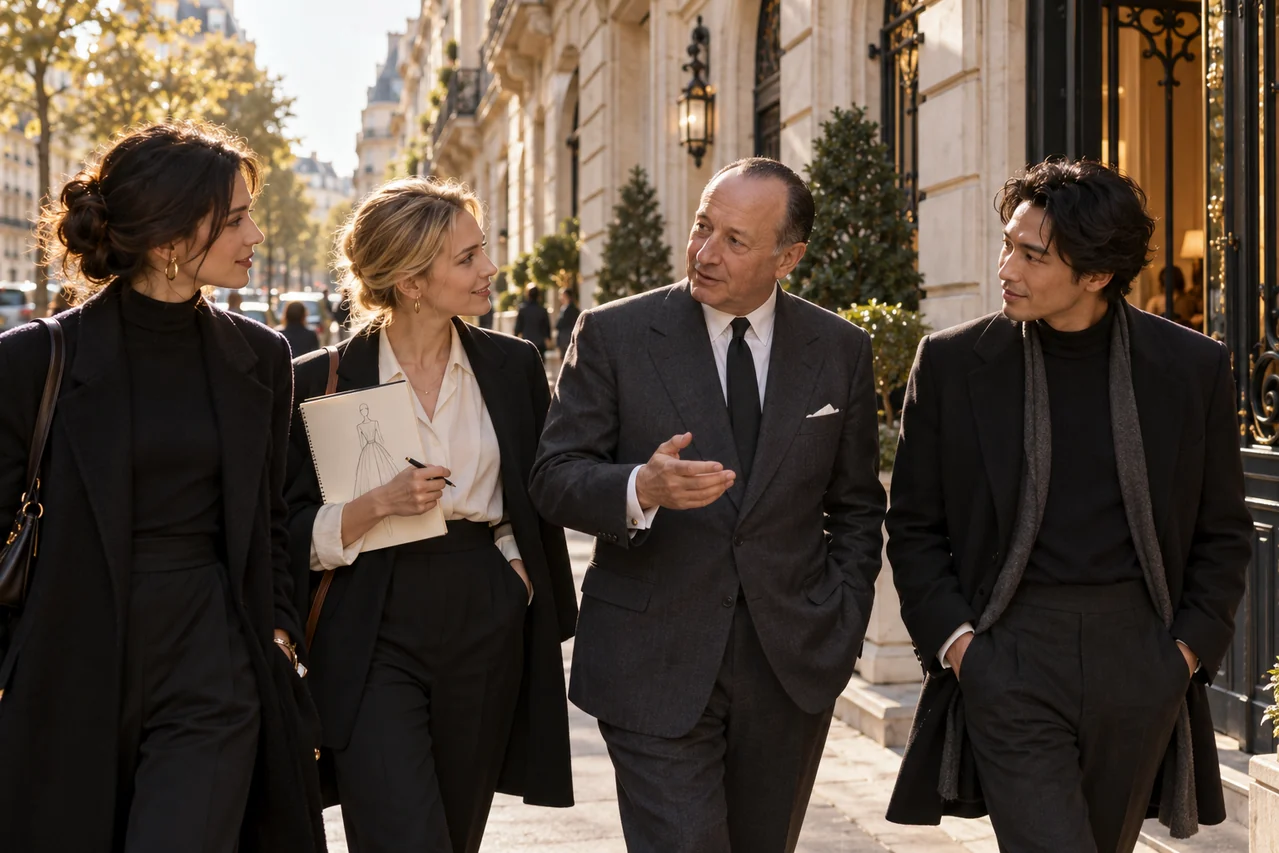
Ask what being a Dior enthusiast means
One guest may collect clothes, another may know the house through photography, and a third may be interested in the founder's biography. Those are different starting points. An advisor should ask what the guest wants to understand and what they already know before selecting venues. A specialist may welcome discussion of construction or successive creative periods, while a first-time fashion traveler may need a clear introduction to 1947. This intellectual qualification matters as much as logistical preference. It keeps a Dior day from becoming a standard route sold to anyone who recognizes the name, and allows the content to feel personally relevant.
Establish the founder before exploring the house
Christian Dior's route through art, drawings and employment in other fashion houses gives the later creations a human context. His Normandy childhood also prevents the story from beginning and ending on avenue Montaigne. Dior before the legend is a useful preparation for guests whose familiarity is mainly with the contemporary brand. The aim is not to insert a long biography before the enjoyable part of the day. It is to establish whose decisions and experience are being discussed. Once the founder becomes a person rather than a logo, an address or garment can acquire a clearer narrative role.
Use Avenue Montaigne as a historical anchor
The significance of 30 avenue Montaigne comes from its relationship with the founding house. A neighborhood walk can situate that address within the geography of Parisian fashion, giving guests more than a facade photograph. The contemporary setting should still be distinguished from the world of Christian Dior himself. Today’s commercial identity and spaces reflect a history that continued after him. Any planned interior visit needs its actual conditions confirmed for the trip; association with the address does not imply unrestricted access. A reliable itinerary describes the cultural purpose of a stop while making only the access promises that can genuinely be fulfilled.
Give the Galerie Dior a specific role
When its arrangements fit the guest's dates and program, the Galerie Dior offers a relevant setting for exploring the house's history and visual world. The advisor should decide what the guest is looking for there, rather than use it as an automatic stop. A visitor interested in the founder might trace early silhouettes; one interested in continuity may compare different periods. An introduction to the New Look can provide a focused question before viewing objects. Museum and gallery displays should be approached on their own terms, with the current content and practical arrangements checked during planning instead of assumed from a previous itinerary.
Choose a complementary museum for a reason
Palais Galliera or the Musée des Arts Décoratifs can place Dior within a wider fashion history when the relevant displays suit the trip. Their program should be verified rather than treated as a permanently available Dior exhibition. The strongest complement introduces a perspective the guest will not already receive elsewhere: another period, a different designer or a specific craft. Adding a venue only because it is famous risks repetition and fatigue. For knowledgeable guests, one carefully selected comparison can be more useful than another large visual survey. The museum should advance the question guiding the day, not simply increase the number of reservations.
Make room for craft and for shopping if desired
A guest who appreciates couture may also want to understand the hands behind it. An artisan encounter or workshop visit can be valuable when separately available and appropriately arranged, but it should never be implied as part of an Elyrea experience without confirmation. Craft can also be explored through objects and the atelier process. Shopping may follow naturally if the guest wishes. Placing it after cultural interpretation changes the conversation: details and house codes have meaning before a purchase is considered. The advisor can respect a guest's interest in buying while giving the day a depth that commerce alone cannot provide.
Add Chanel or extend toward Granville selectively
Chanel offers a useful comparison for guests interested in competing approaches to twentieth-century elegance. The Chanel encounter ends at place Vendôme, in front of the Vendôme Column; its role should be a distinct chapter, rather than an assumed continuation of Dior's route. For a longer French journey, Granville and the childhood setting of Christian Dior provide a biographical extension beyond Paris. Either addition should respond to the guest's actual passion and available time. Combining everything can weaken the theme by exhausting the traveler. A focused Paris day and a longer biographical trip are different products, even when both begin with Dior.
Let the encounter connect objects with intention
La mode selon Dior can provide a narrative pivot before viewing collections or a reflective conversation afterward. It returns attention to the historical creator and the circumstances of his work, helping the guest connect familiar images with choices and questions. The experience should not be presented as a visit led by a present-day representative of the Maison or a guarantee of commercial access. Its cultural value lies in character, place, story and interaction. For advisors comparing different ways to organize the day, a premium couture itinerary develops the pacing and sequencing principles that make those components work together.
FOR YOUR GUEST ITINERARIES
Do you have guests who want to understand Dior rather than simply shop the brand? Ask Elyrea how La mode selon Dior can become the narrative center of a tailored Paris itinerary.
Discuss your itinerary