
Let the places answer a historical question
A succession of plaques provides locations without necessarily explaining why they matter. A more useful route asks how Joan became a prisoner in Rouen, how her case was examined and how the city later remembered her. That question connects surviving structures, vanished places and modern institutions. Travelers can then understand each stop as evidence of a particular chapter. The aim is to relate contemporary Rouen to the fifteenth century while acknowledging change, not to claim that every visible street or façade reproduces the environment Joan knew.
The Vieux-Marché carries the memory of execution
The square is central to Joan's story because of its association with her execution on 30 May 1431. Its present activity contrasts with the violence remembered there. That contrast can make the visit more powerful than a supposed frozen medieval setting. Explanation should establish the preceding trial before concentrating on the final moment. There is no need for graphic detail or staged distress. A considered account and time to look allow the site to function as a place of memory within a living city.
Read the church as a later act of remembrance
The church of Sainte-Jeanne-d'Arc belongs to the city's memorial relationship with Joan, rather than to her own experience of Rouen. Such a distinction is fundamental to a historical itinerary. A later building can tell a valuable story about how a community chooses to remember without being mistaken for an eyewitness structure. The visitor moves from the event to its representation and asks what the commemorative form emphasizes. This opens the making of Joan as a national heroine, a history that extends far beyond 1431.
Be precise about the tower and detention
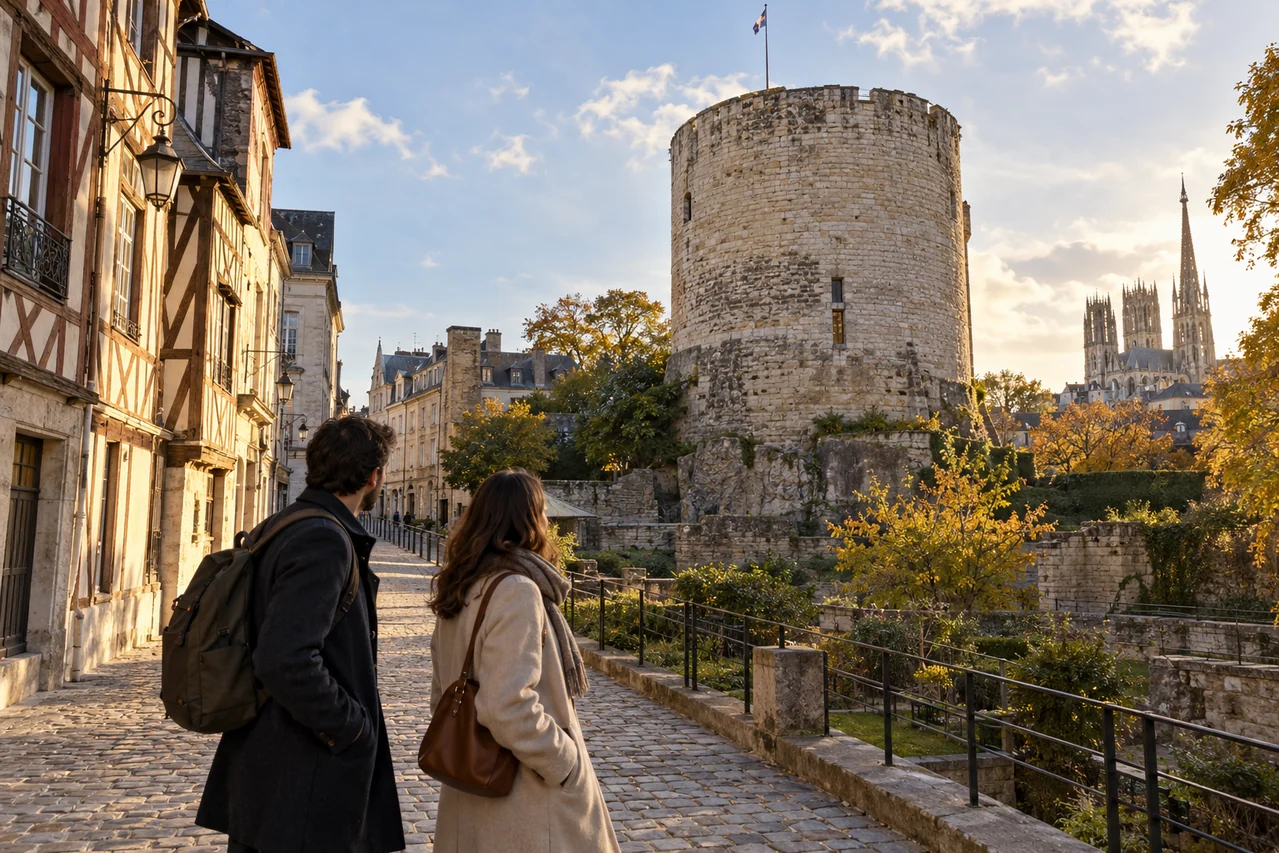
The surviving Tour Jeanne-d'Arc belongs to Rouen's former castle and connects the visit with the military and institutional setting surrounding the trial. Its commemorative name does not, by itself, establish that the visible tower was Joan's prison. The structure and the locations associated specifically with her detention need to be distinguished. This makes the landmark more informative, not less important: it reveals part of the environment in which power was exercised while also showing how later memory can give one surviving building a broader association than the evidence supports.
Use the Historial as a complementary form of interpretation
The Historial Jeanne d'Arc can provide a museum-based chapter for guests who want to deepen their understanding of the case and its memory. It offers a different relationship with evidence and narrative from a walk or embodied Encounter. These formats need not compete if the advisor gives each a purpose. The key is to avoid several repeated introductions to the same events. An itinerary can move from contextual interpretation toward the encounter with a character, then onward to reflection on the city and its commemorative spaces.
Let the wider city remain visible
Rouen's cathedral and historic center can situate Joan's story within a substantial religious and urban environment. They also deserve attention beyond their association with her. The city should not be reduced to the place where one famous person died. Changes, rebuilding and the passage of centuries belong to its visible fabric, so claims of complete medieval authenticity require care. For international travelers, the broader setting helps prevent an isolated account of the trial from obscuring the life and complexity of the destination around it.
Shape the route around the guests' interests
Medieval history enthusiasts may want more discussion of institutions and evidence, while families may engage through questions about accusation and judgment. Guests interested in religion may prefer a considered exploration of faith and authority without the itinerary automatically becoming devotional. Pace, attention and existing knowledge matter in each case. Planning a Joan of Arc day in Rouen begins with those choices. The strongest route is not the one with the most commemorative stops, but the one that makes the relationships between its selected places intelligible.
Make the Encounter a narrative center, not a substitute for context
Elyrea's Joan of Arc Encounter can restore a voice and point of view to a case whose result travelers already know. It remains an interpretation informed by historical material, rather than a guarantee that every performed exchange is a quotation. Rouen's places anchor that interpretation and provide opportunities to compare event, trace and later memory. A balanced day leaves time for thought after the trial and execution chapters. The guest departs able to explain what the locations mean, not merely carrying photographs of them.
FOR YOUR GUEST ITINERARIES
Planning a Rouen itinerary around Joan of Arc? Elyrea can help position the Encounter among the city's historical and memorial places for your guests.
Discuss your itinerary