
A height that demanded new thinking
A tower approximately 300 meters high belonged to the ambitions of a century testing the possibilities of metal construction. Paris's planned 1889 World's Fair supplied a setting in which an unusually bold proposal could become a public demonstration. The project was therefore neither an isolated flash of inspiration nor simply an enlarged conventional building. It asked engineers to imagine height, wind resistance and assembly together, while organizers considered what such a structure might communicate to visitors.
Koechlin and Nouguier's starting point
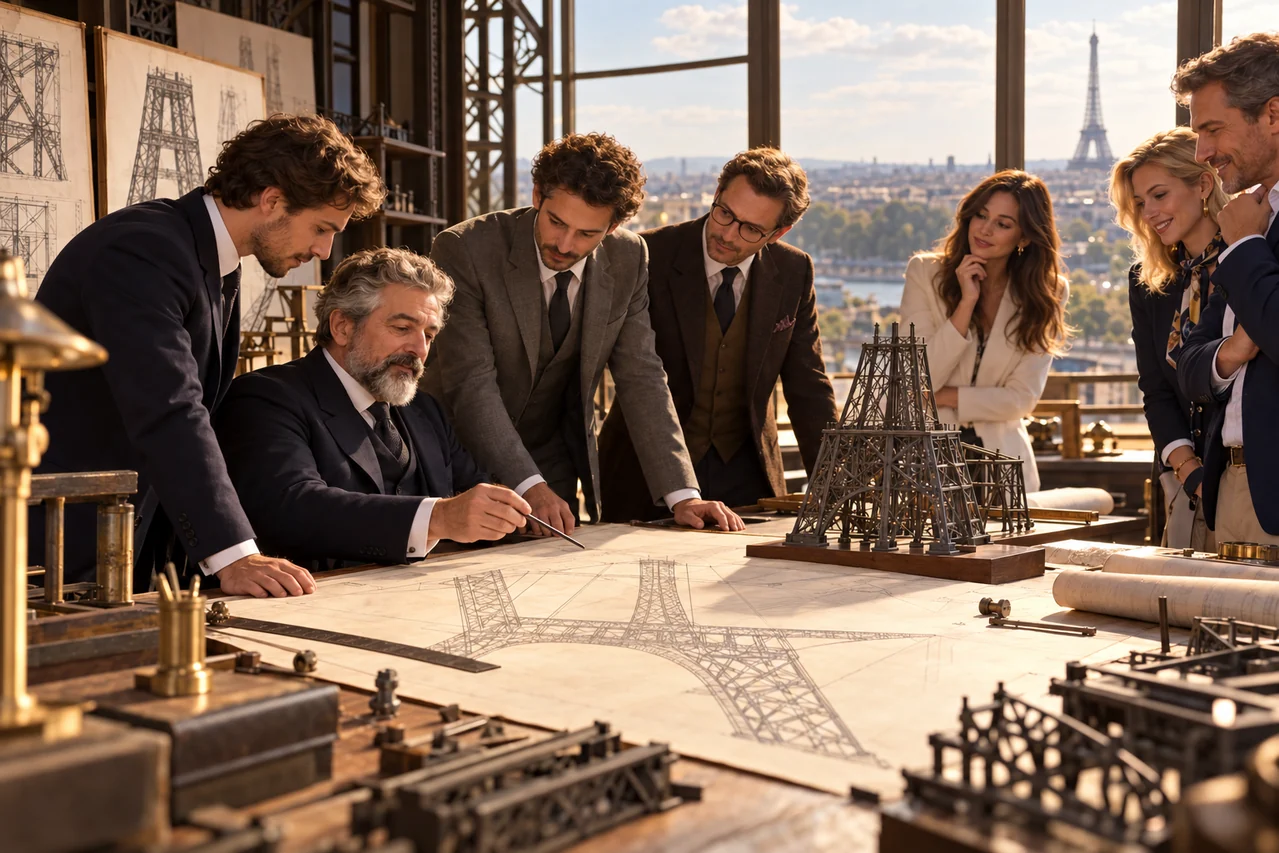
In 1884, Maurice Koechlin and Émile Nouguier developed the initial tower proposal within the Eiffel company. Koechlin's early drawing established a recognizable structural direction for the project. Their role is essential to any fair account of its origins. Naming them does more than correct a trivia question: it reveals the professional setting in which ideas were generated. The structure emerged from engineers working within an organization capable of investigating and developing an ambitious technical proposition.
Sauvestre shaped its architectural expression
Stephen Sauvestre contributed architectural changes to the initial engineering proposal, including treatment of the arches and elements at the different levels. His involvement helps explain why structural design and architectural appearance should be discussed together without being treated as identical tasks. A tower needed to be convincing as a construction and as a public monument. The eventual landmark resulted from interaction between those concerns, rather than from choosing either engineering efficiency or an entirely independent decorative scheme.
Eiffel turned a proposal into a project
Gustave Eiffel's importance lies in his support, development and promotion of the tower, as well as the organization through which it was built. Recognizing the original designers does not make him incidental. A proposal still requires resources, negotiation, calculations, public defense and coordinated execution. Eiffel supplied leadership and became its public face. The question of authorship becomes richer when it includes that practical work: having an idea and bringing it into existence are related but different achievements.
Why the name endured
The enterprise carried Eiffel's name, and he was closely identified with the project's public defense. Over time, that name became attached to the entire structure in popular memory. Such shorthand is convenient, but it compresses a collective undertaking into a single biography. Travelers need not stop using the familiar name to understand its limits. The useful change is to see a landmark associated with Eiffel while retaining the engineers and architect whose contributions helped make it possible.
Workers made the drawings real
Design alone did not produce a tower. Metal components had to be prepared accurately, transported and assembled into a structure whose geometry mattered at every stage. Workshop and site workers turned calculations into physical connections. The construction story brings those people back into view and shows why successful execution cannot be reduced to a signature on a plan. Visitors observing the lattice are looking at the results of both intellectual preparation and sustained skilled labor.
A useful question for younger travelers
Asking who designed the tower invites children and teenagers to distinguish inventing, improving, organizing and building. These roles are accessible without simplifying the history into a contest with one winner. A family might compare how a school project distributes responsibility, then return to the much greater scale of nineteenth-century construction. The point is to understand cooperation and credit, rather than to replace an exaggerated Eiffel legend with an equally simplistic claim that he contributed nothing important.
Rediscovering a familiar landmark
For repeat visitors, the authorship question supplies a fresh reason to pause at the tower without assuming another ascent is necessary. It also prepares an encounter with the broader career of Gustave Eiffel. In a private itinerary, the story can connect engineering, architecture and leadership through a place the guests immediately recognize. Elyrea's character-led approach gives those distinctions a conversational form, helping travelers leave with a more accurate and more human understanding of the landmark.
FOR YOUR GUEST ITINERARIES
Designing a Paris itinerary for architects, engineers or curious families? Contact Elyrea about using Eiffel by Eiffel to explore the people behind the structure.
Discuss your itinerary