
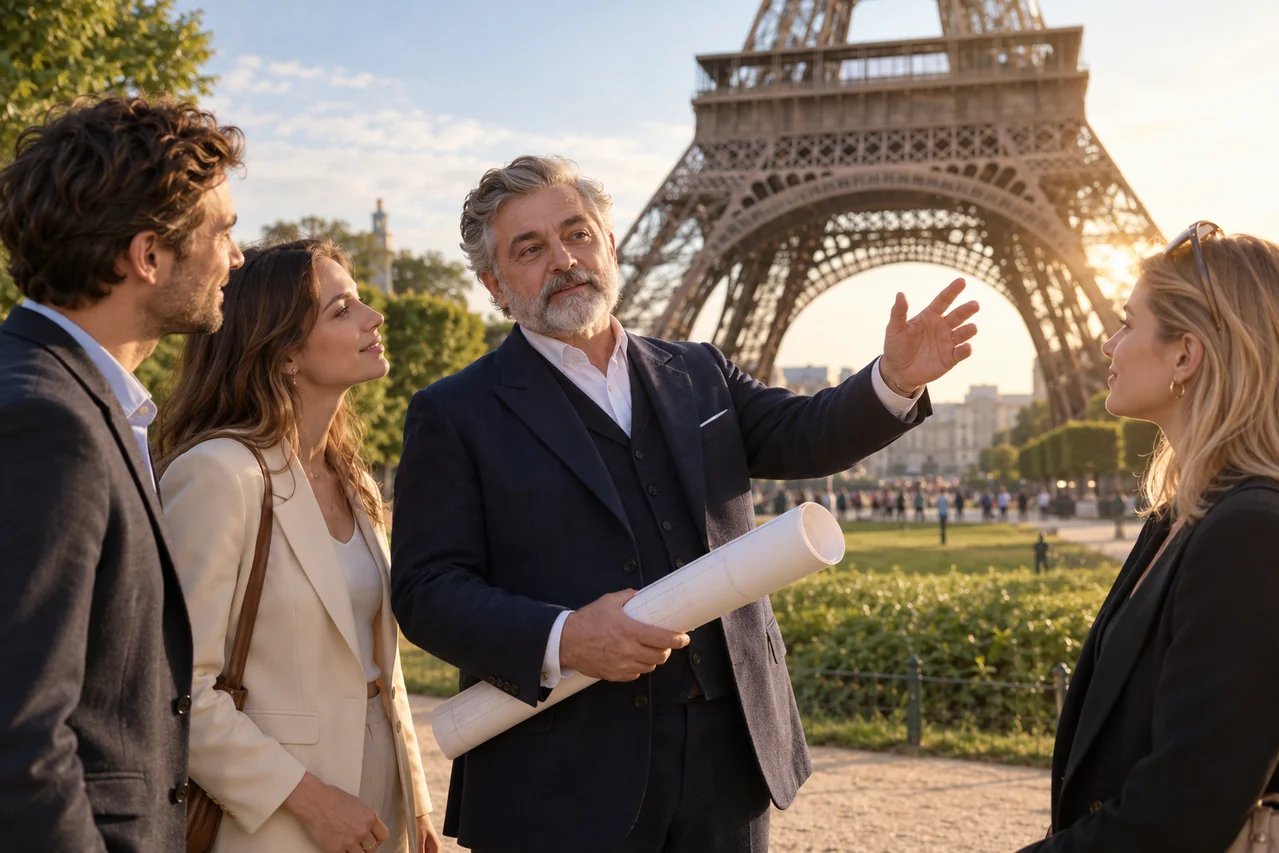
An engineer in an industrial age
Born in Dijon in 1832 and educated at the École centrale, Eiffel entered a world being reshaped by railways and metal construction. Engineering addressed practical questions: how to span difficult ground, support increasing loads and organize work at unfamiliar scales. Looking at his career through those problems gives the tower a useful context. It was an extraordinary undertaking, but it also belonged to a longer development in industrial knowledge, business organization and confidence in metal structures.
The company behind the name
Eiffel's reputation rested on an enterprise rather than a solitary drawing board. Engineers, draftspeople, workshop teams and construction workers translated ideas into structures. The distinction matters when visitors encounter a monument carrying one famous name. A company could coordinate design, fabrication and assembly in ways an individual could not. Eiffel's achievement included making that collaboration effective, supporting promising projects and taking responsibility for presenting them to clients and the wider public.
The tower began with a team
In 1884, Maurice Koechlin and Émile Nouguier, engineers in Eiffel's company, developed the initial proposal for a tower approximately 300 meters high. Architect Stephen Sauvestre subsequently helped shape its architectural appearance. Eiffel became its decisive advocate, organizer and public representative. Understanding who actually designed the tower changes the question from identifying one inventor to recognizing different contributions. Structural imagination, architectural treatment and entrepreneurial commitment were all necessary to move the idea toward construction.
A project made for 1889
The tower was built for the 1889 World's Fair, with construction beginning in 1887. Its purpose was closely connected to a public demonstration of modern engineering. Visitors today see a permanent emblem; its first audience saw a remarkable new structure within an exhibition landscape. Restoring that setting helps explain the ambition of the project. Eiffel was promoting something that had to work technically while also persuading the public that an exposed industrial structure could belong in Paris.
Fame did not mean agreement
The artists' protest of 1887 shows how far the tower was from universal acceptance. Its height, material and visual dominance challenged expectations about the city. Eiffel defended the connection between its structural requirements and its beauty, but the controversy was real. It is easier to understand his persistence when the finished icon is temporarily removed from the story. Nobody beginning that construction possessed our knowledge that future generations would consider its silhouette almost inseparable from Paris.
An American connection
Eiffel and his team also contributed to the internal support system of the Statue of Liberty after the death of Eugène Viollet-le-Duc. Frédéric Auguste Bartholdi remained the sculptor and creator of the monumental figure. Eiffel's role inside Liberty offers American travelers a meaningful connection between two landmarks without confusing their authorship. The engineering story extends across the Atlantic, demonstrating that a famous exterior often depends on less visible technical decisions and the work of several specialists.
Curiosity after construction
Eiffel's interests included meteorology and aerodynamics, with experimental work becoming an important part of his later career. The tower provided a platform for scientific uses, while radio communications contributed to arguments for keeping it. This later chapter complicates the familiar image of a man whose career ended when his monument opened. Buildings can become instruments; engineering questions can lead toward research. The tower's history therefore continues beyond its construction deadline and its first visitors.
A person worth encountering
For an architecture enthusiast, Eiffel offers questions about structure and design. For an entrepreneur, his career opens discussion about support, risk and organization. Families can explore how collaboration produces something larger than any one participant could achieve. Elyrea's Eiffel by Eiffel brings a historical character into the monument's cultural setting through performance and interaction. The value lies in a new way of looking: after learning about the people and decisions behind it, an apparently familiar tower becomes evidence of a complex human undertaking.
FOR YOUR GUEST ITINERARIES
Planning Paris for guests interested in engineering or innovation? Ask Elyrea how Eiffel by Eiffel can give the monument a human dimension in their itinerary.
Discuss your itinerary