
An apartment that immediately invited legend
The idea is irresistible: the engineer supposedly lived above Paris, ruling a private refuge suspended inside his own creation. From the Tower’s opening in 1889, rooms reserved for Gustave Eiffel attracted attention because they differed from the public areas of the monument. Their extraordinary view gave the builder a privilege ordinary visitors could not buy. The image of a secret apartment grew easily from that exclusivity. The phrase still captures fascination, but it becomes misleading when it suggests a complete home in which Eiffel conducted the ordinary routines of domestic life.
What the space actually contained
The Eiffel Tower’s official history places the rooms on the upper platform just below the spire. Roughly one hundred square meters were reserved, although the elevator, stairs and technical systems occupied much of that area. The private portion included a sitting room, a kitchen, a washroom with a sink and a toilet. One significant room does not appear in the inventory: a bedroom. Its absence cannot answer every question by itself, but it makes permanent residence unlikely. The monument’s administration states that Eiffel presumably never slept there, drawing a clear line between private access and a home.
Receiving guests at the summit was a manifesto
Inviting a notable visitor into these rooms offered much more than tea with a view. The ascent, height and exposed iron structure turned the meeting into a demonstration of modernity. Thomas Edison was among the celebrated guests Eiffel received in 1889. Their encounter joined two men associated with new technologies and international fame. The setting allowed Eiffel to make the Tower itself his strongest argument: it was not merely a gigantic curiosity but a stable, inhabitable place for serious conversation. Hospitality at the summit subtly defended the usefulness and cultural authority of a monument whose future was not yet guaranteed.
A retreat connected with scientific work
Eiffel did not abandon the Tower after the Universal Exposition. He promoted scientific uses that could strengthen its future beyond the original concession. The monument supported meteorological observation, wireless communication and investigations of air. The summit rooms belonged to this culture of experimentation as much as to social hospitality. Was Gustave Eiffel also a scientist? follows the measurements and research that shaped the second half of his career. Describing the rooms only as a luxurious apartment therefore removes the strategic effort that helped make the Tower permanently useful rather than temporarily spectacular.
Comfort did not equal everyday residence
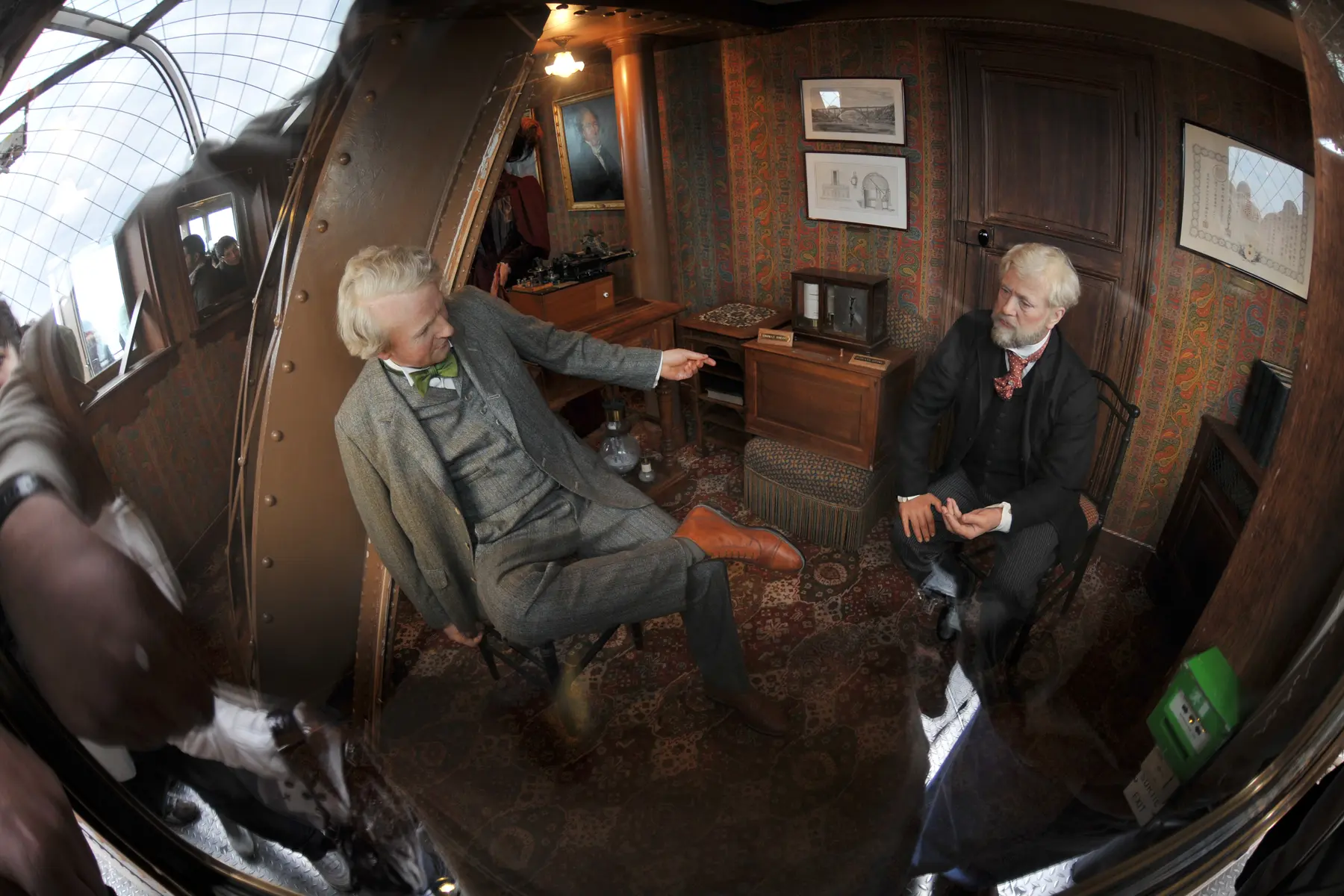
Photographs and descriptions create a bourgeois impression: wallpaper, furniture, a piano and selected objects contrast with the industrial frame outside. That comfort served an obvious social purpose by reassuring guests and making the extreme height feel civilized. Yet the rooms should not be read as a complete Paris apartment. They stood inside a monumental machine, depended on elevators and experienced the particular conditions of the summit. Eiffel maintained other residences, and the evidence does not establish the Tower as his habitual home. The real fascination lies in the tension between a familiar interior and one of the most extraordinary architectural positions in the world.
What visitors see today is a reconstruction
The present display includes wax figures of Gustave Eiffel, his daughter Claire and Thomas Edison. It evokes a documented visit but should not be mistaken for an interior preserved untouched since 1889. Furnishings and arrangements changed, and the current presentation is a heritage reconstruction. The photograph used with this article shows that modern interpretive scene rather than a nineteenth-century gathering. Identifying its status does not reduce its value. It allows visitors to distinguish the historical meeting, surviving or reconstructed objects and the contemporary device created to help the public imagine a conversation at the summit.
The rooms reveal the man behind the monument
The episode illuminates Eiffel’s ability to combine engineering, public relations and research. Who was Gustave Eiffel beyond the famous silhouette? places the Tower within a much wider career. The private rooms show a builder aware of his structure’s symbolic power and determined to use it as a platform for encounters. His later laboratory at Auteuil extended the same logic in surroundings better suited to aerodynamic experiments. Eiffel’s Auteuil wind tunnel traces that scientific continuity. The celebrated refuge was not an isolated eccentricity; it condensed several of his ambitions.
B2B guidance: tell the difference between myth and use
For itinerary designers, the apartment is an effective entry point because the question “Did he live there?” demands a nuanced and memorable answer. The Elyrea Encounter devoted to Gustave Eiffel can connect architecture, innovation and the construction of public reputation. Advisors should state that today’s scene is a reconstruction and avoid promising private access to a space that belongs to the monument’s visitor experience. The premium value does not come from manufacturing secrecy. It comes from informed interpretation: why Eiffel reserved the rooms, whom he received there and how they supported the intellectual as well as the physical survival of the Tower.
FOR YOUR GUEST ITINERARIES
Planning a private Paris journey around engineering? Elyrea can place this episode within an Encounter devoted to Gustave Eiffel.
Discuss your itinerary